


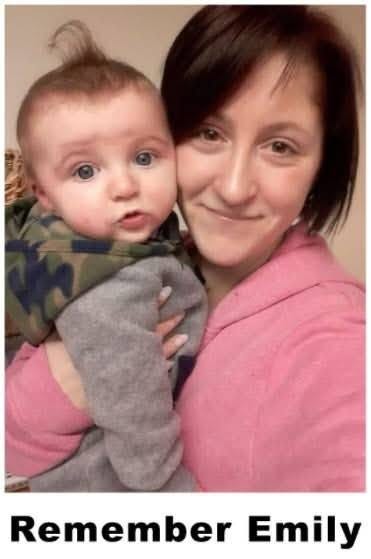
Kelly Carroll’s daughter Emily Hamann was 26 when she was slashed to death in downtown Bennington by a man who had previously been charged with violent crimes and found incompetent to stand trial.
The accused, Darren Pronto of Pownal, had been court-ordered to a psychiatric hospital in a prior case, stabilized, and then released into the custody of his mother — because once he no longer met the clinical threshold for hospitalization, the Department of Mental Health was required to let him go. That was three months before he allegedly killed Hamann. There was no secure middle ground. No competency restoration program. No locked facility designed for someone who couldn’t stand trial but still posed a danger.
After his release, according to Carroll and court records, Pronto allegedly killed her daughter. He was again found incompetent to stand trial. Pronto appears to remain in some form of state custody, but his precise status is unclear from available public records.
Emily Hamann left behind a son.
That was five years ago. Vermont still has no secure treatment facility. Vermont still has no formal competency restoration process. And S.193 — the bill that would begin to change that — is running out of time.
What the bill would do
S.193, introduced by Senator Virginia “Ginny” Lyons, would create a secure treatment facility within the Department of Corrections for a narrow group of defendants: those charged with crimes carrying potential life sentences who have been found incompetent to stand trial or not guilty by reason of insanity — and who don’t meet the clinical threshold for psychiatric hospitalization. The bill’s official language calls it a “forensic facility,” but in practice it would function as a locked treatment center where defendants could receive mental health care and undergo a competency restoration process — with the goal of eventually enabling them to stand trial.
The Agency of Human Services supports the bill. Jon Murad, who served as Interim Commissioner of Corrections during much of the bill’s committee process and was subsequently confirmed as Commissioner, has testified that DOC currently holds six such individuals with no formal process for restoring their competency. The state’s for-profit corrections healthcare contractor, Wellpath, already provides competency restoration services in other states.
Vermont may be the only state in the country without such a facility, according to Karen Barber, General Counsel of the Department of Mental Health.
The concept isn’t new. Lawmakers have tried to address the gap since at least 2020. A similar proposal was included in legislation in 2024 but was stripped before the bill became law.
What the Senate has done with it
The legislative record on S.193 is extensive. Senate Judiciary took it up on January 20. Over the next two months, the bill received at least 20 scheduled committee sessions across three Senate committees — Judiciary, Health and Welfare, and Appropriations. Twenty-seven witnesses testified, including the Attorney General’s office, the Defender General, the Chief Superior Judge, the Department of Mental Health, the Department of Corrections, the Agency of Human Services, Disability Rights Vermont, MadFreedom, Vermont Legal Aid, the Howard Center, and the Vermont Developmental Disabilities Council.
Three witnesses were not state officials, legal professionals, or representatives of advocacy organizations. They were citizens. Kelly Carroll, testifying as Voices for Vermont Victims — a grassroots advocacy group she founded and runs with volunteer support under the slogan “Because Mental Health Shouldn’t Erase Accountability” — was one of them. She testified on February 13, one morning, after weeks of agency testimony. The other two citizen witnesses were Alex Margolies and Lee Anne Billings.
Carroll has publicly credited Lt. Governor John Rodgers for S.193 reaching this point at all. Had he not invited victims to the State House in January, she wrote on social media, she does not believe the bill would have been discussed.
Senate Judiciary voted S.193 out on March 12, one day before the policy crossover deadline — but not unanimously. Senator Tanya Vyhovsky voted against it. The bill then moved through Health and Welfare and Appropriations, where it again drew opposition: according to Carroll’s social media account of the proceedings, Senator Major voted against it and Senator Plunkett abstained. Compass Vermont has not been able to independently confirm those votes from published committee records. Senate Appropriations issued a favorable report on March 27. As of this writing, S.193 has not yet received a Senate floor vote. That discussion has been pushed to March 31.
The crossover question
In a March 24 email exchange that was copied to media outlets including Compass Vermont, Carroll wrote to Senate Judiciary Chair Nader Hashim expressing concern that S.193 had missed crossover and that delays were jeopardizing the bill’s chances. She formally requested that her statement be entered into the public record and read into committee during the March 25 hearing.
Hashim responded within minutes: “This bill has not missed crossover. Our full committee needs to be present for the walk-through and to vote on the amendment. The bill is to be reported on March 31st, leaving the house with at least a month and a half to work on it. Our committee has spent more time on this bill than any other bill or topic.”
Carroll replied respectfully but pointedly. She noted that Senate President Pro Tempore Phil Baruth had indicated that crossover had “effectively passed” the previous Friday. She acknowledged the technical distinction but raised a practical concern: the Senate had spent roughly two months working through S.193. Asking the House to review, amend, and reconcile the bill in a fraction of that time could limit the kind of meaningful review the bill deserves.
The next morning, the committee held its walk-through and vote on the S.193 amendment. Carroll’s letter was not read into the record as she had requested. The committee posted it on its website instead. Carroll, who had predicted exactly that outcome to her supporters on social media the night before, noted the result publicly: “They didn’t read my letter — but it was posted on the website. Progress?”
The math supports her concern. If S.193 passes the Senate floor on March 31, the House would have approximately five weeks before the session’s scheduled May 8 adjournment. That window includes the budget, Act 73, and every other bill that crossed over. And S.193, even after two months of Senate work, still leaves significant questions unanswered. Seven Days reported this week that the bill does not specify where the facility would be located or how many beds it would have.
Hashim’s claim that the bill hasn’t missed crossover is technically accurate. The joint rules set the policy crossover deadline at March 13 and the appropriations deadline at March 20. S.193 cleared Judiciary on March 12. But the Appropriations favorable report didn’t land until March 27 — a week past the appropriations deadline — and the bill still hasn’t reached the Senate floor.
Whether S.193 is alive or on life support depends on whether you’re reading the rules or reading the calendar.
What consumed the committee’s time
Carroll raised another point in her March 24 letter that deserves examination. She wrote that S.193 “missed crossover after valuable committee time was spent on the Burlington ICE hearing instead of advancing time-sensitive public safety legislation.”
On March 11, Senate Judiciary held a mark-up session on S.193. That same day, the South Burlington ICE enforcement action occurred — an event that consumed significant legislative attention in the days that followed. The operation resulted in three detentions. Senator Vyhovsky, who voted against S.193 in committee the following day, was present at the ICE protest in South Burlington on March 11 and later called publicly for an investigation into state and local law enforcement’s role in the operation. Carroll noted the juxtaposition directly on social media: “If she truly cared about public safety she would have voted yes on S.193.”
As Compass Vermont reported on March 19, when Governor Scott held a press conference on the administration’s entire public safety package — including S.193 — the question-and-answer period was consumed almost entirely by the ICE action. Not a single reporter asked about the public safety legislation that had just been detailed.
The competency gap that S.193 is designed to address is not theoretical. Emily Hamann was killed in downtown Bennington by a man who had been found incompetent in a prior case, hospitalized, stabilized, and released. Karina Rheaume, 38 — a mother of four — was shot and killed by her father James Perry Jr. in Newbury in May 2021. She had gone to his home to bring him cookies and check on his well-being. Perry was found not guilty by reason of insanity in April 2025. He has no criminal record. Last August, a judge placed him in a residential care program — not a locked facility, because Vermont doesn’t have one. At the hearing, Rheaume’s son Joshua told the court that his grandfather “is at risk of being released into circumstances that fail to recognize the severity of his actions.” His aunt, Emilie Perry, asked the judge to “please choose justice in this case in the form of safety.”
Two mothers killed. Children left behind. Two families asking the same question. And the system that produced both outcomes is the one S.193 would begin to change — if it gets to the governor’s desk.
The South Burlington ICE action received weeks of sustained legislative and media attention. S.193 has been waiting for a floor vote since 2020. Carroll’s point isn’t that the ICE situation didn’t matter. It’s that the bills affecting whether Vermont’s criminal justice system works — for victims, for communities, for defendants stuck in limbo — got pushed to the margins during the most compressed period of the legislative session.
Why this happens, and how it affects you
Vermont’s competency gap exists because secure treatment for this population falls between institutional boundaries. The Department of Mental Health handles psychiatric hospitalization but is required to release patients who stabilize. The Department of Corrections holds defendants who can’t stand trial but has no mandate or program to restore their competency. The courts can order evaluations but have limited options when those evaluations come back saying a defendant can’t participate in their own defense.
The result is what Hashim himself described in a January 20 committee hearing, as reported by the Associated Press: cases that “float off into the ether.”
For the six individuals currently in DOC custody who can’t stand trial, that means indefinite detention without a formal treatment pathway. For victims and their families, it means no trial, no verdict, no closure. For communities, it means defendants charged with murder, aggravated sexual assault, or kidnapping who may cycle through psychiatric facilities and back into the community without the underlying competency question ever being resolved.
Carroll put it plainly in her March 25 follow-up to the committee, after the walk-through was completed: “I do hope the urgency of this issue continues to carry forward.”
She has been asking for urgency since her daughter was killed. The legislature has been discussing this since 2020. S.193 is the closest Vermont has come to action, and it still needs a Senate floor vote, a House committee process, a House floor vote, reconciliation, and the governor’s signature — in five weeks.
Senator Hashim says the bill is alive. Kelly Carroll wants to believe him. The calendar will decide.
Compass Vermont is free, independent, and has no ads, no sponsors, and no corporate owner. If you value reporting that gives you the full picture and lets you draw your own conclusions, please consider subscribing or upgrading to a paid subscription. Every subscription — free or paid — helps us keep doing this work.
As someone who worked in the system, and who has a personal connection to someone who is profoundly ill, I believe the problem is that Vermont has shunned involuntary treatment to the detriment of the entire system. This is not unique to Vermont, but it is much more of a systemic failure here. There is no place for the treatment and safe housing of individuals with a history of violence, suffering from a mental illness, when they are not in the moment demonstrating violence, a convoluted process to provide treatment, few supervised venues for them to go to when they begin to recover. Corrections has inadequate treatment capacity, lack of understanding of mental illness, and lacks appropriate training to meet the criteria for long term treatment. We lost that capacity when the State Hospital was shuttered, a crisis that has deepened as UVM cut beds in Central Vermont. In my opinion, a solutions based system would have a bed capacity that is able to quickly respond, that is, the ability to legally treat a discrete group of individuals who are identified as needing ongoing treatment and monitoring to prevent violence, when those individuals stop treatment, before they become violent again. There are many more reasons for the shortfall, but the community, the dedicated staff who work with violent individuals and have limited ability under current law to respond to patient violence, are all at risk, as are the seriously mentally ill.