


ANALYSIS
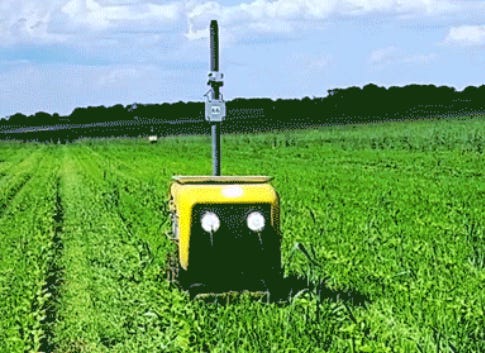
They’re bumblebee yellow, about the size of a ride-on mower, and since May they’ve been humming up and down crop rows on farms in northern Vermont with nobody driving them.
More than 45 people came out to Henry Bros. Wolfridge Dairy in Alburgh on June 30 to watch three of them work at once. UVM Extension is running them again today at its annual Crops and Soils Field Day at Borderview Research Farm.
If you’ve seen them, you probably have a decent idea of what they do. What none of the demonstrations or the public write-ups have said is what one costs.
So we asked. Nathan Dyrud at Greenfield Robotics, the Kansas company that builds the BOTONY robots, wrote back with a number: $36,500 apiece.
Here’s what that means if you farm here.
How many you’d need
Start with the part that decides the bill.
Dyrud’s rule of thumb is one robot for every 80 to 100 acres of row crops. So under 80 acres of corn or beans, you’re looking at one machine — $36,500. Two hundred acres puts you at two or three. Three hundred, three or four. Where you land in that range depends on your fields, and it’s the difference between a $73,000 decision and a $146,000 one.
You’ll see a couple of different speed numbers floating around, and they’re measuring different things. UVM’s team clocked the robots at about seven acres in a day during the pilot, running on batteries good for three to three and a half hours before they need about that long to charge back up. Greenfield says the machines are now running 0.85 acres an hour. Neither is wrong; the acres-per-robot rule is the one to plan against.
What you get for the money is a machine that mows weeds between 30-inch rows and carries a 30-gallon foliar tank. Before it can run anywhere, the field has to be mapped — Adam Reck, Greenfield’s northeast territory leader, flies a fixed-wing drone at 350 feet when the crop is four to six inches tall, taking something like 1,200 pictures of a 70-acre field, which get stitched together into the path the robot follows. Speaking to WCAX in June, Heather Darby compared it to a robot vacuum: map it once, train the robots, and they go do their job.
Worth knowing what it doesn’t do. Mowing between the rows doesn’t touch the weeds coming up inside the row, right against your plants. This is a tool that replaces some passes, not your whole weed program.
Two catches
The first one: you can’t rent your way in anymore.
Greenfield used to sell weeding as a service — you’d hire them the way you’d hire a custom sprayer, try it on a few acres, and never buy anything. Dyrud told us they’ve moved away from that. It’s outright purchase now. A lease option is supposed to come along later this year.
The second: you can’t get one this year anyway. They’re sold out for 2026 and taking orders for 2027. Anybody who watched those robots at Alburgh in June, liked what they saw, and had the money sitting there still couldn’t have put one in a field this season.
Where the pilot’s money came from
One caution before you measure your own situation against the pilot’s: what UVM paid per robot isn’t public, and the numbers below don’t establish it.
The Northwest Crops and Soils program — Darby, agronomy specialist Jeff Sanders, and precision ag specialist Daniel Bliss — got the six robots with $137,000 from the Vermont Agency of Agriculture, Food and Markets, Stonyfield Organic, and donations. That money also covered the drone mapping, a custom trailer with chargers mounted on the wall, and a season of support from the company.
Six robots at $36,500 would run $219,000. That doesn’t mean UVM got $82,000 knocked off. We don’t know the price at the time they bought, whether anything was donated or thrown in, or what the whole arrangement looked like. We asked UVM Extension how the $137,000 broke out across the three funders and how the purchase was put together. We hadn’t heard back by publication, and the question’s still open.
The short version: the pilot’s math isn’t your math. Six machines got onto Vermont farms on state, corporate, and donor money put together by a land-grant university, which is what a pilot is for. It just means watching them run at a field day was never going to tell you what they’d cost you.
What to keep an eye on
That lease option. Dyrud said the company plans to have one later this year. No terms, no firm date yet. For any farm that isn’t writing a $36,500 check up front, that’s the number to wait for.
The 2027 queue. Dyrud said Greenfield is sold out for 2026 and taking 2027 orders. He didn’t say what’s behind the wait, and we don’t know whether it reflects demand, production, or how the company is pacing sales. If you’re thinking about it, the practical point is that the line starts now.
Organic first. Sylvia Jensen, a water quality specialist at the Agency of Agriculture, said at the June demo that she hopes the cost comes down, and that for an organic operation this could be a game changer. That’s the sharpest thing anyone’s said about it. Organic standards limit which herbicides you can use, so mechanical weeding is worth more on those acres than on ground where spraying is an option — which makes organic and no-till the likeliest places for the numbers to work first. Nobody has run those numbers for a Vermont farm yet.
How they hold up. UVM says black beans and sweet corn are still to be tested. Rocky ground and Vermont’s mixed soils were among the reasons for trying this here, and a season’s worth of data off working farms — not a good day at a demo — is what’ll tell you whether these earn their price in this state.
Cell service. You need cell service to start a robot — the command goes through Greenfield’s app. Jeff Sanders said at the June demo that UVM’s crew uses Starlink to get service in rural fields, and that it’s worked OK but has been spotty enough to cause delays. Around here, that’s not a footnote. That’s a condition of use.
Compass Vermont is independent and reader-supported.