


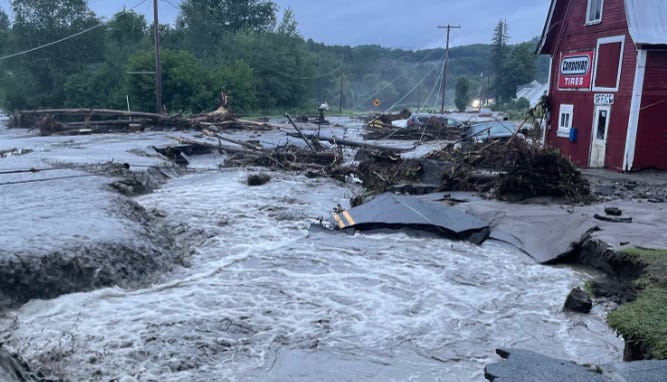
Vermont’s careful budget management has become a liability in securing federal disaster relief, as FEMA denied the state’s request for assistance following devastating floods in the Northeast Kingdom last July. The denial, upheld on appeal in February 2026, illustrates how federal disaster policy creates a “success penalty” where fiscally responsible states are the first to lose aid for mid-sized disasters.
The July 2025 Flooding Event
On July 10, 2025, intense localized flooding struck Caledonia and Essex counties, depositing several inches of rain in just hours across the steep terrain of towns including Sutton, Burke, Sheffield, Wheelock, Newark, and East Haven. The storm caused approximately $1.85 million in program-eligible costs to public entities, with infrastructure damage concentrated on Class 3 town highways—unpaved roads highly susceptible to washouts during rapid runoff events.
For context, this marked the third consecutive year of major flooding in the region, following Hurricane Beryl’s remnants in July 2024 and historic floods in July 2023. The repeated hits have left local infrastructure in perpetual emergency repair mode, preventing towns from accumulating reserves or completing long-term mitigation projects.
Understanding the Federal Denial
FEMA’s rejection came despite Vermont exceeding federal damage thresholds. The agency uses per capita indicators to determine if disaster costs exceed a state’s capacity. For 2025-2026, Vermont’s $1.85 million in documented damages significantly surpassed the statewide threshold of approximately $1.22 million, and Caledonia County’s damages were more than ten times the county-level threshold.
However, FEMA cited Vermont’s $465 million in state reserves as evidence the state could handle the costs without federal intervention. This interpretation of the Stafford Act creates what critics call a “success penalty”—states that maintain healthy budgets through prudent fiscal management become ineligible for aid that would flow to states with depleted reserves.
The “Success Penalty” in Practice
The denial reflects updated federal regulations from 2019 that weigh a state’s Total Taxable Resources more heavily in aid decisions. While Vermont as a whole can absorb $1.85 million, individual towns cannot. Sutton, for example, faces $1.4 million in damage—twice its entire annual highway budget—but federal authorities use the state’s healthy balance sheet to justify denying aid to effectively bankrupt municipalities.
This creates a perverse incentive structure where states benefit from poor financial planning. Well-managed states like Vermont face denial while states with depleted reserves receive assistance for similar disasters.
What the Denial Actually Covers
A common misconception following the denial was that FEMA “abandoned residents” seeking home repair assistance. In reality, Governor Phil Scott requested only Public Assistance for municipal infrastructure repairs, not Individual Assistance for private property damage. The state recognized that private damages didn’t meet the separate, higher thresholds required for individual aid programs.
The denial specifically impacts town budgets and property tax rates, not direct assistance to flood victims. Towns like Sutton now must secure loans to fund repairs already completed, creating debt service obligations that will require sustained property tax increases in communities with limited economic capacity.
The Northeast Kingdom’s Economic Reality
The economic impact falls disproportionately on the Northeast Kingdom’s vulnerable population. Essex County’s median household income of $48,500 represents just 60% of Vermont’s statewide median. With poverty rates above state averages—14.4% in Essex County versus 9.9% statewide—residents have limited capacity to absorb property tax increases needed to fund flood repairs.
The region’s aging population and higher unemployment rates compound these challenges. When towns raise property taxes to pay for infrastructure repairs, the burden falls heaviest on fixed-income residents, farmers, and small-town workers who form the backbone of these rural communities.
The State’s Legislative Response
The Vermont Legislature is considering House Bill H.679, which would create state-level disaster assistance independent of federal approval. The bill proposes having Vermont cover 100% of local matching requirements for federal aid and provide immediate financial assistance for infrastructure repairs.
However, this approach carries significant risk. FEMA operates under a “Payer of Last Resort” doctrine, meaning any available state funding can negate eligibility for future federal reimbursement. By providing immediate state assistance, Vermont could inadvertently “supplant” federal dollars and lose millions in reimbursements when larger disasters occur where federal declarations are granted.
Alternative Federal Funding Sources
Towns aren’t entirely without federal options. The Federal Highway Administration’s Emergency Relief program provides different assistance parameters than FEMA. FHWA pays 100% of emergency repair costs completed within 270 days and covers 80% of permanent repairs with 10% state and 10% local shares.
However, this program only applies to federal-aid highways, typically Class 1 and Class 2 roads. Many of the worst-hit roads in the Northeast Kingdom are Class 3 gravel roads ineligible for FHWA assistance, leaving the most vulnerable infrastructure in rural towns with the least access to federal support.
The Construction Cost Crisis
Recovery costs are compounded by construction inflation that has increased road and bridge work costs by 62% since 2020. Vermont’s Transportation Fund faces a $317 million funding gap starting in FY 2026 due to these rising costs. For small Northeast Kingdom towns, the price of a single box culvert has nearly doubled in three years, making both the 25% local match required for most grants—or 100% cost of denied FEMA claims—potentially insurmountable.
Political Dimensions
The denial occurs amid broader concerns about political bias in disaster declarations. Multiple Democratic governors have characterized recent denials as “political games” played by the Trump administration, noting that requests from Democratic-led states like Vermont, Illinois, and Maryland were denied on the same days that Republican-led states received approval.
While the Department of Homeland Security maintains decisions are “based on policy, not politics,” the pattern has eroded trust between state emergency managers and federal counterparts, complicating future disaster response coordination.
What Happens Next
Vermont faces a policy crossroads as the 2026 spring flood season approaches. State officials must decide whether to continue appealing federal decisions or fundamentally reorder fiscal priorities to sustain rural infrastructure independently.
The success of H.679 will determine whether Vermont can create a viable state-level safety net without jeopardizing future federal eligibility. Meanwhile, towns like Sutton face the prospect of entering a debt cycle where they’re still paying for 2025 flood damage when the next inevitable disaster strikes.
The broader implications extend beyond Vermont’s borders. As climate change increases disaster frequency while federal policy restricts aid access, the “success penalty” threatens to undermine the fiscal responsibility that has traditionally made states like Vermont attractive places to live and do business.
For Northeast Kingdom residents, the immediate reality is clear: the federal safety net they’ve contributed to through taxes is no longer reliably available when disaster strikes. The transition represents a fundamental shift in the social contract between federal, state, and local governments in an era of increasing climatic instability, with rural communities bearing the heaviest burden of this new reality.