


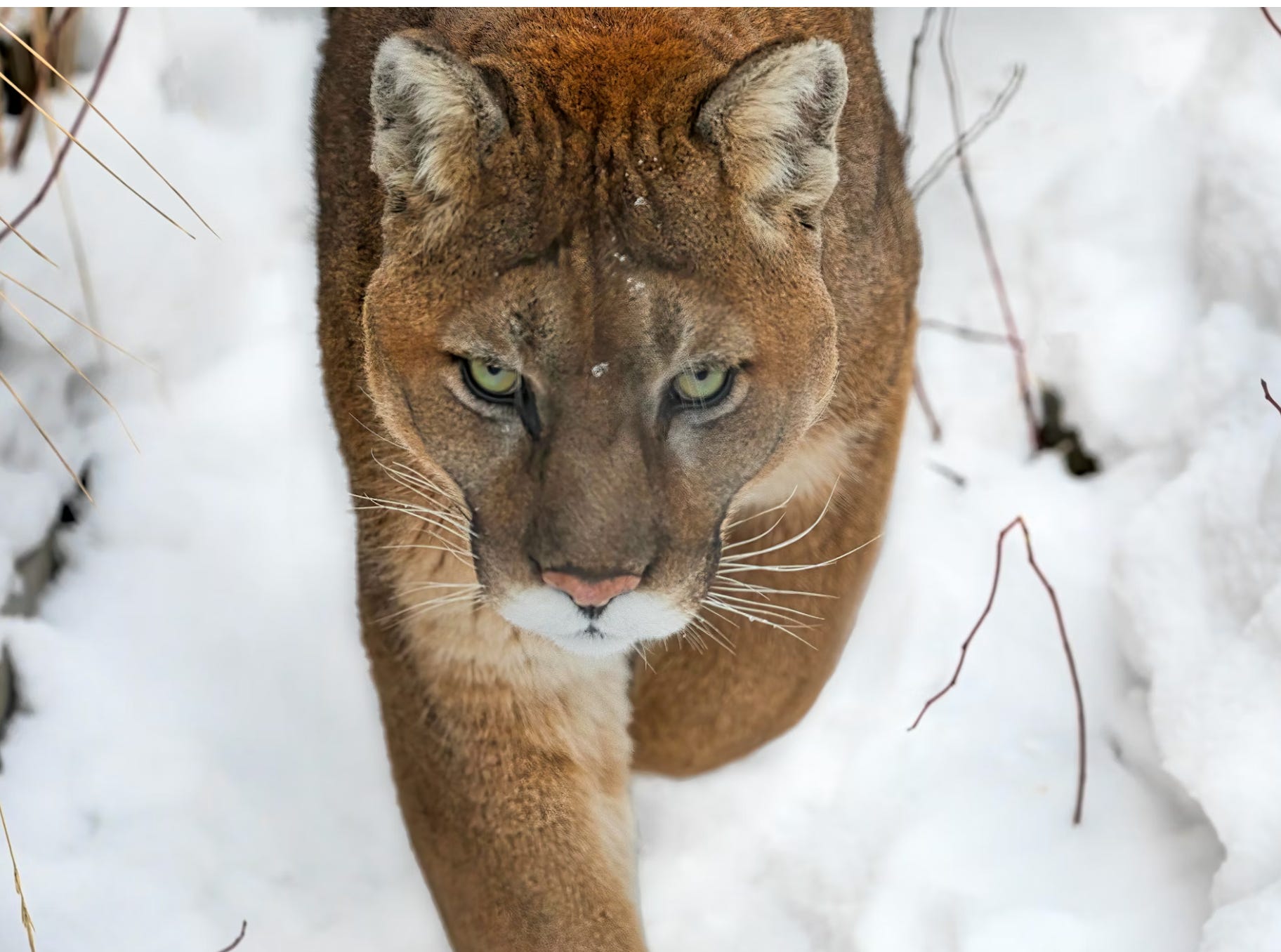
The catamount—Vermont's legendary mountain lion—is at the center of a debate that pits environmental advocacy against institutional caution.
A Ghost Story With an Official Ending
The last verified catamount in Vermont was killed in Barnard in 1881, marking the end of the species’ presence in a state that would later put the animal on its license plates and nickname its university athletic teams after it.
For decades afterward, the “eastern cougar” remained on the federal endangered species list—a kind of legal ghost. But in 2018, the U.S. Fish and Wildlife Service officially declared the eastern cougar extinct and removed it from the list entirely. The agency had concluded the subspecies had likely been gone since the 1930s.
This legal distinction matters for today’s debate: because Vermont’s native catamount population no longer exists, any effort to bring mountain lions back would technically be a “reintroduction” using western populations—not a “recovery” of local animals.
The Push to Bring Catamounts Home
The current advocacy effort is led by Mighty Earth, an international nonprofit that launched its “Bring Catamounts Home” campaign in early 2025 as part of a broader global rewilding strategy.
The group argues that Vermont’s forests are ecologically out of balance without a top predator. White-tailed deer populations, unchecked by natural predation, are over-browsing the forest floor, preventing regeneration of native trees like oak and maple, and giving invasive plants room to spread.
In a statement to the Washington Post, Mighty Earth CEO Glenn Hurowitz expressed an “aspirational goal” to have “paws on the ground in four years.”
That timeline has become a flashpoint in the debate.
Why Fish and Wildlife Says “Slow Down”
The Vermont Fish and Wildlife Department has called the four-year timeline “unrealistic” and potentially misleading. In an op-ed published by the department, agency officials argued that the scientific groundwork simply doesn’t exist for the Northeast to responsibly move forward with reintroduction anytime soon.
Their core concern: a feasibility study—the kind being proposed in current legislation—is meant to evaluate whether a reintroduction can happen. But state biologists say the peer-reviewed research necessary to even begin that evaluation hasn’t been conducted for this region.
Department officials have described the current approach as “putting the cart before the horse.” They argue the responsible first step is a multi-year research initiative led by regional universities, not a state-mandated study operating without a scientific foundation.
The Survey Numbers—and What They Don’t Tell You
Supporters of reintroduction point to a survey conducted by the Cougar Research Collaborative showing that Vermonters support mountain lion restoration by a margin of 12 to 1.
That figure compares respondents who expressed “strong support” to those who expressed “strong opposition.” However, the same survey found that a substantial portion of the population in every state surveyed remained neutral on the question.
State officials argue this neutral group is significant. Research on public attitudes suggests these individuals are highly susceptible to shifting their opinions based on new information about risks to livestock, pets, or public safety.
The survey also found that support was highest among urban residents and those who identify as politically liberal. Notably, respondents who identify strongly as hunters were actually more supportive of reintroduction than those who don’t hunt—contradicting historical assumptions that hunters would view the cats as competition.
The Ecological Case—and Its Complications
Advocates argue that mountain lions, as “keystone species,” would trigger what biologists call a “trophic cascade.” By killing deer and creating what researchers describe as a “landscape of fear,” the predators would prevent deer from congregating in sensitive forest areas, allowing vegetation to recover.
An adult mountain lion typically kills a large ungulate every seven to ten days—more frequently for females with cubs.
But some of the ecological claims being made in support of reintroduction are more complicated than they appear.
The Lyme Disease Question
One persistent claim is that mountain lions would reduce Lyme disease in humans by killing deer, which host the ticks that spread the disease. The logic seems straightforward: fewer deer means fewer ticks.
However, scientific research indicates this is an oversimplification. While deer host the adult black-legged tick, they’re not the primary reservoir for the Lyme disease bacterium itself. That role belongs to small mammals—specifically, the white-footed mouse.
Research published in the Proceedings of the National Academy of Sciences found that the increase in Lyme disease over the last three decades frequently does not correlate with deer abundance. Instead, the spread of the disease is more closely tied to the decline of small-mammal predators like the red fox.
In the current ecosystem, expanding coyote populations have displaced red foxes. Because coyotes don’t hunt rodents as efficiently as foxes do, mouse populations have remained unchecked.
The Moose and Tick Connection
Some proponents have suggested mountain lions could help Vermont’s struggling moose population, which is being decimated by winter tick infestations.
But this conflates two different problems. Vermont’s moose crisis involves the winter tick—a different species from the black-legged tick that carries Lyme disease. In northeastern Vermont, winter ticks were responsible for 91% of moose calf mortalities between 2017 and 2019.
The Fish and Wildlife Department has determined that mountain lions have a “negligible” impact on moose survival. The effective way to reduce winter tick loads, according to state research, is to decrease moose density through human harvest—hunting—not through large cat predation.
The Canada Lynx Concern
Another issue that receives less attention in advocacy materials: the Canada lynx. This federally threatened species currently lives in parts of Vermont and the broader Northeast.
Mountain lions are dominant over smaller cat species and could potentially kill lynx or compete with them for habitat and prey. The Fish and Wildlife Department has explicitly stated that any feasibility study must address how introducing a large generalist predator would affect recovery of the more specialized lynx.
The Borderless Predator Problem
Young male mountain lions routinely disperse more than 100 miles from their birth territory. Given Vermont’s relatively small size, any cats released in the Green Mountains would almost certainly cross into neighboring states or Canada within weeks.
This reality has prompted the Northeast Association of Fish & Wildlife Agencies to express serious concerns about Vermont moving forward without regional consensus. In a letter to the Vermont House of Representatives, the association stated that any reintroduction must include “close consultation” and “consent and collaboration” from all surrounding wildlife agencies.
Without this buy-in, Vermont could potentially be held liable for livestock losses or public safety incidents in neighboring jurisdictions where the cats were never officially sanctioned.
The Infrastructure Question
Modern Vermont is a different landscape than it was in 1881. The state is more developed, its forests more fragmented by roads and highways.
Research from the Midwest has shown that road traffic is a major source of mortality for dispersing mountain lions and can prevent a population from becoming self-sustaining.
For a reintroduction to succeed, Vermont would likely need significant infrastructure investments—wildlife underpasses and overpasses to allow cats to cross major highways like I-89 and I-91 safely. These projects could cost millions of dollars and would require coordination with the Department of Transportation.
Livestock and Coexistence
Vermont’s dairy and sheep farmers have expressed concern about livestock predation. Research from western states shows that while mountain lions typically kill a small percentage of total livestock—often less than 0.1% of inventory—these losses can be devastating for individual producers.
Vermont currently has no compensation fund for livestock lost to predators. If reintroduction occurred, the state would need to establish a system for verifying kills and reimbursing farmers.
State officials have also raised questions of liability: “Who will be held accountable when a cat dens near a home or a school?”
The Legislation: House Bill H.473
Representative Sarita Austin of Colchester introduced H.473 in March 2025. The bill would mandate the Vermont Department of Fish and Wildlife to conduct a comprehensive feasibility study on mountain lion reintroduction.
The study would need to address geographic suitability for a breeding population, protocols for managing human-lion conflicts, success metrics for population growth and genetic health, and the total cost and timeline for implementation.
The bill sets a deadline of January 1, 2027, for the Commissioner of Fish and Wildlife to submit results to the House Committee on Environment and the Senate Committee on Natural Resources and Energy.
Agency officials have criticized this deadline as too aggressive given the lack of existing regional research.
What Happens Next
As of early 2026, H.473 remains in the House Committee on Environment following testimony from experts including representatives from Mighty Earth and the University of Vermont.
The central question for legislators is whether to mandate a study that the agency responsible for implementing it believes is premature—or whether to wait for the foundational research that state biologists say must come first.
The outcome of this session will determine whether Vermont takes what supporters call a “bold step” toward rewilding, or follows the advice of its wildlife professionals to slow down.
For a state that has made the catamount part of its identity—on license plates, in team names, at the Vermont History Museum—the decision carries symbolic weight. But it also carries practical implications that would extend well beyond Vermont’s borders, affecting the entire Northeast for generations to come.
I find it almost entertaining, that Vermont wants to "conserve" the "Green Mountains", and surrounding area, yet at the same time promote growth/more people! Remember the 10k$ to move here??? Hypocritical??? I think the "Mountain Lion" is a beautiful animal and deserves Respect. Certainly our boarding States should be involved in the decision, their going to roam.....