


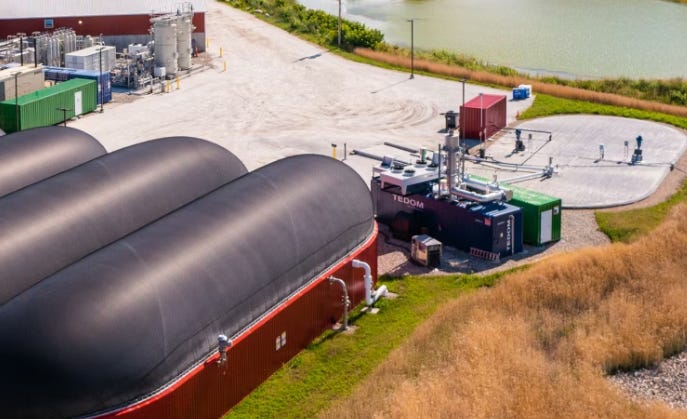
The U.S. Department of Agriculture announced today that it is extending an administrative pause on accepting, processing, and issuing loan note guarantees for biodigester and controlled environment agriculture projects through December 31, 2026.
The pause, originally imposed for 90 days in January, covers all loan guarantees issued through the agency’s Rural Business-Cooperative Service programs — and any pending applications in these categories will be withdrawn. The agency stressed that the action does not establish new eligibility requirements and does not reflect a judgment on any specific applicant or technology.
What the Freeze Covers — and Why
USDA says the freeze is driven by financial performance. The agency reports a 28 percent delinquency rate on biodigester loans and a 40 percent delinquency rate on controlled environment agriculture projects, which include vertical farming, hydroponics, aeroponics, and aquaponics. The agency says continuing to guarantee what it calls high-risk projects — “particularly those underwritten by lenders lacking expertise” — threatens the long-term stability of the program.
The pause covers loan guarantees administered through RBCS, not grants — a distinction that proved critical for four Vermont projects already in the pipeline.
Why Vermont Is Disproportionately Exposed
Vermont’s dairy sector accounts for roughly 70 percent of the state’s agricultural sales — a higher single-commodity concentration than any other state. Agriculture generates about 16 percent of Vermont’s greenhouse gas emissions, and manure management is a significant contributor. Under the Global Warming Solutions Act of 2020, those emission reductions are not aspirational — they are a statutory requirement. Anaerobic digesters — which capture methane from cow manure and convert it to electricity or renewable natural gas — have been a cornerstone of the state’s strategy to meet those mandates while giving dairy farmers an additional revenue stream.
But Vermont’s dairy farms are small by national standards. According to the Vermont Dairy Promotion Council, about 82 percent of the state’s dairy farms have fewer than 200 cows. A digester project typically costs between $1.5 million and $2.5 million, according to state and federal project estimates. Without federal grants and loan guarantees to offset upfront costs, most Vermont farms simply cannot self-finance these projects.
The state currently has 15 operating manure biodigesters, with several more in various stages of development. The federal Rural Energy for America Program has served as a primary financing mechanism for these projects — providing both grants and the loan guarantees now paused. The disruption is compounding: USDA separately paused all REAP grant applications in June 2025 to address a backlog created by the Inflation Reduction Act’s expansion of the program. Vermont’s digester pipeline is now caught between a grant backlog and a loan guarantee freeze.
Four Vermont Projects Cleared the Wire — Barely
Four Vermont digester projects managed by Agricultural Digesters LLC received federal grant awards through REAP: Machia & Sons Dairy in Sheldon ($929,360), Machia Brothers Dairy in Sheldon ($747,124), and Percy Farm in Stowe ($750,284), all awarded in 2024. A fourth project, Bullis Savage View Farm in Grand Isle, received a REAP grant of $278,195 in 2022. The projects also drew funding from the Vermont Community Loan Fund and the USDA Environmental Quality Incentives Program. According to Agricultural Digesters LLC, combined federal and state support across all four totals nearly $4 million.
Jim Muir, CEO of Agricultural Digesters LLC, told Compass Vermont that all four projects received their grant funding, though it came with delays. Those projects are not using the federal loan guarantee program — but future Vermont digester projects that would need loan guarantees face an uncertain path forward.
“I was pretty depressed about it last year,” Muir said of the freeze. But he said he came to an unexpected realization: Vermont might be able to make digester projects work even without federal incentives.
Vermont’s Advantage: The 20-Year Lock
The reason for Muir’s cautious optimism is Vermont’s existing financial support system for digesters. The state offers 20-year power purchase agreements for farm-generated renewable electricity — terms Muir called “clearly the highest in the nation.” That guaranteed, long-term revenue stream, he said, is what makes Vermont projects attractive to private equity investors even without federal backing.
“The money is good once it’s built,” Muir said. The problem is the upfront capital. Without REAP grants covering a significant share of construction costs, someone has to put up the money to build the digester before those 20-year revenue streams kick in. That’s either the farmer — “a big lift,” Muir acknowledged — or an equity investor willing to fund construction in exchange for a share of the returns.
Muir said he is actively pursuing private equity partners for new projects to fill the gap left by the federal freeze. Under that model, the equity partner would be the majority owner, but the farmer would be well compensated — a tradeoff that keeps the project viable without requiring the farmer to front the full construction cost.
Carbon credits for methane-reducing projects are also increasing, Muir noted, adding another revenue stream that makes the economics more attractive to investors. Muir said the largest operating digester in Vermont — Pleasant Valley Farms in Berkshire — is moving toward renewable natural gas production, a higher-value use of biogas, though he noted that RNG requires a very large herd to be economical.
The Wait-It-Out Option — and Why It Doesn’t Work
One alternative is simply waiting. If a future administration restores the loan guarantee program, the pipeline could reopen. But Muir said the math doesn’t work. Even if the next president took office and immediately restarted everything, he said, grant applications could not even be submitted until January 2029 at the earliest. Factor in years for grant processing, environmental review, and construction, and Muir estimates no new project would come online before 2031 or 2032.
That’s too long for Vermont dairy farmers already operating on thin margins in an industry that has seen decades of consolidation and declining farm counts.
“It’s more economic to go with an equity investor,” Muir said.
The Bigger Picture
The USDA framed today’s extension as responsible stewardship — a pause to review underwriting standards and reduce portfolio risk. And the delinquency numbers are real. When the original pause began in January, the agency reported that 21 digester loans totaling $386.4 million carried a 27 percent delinquency rate, while $311.9 million in controlled environment agriculture loans posted a 43 percent delinquency rate. Today’s announcement puts the current figures at 28 percent for biodigesters and 40 percent for CEA — a slight shift, but still alarming enough for the agency to justify extending the freeze through year’s end.
The fiscal pressure behind the decision is concrete. According to the USDA’s unnumbered letter, the current subsidy rate of 1.09 percent requires $19.75 million in appropriations to maintain lending authority. The projected rate for fiscal year 2027 is 2.95 percent — more than doubling the taxpayer cost to $51.6 million for the same level of lending. Left unchecked, the agency warned, the losses would reduce capital available for all rural projects, not just digesters and indoor farms.
But the question Vermont farmers need answered is whether their projects are part of that problem — or collateral damage from failures in other states with different economics, different lenders, and different oversight. The USDA has not broken out delinquency data by state.
What remains to be seen is whether Vermont’s digester infrastructure — and the climate, energy, and farm-viability goals it supports — can be sustained by private capital while federal support remains on hold.
Compass Vermont is reader-supported independent journalism. If this kind of reporting matters to you, consider becoming a subscriber or upgrading to a paid membership. Every reader helps us keep doing this work.