


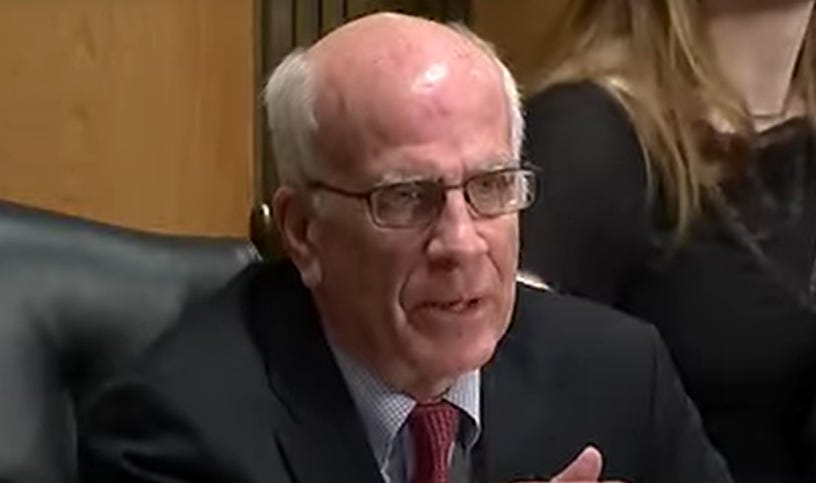
When the Senate Finance Committee convened on February 12, 2026, to review the United States-Mexico-Canada Agreement (USMCA), the hearing became more than a routine trade policy check-in.
It exposed a fundamental tension: Vermont businesses struggling with what Senator Peter Welch described as “havoc” from unpredictable tariffs, a trade system where roughly 80% of imports remain protected while 20% face crushing duties, and a Supreme Court case that could determine whether the entire tariff structure represents unconstitutional executive overreach.
Since President Trump’s second administration began on January 20, 2025, the federal government has used emergency authorities under the International Emergency Economic Powers Act (IEEPA) to impose a universal 10% tariff on nearly all global imports, with additional country-specific duties ranging from 11% to 50%, and targeted 25% to 35% tariffs on Canada and Mexico. These measures, justified by concerns over fentanyl trafficking and migration, have driven the U.S. tariff rate to levels not seen since the 1930s.
The impact on Vermont communities has been real but uneven, concentrated in specific sectors and municipalities while leaving others largely untouched.
Where the Pain Hits Hardest: Five Vermont Towns Tell Different Stories
Senator Welch’s roundtable discussions in Williston, Stowe, Newport, St. Albans, and Manchester revealed how tariff impacts vary dramatically based on local economic structures.
Newport: The Border Economy Collapses
At Jay Peak Resort near Newport, owner Steve Wright reported a 45% decline in hotel reservations from Canada and a 35% reduction in winter season pass sales to Canadians. For Newport, where the “hockey economy”—Canadian youth teams traveling for tournaments—drives significant winter revenue, the trade tensions have already triggered local workforce reductions. The proximity to the Quebec border, once Newport’s greatest economic asset, has become a vulnerability.
St. Albans: Food Security Meets Trade Policy
In St. Albans, integration with Quebec’s food supply chain is a matter of daily necessity. The Vermont Foodbank and local grocers source a significant portion of their produce from across the Canadian border. According to Vermont’s January 2026 Economic Review, fresh produce prices increased approximately 7% following the April 2025 tariffs, creating what local leaders describe as “food insecurity for the middle class.” The St. Albans dairy sector faces additional pressure from Canadian retaliatory tariffs on U.S. dairy exports, narrowing profit margins for farmers who depend on international market access.
Williston: When Small Orders Become Big Problems
As a retail and distribution hub, Williston businesses confronted new challenges when the “de minimis” exemption ended in August 2025. Previously, orders under $800 were exempt from duties. Now even small imports from Canadian artisans face the full tariff schedule. Business owners report that administrative paperwork for these small orders often proves more burdensome than the tariffs themselves, leading many to stop importing specialized Canadian goods entirely.
Stowe: Luxury Goods and Infrastructure Delays
Stowe’s high-end tourism economy faces pressure on two fronts. The 2025 tariffs on luxury imports—specialty foods, spirits, and premium outdoor apparel—force resorts and retailers to choose between absorbing costs or raising prices for inflation-weary customers. Additionally, pauses in federal funding for programs like the National Electric Vehicle Infrastructure (NEVI) program have slowed deployment of EV chargers at mountain resorts, an initiative critical for attracting environmentally conscious travelers.
Manchester: The Stockpile Strategy Runs Out
Manchester’s artisanal economy, anchored by retailers like the Vermont Country Store, initially avoided the worst impacts. Larger retailers stockpiled inventory in late 2024 and early 2025, cushioning the price shock through fall 2025. But as those stockpiles deplete in early 2026, what business owners call the “lull before the storm” is ending. Artisans who source materials like specialty wool or stainless steel components from overseas find that maintaining their “Made in Vermont” brand is becoming increasingly expensive.
The Uneven Impact: Why 80% Escape While 20% Suffer
The story of these tariffs is incomplete without understanding what former House Ways and Means Chairman Kevin Brady called the USMCA’s “secret sauce”—the zero-tariff framework that still protects most cross-border trade.
Approximately 80% of goods imported from Canada meet USMCA “Rules of Origin” and remain exempt from many emergency duties. The havoc Senator Welch describes is concentrated in the remaining 20% of imports that fall outside treaty protections—plus any goods containing components from non-USMCA countries that get caught in “stacked” tariffs.
This creates what economists call a dual trade regime. A Canadian-made product using entirely North American components crosses the border duty-free. That same product containing Chinese semiconductors or Vietnamese textiles faces multiple overlapping tariffs that can reach effective rates of 70% or higher.
When Making Snowboards Becomes a Legal Puzzle
Burton Snowboards, headquartered in Burlington, exemplifies this complexity. With nearly two-thirds of production in China and Vietnam, and 40% of that destined for the U.S. market, Burton faces stacked global and China-specific tariffs creating effective rates as high as 70% for some products. Burton’s B Corp certification requires maintaining rigorous social and environmental performance standards, making it impossible to simply “pivot” to different, non-tariffed countries without years of preparation.
Forest products tell a similar story. Vermont imports 25% of its softwood lumber from Canada. The import tariffs have increased the cost of a new single-family home by an estimated $9,200, complicating Vermont’s affordable housing goals. Meanwhile, Vermont loggers have seen their sector shrink by 40% in four years due to lost export markets and inflation—a double squeeze where they can’t sell their hardwood abroad while facing higher costs for imported softwood at home.
The Constitutional Question: Can the President Tax Without Congress?
Behind Vermont’s local struggles lies a fundamental legal question now before the Supreme Court: Does a 1977 emergency powers law give the president authority to impose what amounts to a massive new tax?
The International Emergency Economic Powers Act (IEEPA) was designed to provide emergency tools for financial sanctions and asset freezes during “unusual and extraordinary threats.” Historically, it was never used to impose tariffs until 2025. The administration’s legal defense argues that in the 21st century, economic imbalances and non-reciprocal trade practices constitute national security threats as potent as military action.
In the case of VOS Selections, Inc. v. Trump, the U.S. Court of Appeals for the Federal Circuit ruled 7-4 in August 2025 that IEEPA does not explicitly grant the power to impose taxes or duties. The court emphasized that while the president may “regulate” or even “prohibit” transactions during emergencies, the power to raise revenue through taxation is a core Article I power reserved for Congress. The statute’s text contains no mention of “duties,” “customs,” or “taxes.”
The administration counters by citing the 1971 precedent when President Nixon imposed a 10% surcharge under the Trading with the Enemy Act. However, IEEPA was specifically created to refine and limit those broad wartime powers for peacetime emergencies.
As Justice Ketanji Brown Jackson suggested in recent public remarks, the core question centers on whether a “revenue-raising tariff” differs fundamentally from a trade “regulation.”
The Numbers: Who Pays and How Much
The 2025 tariffs generated approximately $132 billion in federal revenue, but economists characterize this as a regressive consumption tax. According to analysis from the Yale Budget Lab and Tax Foundation, low-income households spend a larger share of their income on tariff-affected goods like clothing and food, bearing a disproportionate burden.
The poorest 10% of households saw an estimated annual income loss of $1,300, representing 3.4% of their adjusted gross income. Middle-income households lost approximately $2,100, or 2.1% of AGI. The wealthiest 10% lost $4,800, but this represented just 1.0% of their income.
Contrary to administration goals of reshoring manufacturing, U.S. manufacturing shed over 70,000 workers between April and December 2025. Economists attribute this to the “input cost” effect: when prices for imported steel, aluminum, and semiconductors rise, U.S. manufacturers using those components become less competitive globally.
Oxford Economics analysis found that “all metros will be worse off” from these policy shifts, with legacy manufacturing hubs in the Midwest and Northeast bearing the heaviest burden.
Legislative Pushback Meets Political Reality
Congress has attempted to reassert its constitutional authority over trade policy. S.J. Res. 88, which passed the Senate in October 2025, and H.J. Res. 72, which passed the House on February 11, 2026, represent formal congressional disapproval of using emergency powers to tax imports.
The February 10 House vote proved particularly significant. Three Republicans—Bacon, Kiley, and Massie—joined Democrats to sink a procedural rule that would have barred lawmakers from overturning tariffs until July, signaling fractures in Republican support for the president’s trade policies.
However, these resolutions face near-certain presidential vetoes, and Congress lacks the two-thirds majority needed to override. This leaves the judicial branch as the likely arbiter of the dispute.
The Technical Chaos: Why “Uncertainty” Means More Than It Sounds
When Senator Welch says “businesses just can’t deal with the uncertainty”, he’s describing a specific technical problem. In 2025 alone, the administration modified tariff proposals dozens of times—announcing, pausing, and re-implementing duties based on shifting diplomatic negotiations.
This “whiplash” creates concrete challenges. Most Enterprise Resource Planning (ERP) systems track where a product shipped from, not where its components originated. For metals, the 2025 rules require identifying the country of origin for raw materials to determine if Section 232 or IEEPA tariffs apply. U.S. Customs and Border Protection has increased scrutiny on whether goods have been “substantially transformed” in third countries like Mexico or Vietnam to avoid China-specific tariffs, creating risks of retroactive duty assessments.
Importers have filed nearly 2,000 “protective cases” in the Court of International Trade, hoping a Supreme Court ruling might trigger massive refunds of duties already collected.
What Happens Next
Vermont businesses, farmers, and consumers now find themselves in a waiting pattern with three possible resolution paths:
Supreme Court Decision: The Court is expected to rule by July 2026 on whether IEEPA grants tariff authority. An adverse ruling could require the government to refund the $132 billion collected so far and would eliminate the legal basis for current emergency tariffs. A favorable ruling would cement executive trade dominance and potentially establish tariffs as a permanent revenue stream rather than a temporary policy tool.
Legislative Override: If Congress achieves a veto-proof majority on disapproval resolutions, it could terminate the emergency declarations underlying the tariffs. The February 11 House vote suggests growing Republican willingness to challenge executive authority, but reaching two-thirds in both chambers remains a steep climb.
Diplomatic Resolution: The administration could negotiate agreements that reduce or eliminate tariffs in exchange for trade concessions from affected countries. However, such agreements would likely maintain the legal framework allowing future presidents to quickly reimpose duties.
For Vermont’s border communities, none of these paths offers immediate relief. Newport’s hotel owners, St. Albans’ food suppliers, and Manchester’s artisans remain caught between a statutory trade agreement that promises duty-free access and an emergency powers regime that can override those promises with a presidential proclamation.
The February 12 Finance Committee hearing underscored a reality that transcends partisan politics: The United States is operating under what witnesses called a “dual trade regime.” Whether that regime represents necessary executive flexibility to address 21st-century economic threats or an unconstitutional power grab that undermines legislative authority is a question Vermont businesses can’t answer—but one they’re paying to resolve.