


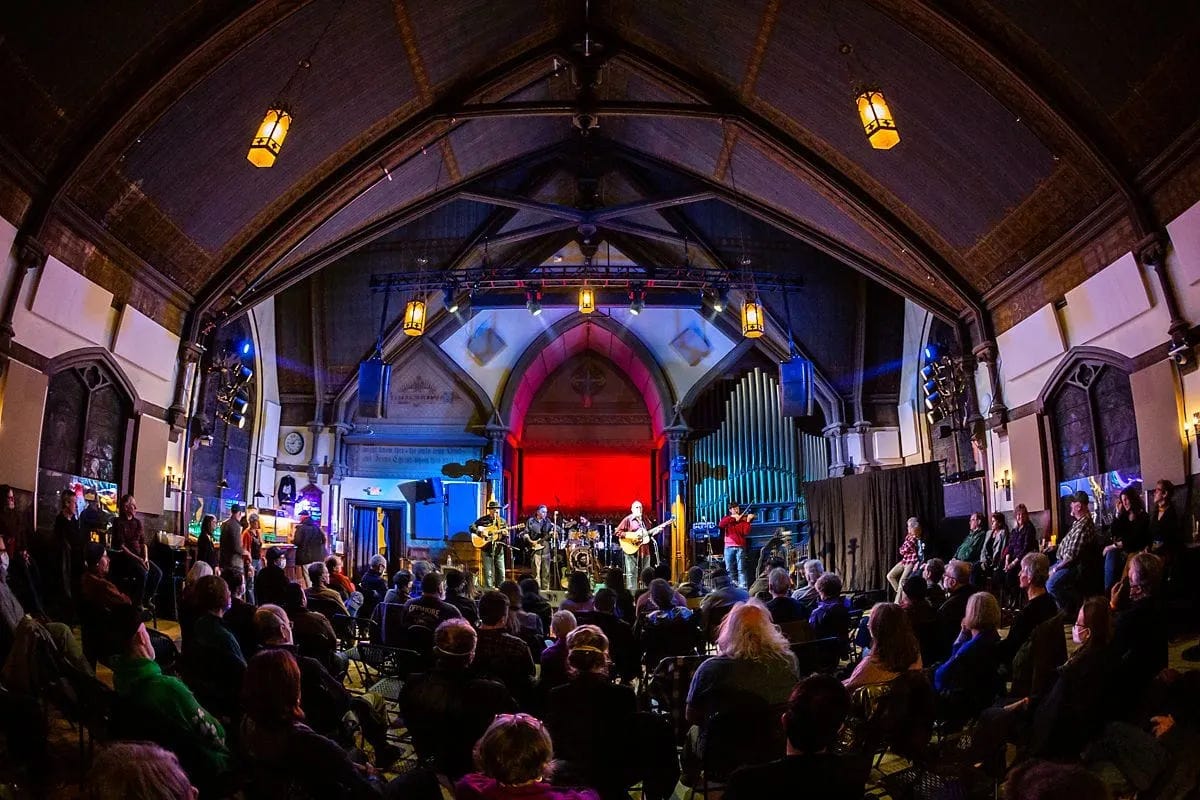
The Stone Church, a small music venue in a converted Victorian Gothic church on Main Street in Brattleboro, filed suit against StubHub on August 17 in federal court in Manhattan. According to Digital Music News and Hypebot, which reported the filing, the venue is seeking more than $5 million in damages and a court order forcing the ticket-resale platform to change how it sells tickets to Stone Church shows.
The claims are federal ones — trademark infringement and false advertising under the Lanham Act, the 1946 statute that governs trademarks and false advertising in commerce. The trade coverage puts the case in the Southern District of New York, docketed as 1:26-cv-06823.
Six weeks before that filing, a Vermont law took effect that bans nearly everything the venue is complaining about.
What Act 109 Does
Gov. Phil Scott signed H.512 on May 26. It became Act 109 and took effect July 1, 2026, adding a new subchapter to Vermont’s consumer protection law at 9 V.S.A. § 2479f. By the Boston Globe’s count, Vermont is the only state with an enforceable cap on ticket resale prices.
In plain terms, the law says:
A reseller can’t charge more than 110 percent of the original price. “Price” means the whole thing — face value plus every tax, fee, and charge. Shipping doesn’t count.
That cap applies to independent venues seating 3,000 or fewer, plus nonprofit fairgrounds and college and amateur sports venues. An “independent venue” is one that makes most of its money from ticketed events, isn’t majority-owned by a publicly traded company, and doesn’t operate in more than 10 states.
Nobody can sell a ticket they don’t own yet. The law calls this a “speculative ticket” — one that isn’t in the seller’s hands, or under a contract to be handed over, at the moment they list it. Selling one is flatly illegal.
A resale site has to tell you whether you’re buying from the venue or from a reseller, and has to tell you the resale price is capped by law.
If a resale site shows you how many tickets are left, that number can’t mislead you — not about what’s available on that site, and not about what’s available anywhere else.
A resale site can’t use a venue’s name, logo, or web address to imply the venue endorses it, or call itself “official,” without written permission.
The Overlap
Set the complaint next to the statute and the lines land almost on top of each other.
The venue alleges StubHub posts urgent scarcity warnings — a claim that only four percent of tickets remain — for shows where most of the box office is still unsold. Section 2479f(b)(3) says availability information can’t mislead about tickets on the platform or elsewhere.
The venue alleges brokers list tickets they don’t have. In one test purchase described in the filing, a broker took a fan’s money and then waited 49 hours before buying the actual ticket from the Stone Church box office. Section 2479f(e) is a one-sentence ban on exactly that.
The venue is asking a federal judge to order all-in pricing and disclosure that StubHub’s listings don’t reflect the venue’s real remaining inventory. Sections 2479f(b)(1) and (2) already require the total price and the buyer-facing disclosure.
And the trademark claim at the center of the federal case — that StubHub trades on the Stone Church name — maps onto § 2479f(d), which bars resale exchanges from using a venue’s intellectual property or implying endorsement without written consent.
The Stone Church is also, by the statute’s own definition, exactly the kind of venue Act 109 was written to protect: independent, under 3,000 seats, Vermont-based.
Why New York, Then
Whatever the venue’s litigation strategy, Act 109 gave it nothing to sue with.
The law’s enforcement provision is a single sentence: a violation is an unfair and deceptive act in commerce under 9 V.S.A. § 2453. That routes everything into Vermont’s Consumer Protection Act, where the Attorney General is the enforcer. The AG can investigate, issue civil investigative demands, sue in Superior Court, and seek civil penalties. The Vermont Arts Council, which led the coalition behind the bill, tells Vermonters that enforcement is complaint-driven — you file with the Consumer Assistance Program, and that triggers the investigation.
The private right to sue under § 2461(b) belongs to consumers. Vermont defines “consumer” broadly enough to include a business buying goods or services for its own use — but the Stone Church didn’t buy anything from StubHub. It’s a third party watching another company sell access to its room. The Vermont Supreme Court held in State v. International Collection Service that business victims who aren’t consumers have no private action under § 2461(b).
So the venue’s options under Vermont law were to file a consumer complaint and wait for the Attorney General. Its option under federal law was to sue for $5 million. It took the second one.
StubHub’s Side of It
StubHub fought this law in Montpelier and lost. David Garriepy testified for the company before the Senate Economic Development Committee on March 25, arguing that resale price caps don’t work as advertised. The company’s position is that caps push sales off regulated platforms and onto social media and private channels, where buyers have no recourse when a ticket turns out to be fake — and it pointed lawmakers to Ireland, France, and Australia as evidence. StubHub also argued that when an incumbent backs a policy limiting market entry or targeting its competitors, the policy tends to entrench that incumbent rather than check it.
Brian Berry, who runs the Ticket Policy Forum on behalf of StubHub, SeatGeek, and other marketplaces, told the Boston Globe his group is “fundamentally opposed to arbitrary price caps.”
The Arts Council’s Susan Evans McClure answered the Ticketmaster argument directly in VTDigger in May: Vermont has no Live Nation or Ticketmaster venues, so there is no incumbent here for the law to entrench.
The bill that passed was substantially narrower than the one introduced. Refund guarantees, reseller licensing, surety bonds, recordkeeping, and audit authority all came out along the way, after pushback from both resale interests and some consumer advocates.
The Clock
Act 109 repeals itself on July 1, 2028. The Legislature gave the law a two-year run and will have to decide whether to renew it.
That makes the next 22 months the entire evidentiary record. If the Attorney General builds a case file under § 2479f, the 2028 Legislature has something to weigh. If the complaints don’t come in — or don’t get worked — the law expires on schedule, and the one Vermont venue that went after a resale platform will have done it in New York under a federal trademark statute.
What This Means If You Buy Tickets in Vermont
If you’re buying a resale ticket to a show at a Vermont venue under 3,000 seats, the price you’re charged — all in, fees included — is capped at 110 percent of what the venue charged. The site has to tell you that. It has to tell you whether you’re buying from a reseller. And the scarcity counter on the page can’t lie to you about what’s still available at the box office.
Those rights exist whether or not anyone enforces them, and they expire on July 1, 2028 unless the Legislature renews them. Enforcement starts with a complaint to the Attorney General’s Consumer Assistance Program.
Two years, two predictions. StubHub says the cap drives buyers somewhere with no recourse at all. The venues say the cap is what keeps a Vermonter from paying four times face value for a seat in a converted church.