


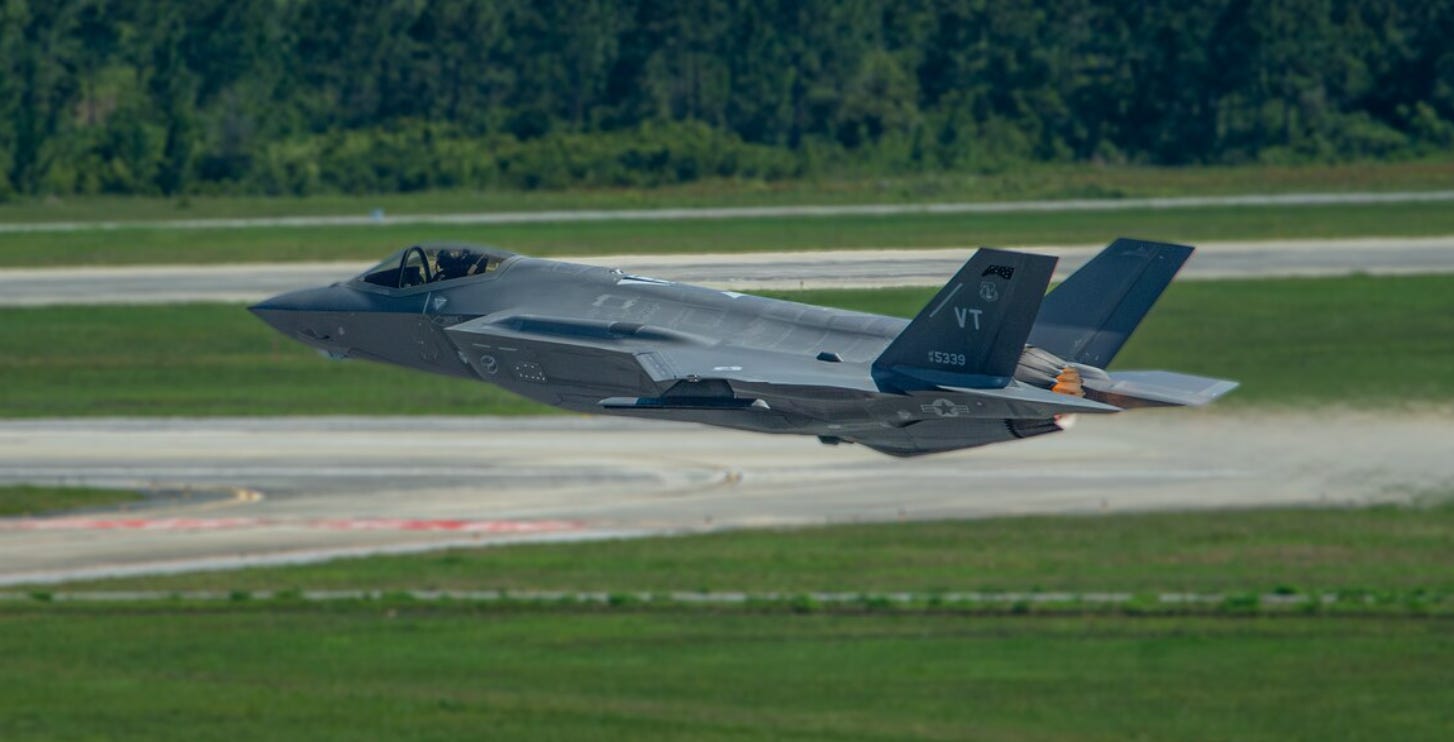
Vermont’s Air National Guard received federal mobilization orders over the weekend of December 6-7, 2025, according to reporting by Seven Days. The 158th Fighter Wing, based in South Burlington, is preparing to deploy sometime this month, though military officials are not disclosing where the unit is headed or how long they’ll be gone.
Lt. Col. Meghan Smith, the unit’s spokesperson, confirmed to Seven Days that “We were federally mobilized, but we can’t talk about the location or the duration.” Vermont Army National Guard spokesperson Joe Brooks indicated the deployment would occur “sometime here in December,” characterizing it as having a “short turnaround time.”
The mobilization affects approximately 1,000 full-time and part-time members of the 158th Fighter Wing, taking Vermont’s “citizen soldiers” away from their civilian jobs and families on relatively short notice.
What Makes Vermont’s F-35 Unit Strategically Valuable
The 158th Fighter Wing operates the F-35A Lightning II, one of the most advanced fighter jets in the U.S. military arsenal. These fifth-generation stealth aircraft are specifically designed for the most challenging combat environments—situations where enemy radar and missile systems would shoot down older aircraft.
The unit deployed earlier this year to Kadena Air Base in Japan, with approximately 200 airmen and several F-35s serving overseas from January through late April 2025. That deployment focused on training with Japanese, Australian, and South Korean forces, demonstrating the unit’s ability to work in complex international coalitions.
The rapid turnaround—just seven months between returning from Japan and receiving new federal orders—is unusually short for National Guard units. Department of Defense guidelines typically aim for much longer rest periods between deployments to allow for equipment maintenance, pilot rest, and members to return to their civilian employment. The compressed timeline suggests an urgent operational requirement.
The Venezuela Connection: Rising Tensions in the Caribbean
The timing of the mobilization coincides with dramatically escalating tensions between the United States and Venezuela. The Trump administration has deployed the USS Gerald R. Ford carrier strike group to the Caribbean, representing the largest U.S. military buildup in the region in decades.
On November 30, 2025, President Trump declared Venezuelan airspace “closed,” and the administration has designated Venezuela’s “Cartel of the Suns”—allegedly run by President Nicolas Maduro and his generals—as a Foreign Terrorist Organization. The U.S. military has also struck boats linked to drug trafficking in the region.
The Miami Herald reported that F-18 fighter jets were observed circling the Gulf of Venezuela on December 9, the same day the Vermont mobilization became public. These older, non-stealth aircraft are typically used for “show of force” missions meant to be seen and intimidate adversaries.
Venezuela operates Russian-made S-300 air defense systems, advanced surface-to-air missiles that can track and engage non-stealth aircraft at long ranges. The F-35’s stealth capabilities make it specifically suited to neutralize these systems—a mission known as Suppression of Enemy Air Defenses (SEAD)—allowing other aircraft to operate safely.
An Alternative Explanation: NATO and Europe
While the Venezuela crisis dominates headlines, there’s another possibility that has received less attention: the 158th Fighter Wing could be deploying to Europe.
When Seven Days contacted Vermont Air Guard Adjutant General Greg Knight, he was in North Macedonia and unavailable to discuss the deployment. This detail might be more significant than it initially appears.
Vermont has maintained a decades-long partnership with North Macedonia through the State Partnership Program. The Vermont National Guard has been instrumental in helping North Macedonia modernize its military for NATO integration, and the Balkans remain strategically important to NATO’s southeastern flank.
The presence of Vermont’s top military commander in Europe during a major mobilization of his premier air unit raises questions about whether the F-35s might be heading to NATO bases in Europe rather than the Caribbean. Without official confirmation of the destination, both scenarios remain plausible.
What This Is Not: Domestic Operations
The Seven Days report notes that the Vermont mobilization comes as federal forces have been deployed to American cities, including 4,000 National Guard troops sent to Los Angeles and deployments to Chicago. National Guard soldiers in Washington, D.C. were recently armed and assigned to patrol with police.
However, the 158th Fighter Wing’s F-35s have no capability for riot control, urban policing, or civil order enforcement. These are air superiority and strike aircraft designed for combat against peer adversaries with advanced military capabilities, not for domestic law enforcement. The conflation of these separate deployments has created some confusion about the unit’s mission.
The Legal Framework: Federal vs. State Control
Lt. Col. Smith’s confirmation that the unit was “federally mobilized” is significant from a legal and command perspective. When National Guard units are federalized under what’s known as Title 10 authority, they shift from state control to federal control. The President becomes their commander, not the Governor.
Governor Phil Scott’s press secretary, Amanda Wheeler, referred questions about the deployment to the Pentagon, which reflects this shift in authority. Once federalized, Governor Scott has no legal authority to countermand or veto the deployment, regardless of his political views.
This represents a fundamental aspect of how the National Guard operates: while normally under state control for disasters and emergencies, Guard units can be called into federal service for overseas missions or national defense operations.
Why Military Officials Won’t Say Where
The refusal to disclose the deployment location is standard operating procedure for military movements, particularly for high-value assets like the F-35. Operational security protocols prohibit releasing information about forward operating locations before or during the initial movement phase.
If the F-35s are deploying to a contested region—whether the Caribbean or elsewhere—announcing their destination in advance would allow adversaries to reposition air defense assets or prepare countermeasures. The aircraft carry classified sensor technology and mission planning systems that require protection.
Lt. Col. Smith noted the unit is “not authorized to share this information yet,” suggesting details may become public once the deployment is underway and force protection concerns are reduced.
What Happens Next
In the coming days and weeks, several developments could clarify the nature and destination of this deployment:
Official Announcements: The Pentagon may release information about “Theater Security Packages” (typically associated with European deployments) or “Counter-Narcotics Surges” (suggesting Caribbean operations). These carefully worded descriptions often provide clues about deployment locations without compromising operational security.
Commander Movements: Whether Maj. Gen. Greg Knight returns to Vermont or remains in Europe could indicate where his unit is headed. Military commanders typically coordinate closely with deploying units during mobilization.
Congressional Notification: Major overseas deployments often require notification to congressional leadership, which sometimes becomes public through congressional sources or reporters covering Capitol Hill.
Family Support Programs: The Vermont National Guard typically activates family support services when units deploy, and local news coverage of family readiness events can provide indirect confirmation of deployment timelines.
For Vermonters, the mobilization means that approximately 1,000 of their neighbors—the pilots, maintainers, logistics specialists, and security forces that make up the 158th Fighter Wing—are preparing to leave their civilian jobs and families for an undisclosed location and duration. The economic and social impact on the South Burlington area will be significant.
The deployment represents a moment when Vermont’s “Green Mountain Boys,” a unit with a proud history now flying some of America’s most advanced aircraft, are being called to serve in what appears to be a rapidly developing international situation. Whether that situation centers on the Caribbean, Europe, or another theater entirely remains, for now, classified information.
Pardon me, but your AI is showing…
"Orchestrated article continuation with European focus and structural consistency.
The user wants me to continue with the article, covering the European angle and other aspects. I need to maintain the same tone and structure."
Aww, such a shame. I thought this "news" was written by AI. Bye-bye.