


If your family gets Medicaid-funded developmental or mental health services and those services were cut, reduced or suspended, the bottom of this story explains the notice you should have received and who can tell you whether you can still appeal.
ANALYSIS
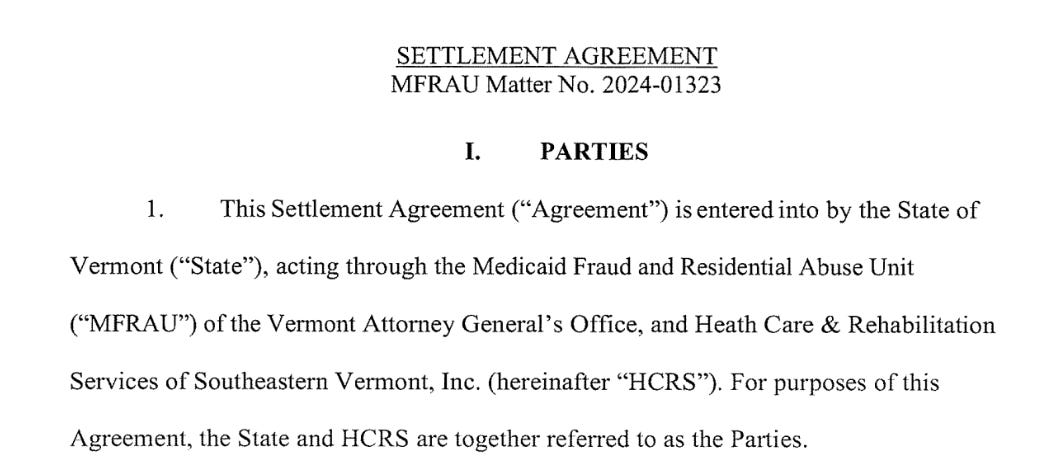
Health Care & Rehabilitation Services of Southeastern Vermont settled a Medicaid case with the State last week, agreeing to pay $391,816, the Attorney General’s Office announced. Since spring, HCRS has also been managing United Counseling Service in Bennington, an agency that settled its own Medicaid case with the same state office in March. The two agencies’ boards are now exploring whether HCRS should take UCS over.
HCRS and UCS are two of Vermont’s ten designated agencies: private nonprofits the State contracts with, one per region, to deliver mental health, substance use and developmental disability services. HCRS covers Windham and Windsor counties. UCS covers Bennington County.
HCRS chief executive Anne Bilodeau is also serving as UCS’s interim chief administrative officer, and HCRS’s chief financial officer, Sarah Truckle, is UCS’s interim deputy administrative officer, according to the Bennington Banner, which reported the arrangement in August. Both boards passed resolutions to explore an acquisition. Bilodeau said the exploration began in earnest in late July and that such discussions generally take three to four months, with another four to six months of legal work after a vote.
UCS’s board has described the arrangement as a way to strengthen the agency’s stability and services. Bilodeau told the Bennington Banner that officials from the Department of Disabilities, Aging and Independent Living and the Department of Mental Health will be fully involved in acquisition discussions, and that state officials have met with both boards. Bilodeau became HCRS’s chief executive on April 1, 2026. Truckle joined HCRS in September 2025, after the period covered by last week’s settlement.
What neither agency will say
The settlement agreement carries a matter number from 2024. The Attorney General’s Office has not said when the investigation opened or when the State’s disability department referred HCRS.
Compass asked HCRS when it first learned of the investigation and whether it disclosed the investigation to the State, UCS’s board or UCS staff when it took on management of UCS. HCRS responded with a statement that did not address either question.
The Department of Disabilities, Aging and Independent Living, which referred both agencies for investigation and oversees developmental-services designations, did not respond by publication to questions about the referral date and what it knew when HCRS took on UCS.
What HCRS settled
The State alleged three things between July 1, 2021 and June 30, 2024:
HCRS kept Medicaid money it was required to return when a client’s services ended or a client’s budget was cut soon after new funding arrived.
HCRS made significant changes to clients’ budgets or services without documenting that the services were medically necessary.
HCRS failed to send clients required notices when their services were reduced or suspended, and didn’t document that it told clients or caregivers about significant changes.
Of the $391,816, $301,397 is restitution, money paid back to the Medicaid program. The rest is damages and penalties. Half is due within 30 days of the agreement’s effective date and the rest within six months. For scale, HCRS took in roughly $175.8 million agencywide over the three fiscal years the settlement covers, according to the agency’s Form 990 filings — the settlement is about two-tenths of one percent of that, or roughly $357 a day.
HCRS does not dispute the facts as the State describes them. In the agreement, HCRS says additional facts would show it lacked the required intent, or that any misconduct was a mistake, and it denies breaking any state or federal law. In its statement to Compass, HCRS said the problems were in its Developmental Services program and “date back to the COVID-19 pandemic,” when service delivery changed rapidly. The period covered by the settlement runs from July 2021 through June 2024. HCRS said it began working cooperatively with the Attorney General’s Office and state regulators once concerns were raised, and “took immediate action to improve compliance, reporting, and quality across multiple areas.”
What the notices do
When a Medicaid recipient’s services are cut, suspended, denied or reduced, the recipient is supposed to receive a written Notice of Adverse Benefit Determination. That notice is not a courtesy letter. Under Vermont Medicaid’s provider rules, it is what tells a recipient a decision has been made and that it can be challenged, and it sets the deadline for doing so.
When an agency doesn’t send that notice, a client may never learn a decision was made or that there was anything to contest. Whether a particular person can still appeal depends on their own circumstances, and the Office of the Health Care Advocate can tell them where they stand.
The settlement’s corrective requirements look forward: write policies, keep records, send notices from now on. The agreement does not require HCRS to find past clients who never received a notice or to reopen any past decision. Compass asked HCRS whether it has contacted those clients. The statement didn’t say.
Neither the settlement nor the Attorney General’s announcement says how many clients were affected. The agreement describes the conduct as happening “in certain cases” and, twice, “on numerous occasions.”
Where the kept money was supposed to go
When a client’s services end, unspent money is supposed to go back to the State’s Equity/Public Safety fund. It doesn’t get redistributed automatically. An agency has to apply on behalf of a named person, and an Equity Funding Committee reviews the request before the State decides. The committee meets monthly.
The State has a name for money agencies send back: Returned Caseload Funding. Money that isn’t returned reduces what’s available to reallocate to other people who need it.
At least four settlements in under three years
HCRS is the fourth organization in Vermont’s network of designated and specialized service agencies to settle with the Attorney General’s Medicaid Fraud and Residential Abuse Unit since late 2023. The Attorney General’s Office announced all four:
Green Mountain Support Services, Morrisville, December 2023 — $459,190, with $75,000 suspendable if the agency met the settlement’s cooperation terms, for billing for services not delivered. The State brought in Champlain Community Services to oversee the agency. Green Mountain Support Services is a specialized service agency rather than one of the ten designated agencies.
United Counseling Service, Bennington, March 2026 — $483,464, after the State found at least 10 cases of ongoing service and supervision failures that the Attorney General said created serious and preventable risks to service recipients and the public. The Bennington Banner reported in August that UCS remains on provisional designation, upgraded in June to provisional without intent to de-designate, with a state review again in December.
Northeast Kingdom Human Services, May 2026 — $65,335, covering neglect of a vulnerable adult and overbilling the agency reported itself.
HCRS, September 2026 — $391,816.
The HCRS and UCS investigations both began with referrals from the State’s disability department. In two of these cases, the State’s answer to a struggling agency was to bring in another agency’s leadership.
HCRS also settled an earlier case. In June 2021, it agreed to pay $170,037.76 after billing Medicaid for nearly a decade of work by an employee barred from federal health programs — a problem HCRS identified and reported itself, and for which the acting U.S. Attorney publicly credited the agency.
If Your Services Changed
When Medicaid-funded developmental, mental health or substance use services are denied, reduced, suspended or ended, you are supposed to receive a written Notice of Adverse Benefit Determination. That notice is what tells you a decision was made and how to challenge it.
If your services changed and you never received that notice, the Office of the Health Care Advocate at Vermont Legal Aid can tell you where you stand and which deadlines apply to your situation. The help is free: 800-917-7787.
To report suspected Medicaid fraud, the Attorney General’s online reporting form takes complaints. The form notes that submissions may become public record.