


While thousands of nurses walked off the job at major New York City hospitals on January 12, 2026, the three hospitals operated by the University of Vermont Health Network in northern New York remain fully operational—though far from labor peace.
Champlain Valley Physicians Hospital in Plattsburgh, Alice Hyde Medical Center in Malone, and Elizabethtown Community Hospital are not participating in the massive nursing strike that has mobilized an estimated 15,000 to 20,000 nurses at hospitals including Mount Sinai, Montefiore, and NewYork-Presbyterian in the New York City metropolitan area. All three North Country facilities continue providing regular patient care with their full nursing staff.
However, the same union representing the striking downstate nurses—the New York State Nurses Association (NYSNA)—also represents more than 700 nurses and healthcare professionals across the UVM Health Network’s New York facilities, and those workers are currently operating without a contract while engaged in what the union describes as contentious negotiations.
Active Negotiations Replace Picket Lines
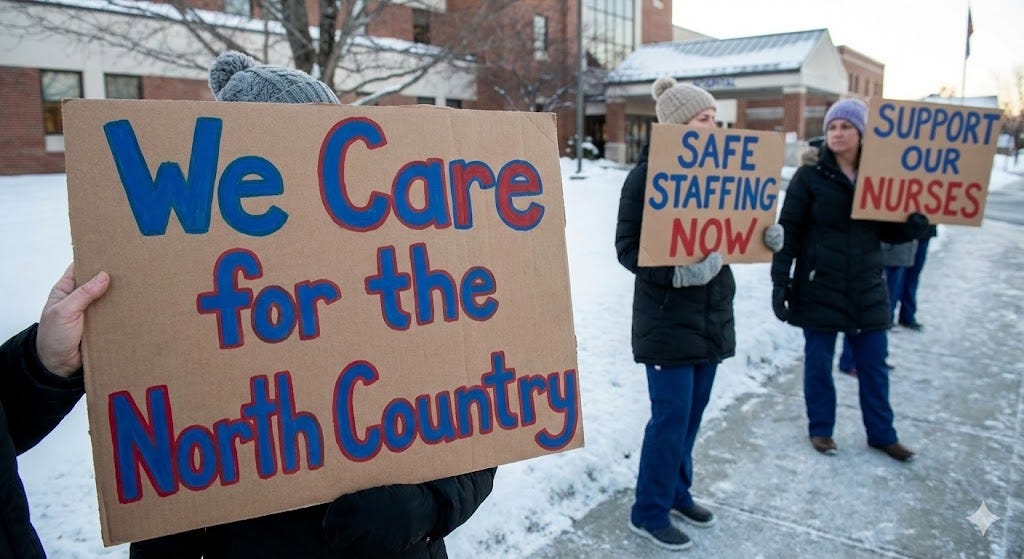
Rather than joining the January strike wave, nurses at the three UVM facilities have launched a coordinated campaign titled “We Care for the North Country” that uses town halls, rallies, and community outreach to pressure hospital management.
The contracts for nurses at all three facilities expired on December 31, 2025, leaving workers in what labor experts call a “no contract” status as of early January. The union confirmed that members were “already at the bargaining table” in late 2025 as contracts approached expiration.
In December 2025, nurses conducted what they called a “March on the Boss” at Alice Hyde and CVPH, delivering petitions signed by staff majorities directly to hospital administration offices. On December 10, the union held a virtual town hall focused on what they termed an “Access to Care Crisis,” linking their contract demands to preservation of trauma, pediatric, and maternal services in the region.
Why Rural Hospitals Face Different Challenges
The distinction between the striking New York City hospitals and the negotiating North Country facilities reflects fundamentally different financial realities. The downstate strike targets what the union characterizes as wealthy academic medical centers with significant resources. The North Country facilities, by contrast, serve as the healthcare safety net for the sparsely populated Clinton, Franklin, and Essex county region.
Champlain Valley Physicians Hospital functions as the regional tertiary care center, offering Level III trauma services, interventional cardiology, and oncology to a vast geographic area. Alice Hyde Medical Center holds Critical Access Hospital designation, and in 2022 closed its maternity unit, forcing expectant mothers in Franklin County to travel significant distances for delivery. Elizabethtown Community Hospital serves the deep Adirondack region with emergency stabilization and outpatient services.
The maternity closure at Alice Hyde remains particularly contentious in labor relations, with union representatives citing it as evidence of what they describe as network disinvestment in rural services.
Complex Financial Pressures Constrain Negotiations
Multiple financial pressures complicate the UVM Health Network’s ability to meet union demands, creating what labor observers describe as a difficult bargaining environment.
Vermont Regulatory Settlement
In early 2025, UVM Health Network reached a settlement with Vermont’s Green Mountain Care Board that significantly constrains the network’s finances. The Board, which regulates healthcare costs in Vermont, found that UVM Health had exceeded allowed patient revenue caps in previous fiscal years.
The settlement requires the network to pay $11 million to non-hospital primary care providers and $12 million to Blue Cross Blue Shield of Vermont. It also mandates reductions in commercial prices and revenue from insurers, and links executive bonuses to specific performance metrics including payments from New York hospitals to Vermont facilities.
UnitedHealthcare Contract Uncertainty
Adding to the financial uncertainty, UVM Health Network’s contract with UnitedHealthcare—a major commercial insurer—extends only through April 2026 following a last-minute deal reached in late 2025. The short-term extension means significant commercial revenue could be at risk in the second quarter of 2026 if a long-term agreement isn’t reached.
Medicaid Reimbursement Concerns
Hospital leadership has also warned that projected federal and state cuts to Medicaid in 2026 will have what they described as “real-life implications” for the New York facilities. Rural hospitals like Alice Hyde and Elizabethtown depend heavily on government payers, lacking the cushion of high-margin commercial procedures that larger urban hospitals enjoy.
The Vermont Comparison
A significant source of friction in negotiations stems from wage comparisons with nurses at the University of Vermont Medical Center in Burlington—the network’s flagship facility just across Lake Champlain from Plattsburgh.
In July 2024, Burlington nurses averted a strike by reaching an agreement that reportedly provided wage increases exceeding 20% over three years. That settlement, which followed a strike authorization vote by nurses represented by the Vermont Federation of Nurses and Health Professionals, has created expectations among New York nurses for similar compensation.
Union representatives argue that if the network can fund substantial increases in Burlington, similar resources should be available for Plattsburgh, Malone, and Elizabethtown. Network management contends that Vermont and New York operate under different regulatory and reimbursement systems that create distinct financial constraints.
History of Labor Friction
This is not the first time CVPH nurses have faced contentious contract negotiations. In 2022, nurses authorized a strike before eventually reaching a settlement. That contract was ratified in December 2022 with a two-year term that expired December 31, 2025.
More recently, in May 2025, the union raised concerns about CVPH management proposing changes to staffing ratios in medical-surgical units, which NYSNA claimed violated New York’s safe staffing laws.
What Union Members Are Seeking
While specific contract proposals remain confidential during negotiations, the union’s public campaign materials indicate several priority issues.
Nurses are seeking enforceable safe staffing ratios rather than advisory staffing committees, with financial penalties if hospitals fail to meet agreed-upon levels. They’re pushing for wage increases that would reduce reliance on expensive temporary travel nurses by making permanent positions more competitive. Protection of healthcare benefits—particularly preservation of the union-run NYSNA health insurance plan—remains a key concern. The union is also advocating for commitments that would prevent additional service closures like the Alice Hyde maternity unit.
What Happens Next
Three potential paths forward emerge from the current situation.
The most likely scenario involves a negotiated settlement before the April 2026 UnitedHealthcare contract deadline. NYSNA has shown willingness to reach agreements with financially struggling hospitals—shortly before the New York City strike deadline, the union settled contracts with several safety-net hospitals recognizing their genuine financial constraints. A similar pragmatic approach could yield agreements at the North Country facilities that balance enforcement of staffing standards with realistic wage gains.
A second possibility involves a delayed strike if financial pressures intensify. If the UnitedHealthcare negotiations collapse in April or if state budget decisions finalize deep Medicaid cuts in March, management might seek emergency concessions from the union. Such demands would likely trigger a defensive strike, potentially in April or May 2026—distinct from the January New York City action.
A third scenario could see regional escalation if the New York City strike extends for weeks. NYSNA might choose to open what labor strategists call a “second front” in the North Country to increase pressure on state political leadership to intervene broadly in healthcare funding issues. This would manifest as a sudden strike authorization vote at CVPH and the other facilities in late January or February.
For now, the three UVM Health Network hospitals in New York continue operating while their nurses work without a contract, watching both the outcome of the New York City strikes and the April deadline for the UnitedHealthcare agreement—either of which could reshape the trajectory of their own negotiations.