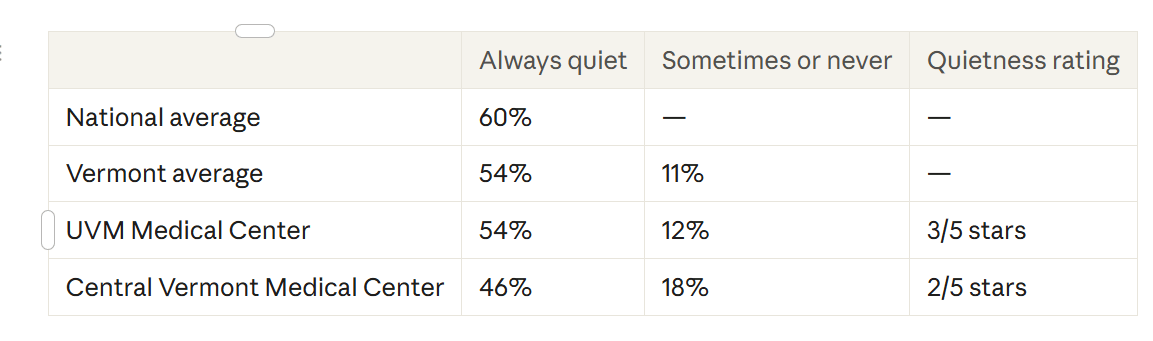
A smaller share of patients at UVM Medical Center say the area around their room was always quiet at night than patients across the country, according to Medicare’s hospital patient survey. The gap is wider at Central Vermont Medical Center in Berlin.
In the survey year that ended Sept. 30, 2025, 54% of UVM Medical Center patients said it was always quiet at night. Nationally, 60% did. At Central Vermont Medical Center, 46% said so.
Put another way, about 1 in 8 UVM Medical Center patients said their area was sometimes or never quiet at night. At Central Vermont Medical Center, it was nearly 1 in 5.
Hospital noise is more than a comfort complaint. Hospitals elsewhere are finding that some of it comes from bedside monitor alarms that don’t need anyone to act, and that cutting those alarms helps nurses catch the ones that do.
At the bottom of this story: how to look up the quiet-at-night score for any hospital, including the one closest to you, and how it compares with the state and national averages.
Most Alarms Don’t Need Anyone to Act
Bedside monitors, IV pumps and other devices sound an alarm when a reading crosses a set limit. According to the Joint Commission, which accredits hospitals, 85% to 99% of those alarms don’t require a nurse or doctor to do anything. Many go off because of a loose sensor, a patient moving, or a setting that’s too tight.
Nurses call the result alarm fatigue: they hear so many false or minor alarms that they stop reacting quickly to all of them, including the ones that matter. In a survey of 3,986 nurses at 213 hospitals, 83% said they experience it, and 55% said they had seen an alarm go unchecked when a patient needed urgent help.
Patients pay too. The alarms that wear on nurses also wake patients, and sleep is part of how people recover.
What Other Hospitals Are Trying
A Sept. 28 Wall Street Journal report laid out three approaches hospitals and researchers are testing:
Making alarms wait. Stanford’s Lucile Packard Children’s Hospital reprogrammed its bedside monitors so a brief dip, such as a short drop in a blood-oxygen reading, is given time to correct itself before an alarm sounds. A serious or sustained drop still sounds right away. Over a month, alarms per patient each day fell 75% in the pediatric intensive-care unit and 82% in the cardiac unit, with no rise in emergencies.
Changing the sound. Researchers at Vanderbilt University Medical Center and McMaster University are designing alarms that tell a nurse what is wrong by how they sound. A blood-pressure alarm, for example, uses a heartbeat sound, rising or falling in pitch to signal high or low pressure. In testing, people recognized an urgent alarm about 10% faster and rated the musical versions less annoying.
Warning earlier, without noise. A tool called Concern reads patterns in nurses’ charting, such as checking a patient’s vital signs more often, and flags patients who may be getting worse. It shows a green, yellow or red icon in the patient’s electronic record instead of beeping. In a trial covering more than 60,000 hospital stays, patients on units using it had a lower risk of dying in the hospital and shorter stays.
What UVM Has Done
Hospitals accredited by the Joint Commission have been required to manage clinical alarm safety for years. Under standards reorganized in January 2026, hospitals must still identify the most important alarms to manage and maintain policies covering safe settings, who can change them, when they can be disabled, and how staff respond.
UVM’s own record on alarms goes back more than a decade:
National work. In 2012, J. Tobey Clark, then UVM’s director of instrumentation and technical services, presented a national survey in which 75.5% of respondents agreed nuisance alarms were the biggest problem. He urged hospitals to make cutting them a high priority.
Quieter rooms. UVM Medical Center installed a sound masking system, ceiling speakers that play a low background sound to cover voices, in an inpatient wing. In a case study from the manufacturer, the hospital reported a marked increase in patients saying their rooms were always quiet at night, and said it was installing the system in all its patient wings. Sound masking covers conversation; it doesn’t reduce alarms.
Fewer alarms on one unit. A 2023 UVM nursing project targeted alarms on an inpatient cardiology telemetry unit, a floor where patients wear heart monitors watched from a central station. Through nurse training and a set of bedside practices, alarms fell 10%, and 24% fewer nurses reported severe alarm fatigue. The project write-up doesn’t name the hospital.
That work leaned on training nurses and quieting rooms. Stanford changed the monitors themselves and cut alarms by 75% or more. Compass found no publicly available documentation establishing whether UVM Medical Center has adopted newer alarm-management approaches, including delayed alerts, redesigned warning sounds or predictive early-warning systems.
Compass sent written questions to UVM Health on Oct. 11 asking whether it tracks alarm counts, whether it has changed monitor settings, whether it uses an early-warning score for patients who may be getting worse, and where the 2023 project was done. UVM Health did not respond by the Oct. 13 deadline.
Look Up Your Hospital
Medicare publishes patient survey results for most hospitals, so you can see how yours compares and decide for yourself what matters in choosing where to get care.
Go to Medicare’s Care Compare and choose Hospitals.
Enter your town or the hospital’s name.
Open the hospital’s page and find its patient survey results.
Look for the share of patients who said the area around their room was “always” quiet at night, and compare it with the figures below.
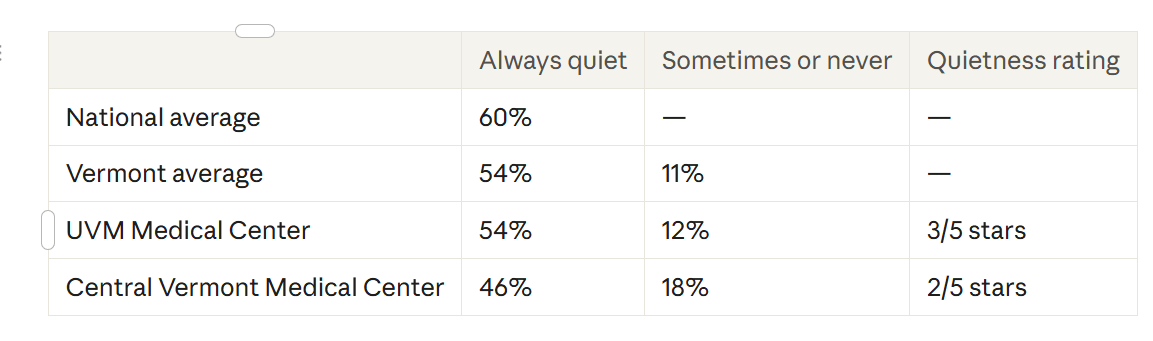
Medicare patient surveys, October 2024–September 2025. Star ratings apply specifically to nighttime quietness, not overall hospital quality. Sources: Medicare hospital data, state averages, national average. The survey question covers all nighttime noise, not just alarms.