


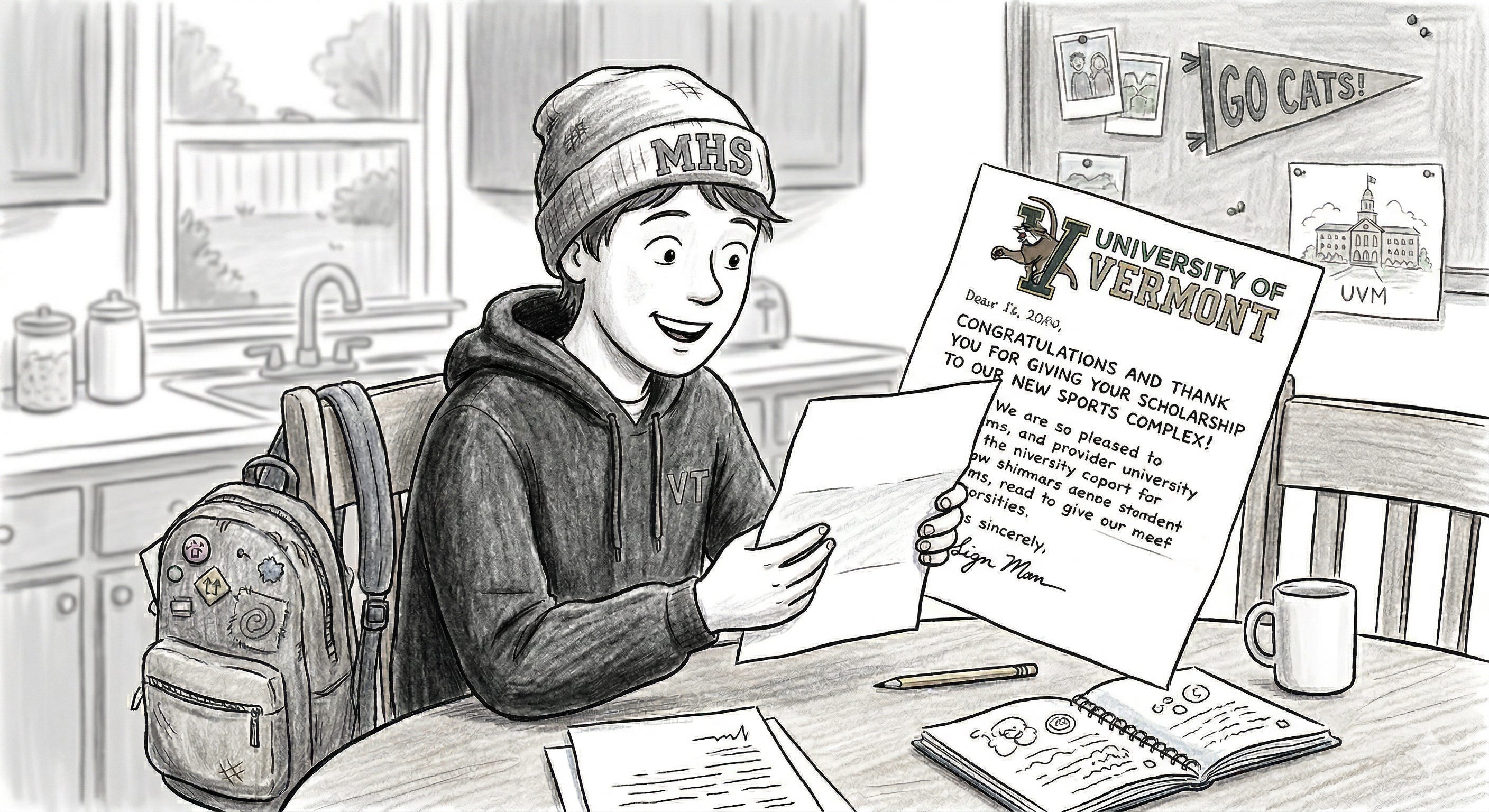
The University of Vermont sits on an endowment of approximately $803 million. It is the state’s second-largest employer, a self-described “Public Ivy,” and an institution that attracts students from 47 states and 28 countries.
It is also a university where fewer than one in four undergraduates is actually from Vermont — the lowest in-state enrollment percentages of any large public university in the country. The University of Virginia pledges to maintain a two-thirds Virginia majority. The University of Maine enrolls 61% in-state students. UVM is at roughly 23%.
And right now, that university is asking the Vermont Legislature to let it take $15 million from a $66 million state scholarship fund so it can put the money toward a campus sports complex.
The fund in question — the Higher Education Endowment Trust Fund — paid for 675 scholarships last year. The average award was $1,400. Nearly three-quarters of the recipients were first-generation college students. The money comes from a simple and poignant source: estate taxes paid when wealthy Vermonters die. The Legislature created the fund in 1999 so that wealth, at the end of a life, could help a young Vermonter start one.
UVM wants to redirect $15 million of that money to help finish a multipurpose athletic center — a project that broke ground in 2019, stalled during COVID, and now needs $100 million more to complete. UVM has already spent $75 million on it.
Governor Phil Scott supports the proposal and included it in his budget. The House stripped the provision from H.951 before passing the bill on March 27. The bill is now before the Senate Appropriations Committee, chaired by Sen. Andrew Perchlik, D-Washington, which is currently taking testimony and is expected to vote on its version of the budget later this month.
What UVM Told the Legislature — and What It Didn’t
UVM President Marlene Tromp made the case to the House Appropriations Committee last month. She argued the facility would attract visitors, boost Burlington’s economy, and make UVM more appealing to prospective students. She argued the $15 million would prevent UVM from needing to raise fees on students to cover the funding gap.
That claim deserves scrutiny.
UVM’s own FY2025 Sourcebook — the university’s official financial reference document — states in a footnote on its tuition and fees page that “In FY 2021 the Board of Trustees approved an increase in the Comprehensive Fee to fund the Multipurpose Center Project.”
The Comprehensive Fee is mandatory. Every full-time UVM student pays it. It is currently being used to fund the same project Tromp told legislators students wouldn’t have to pay for — if only the state would hand over $15 million from its scholarship fund.
Both statements cannot be true at the same time.
Why Can’t UVM’s Alumni Pay for Their Own Gym?
As VTDigger reported last week, Tromp suggested to legislators that the state investment would encourage major donors who have not yet committed to follow suit. Consider what that admission means. UVM is not saying it can’t raise the money. It is saying its donors won’t commit unless Vermont taxpayers go first.
That is not how this works at virtually any other state university in America.
At peer institutions around the country, sports facilities and campus buildings are funded through alumni capital campaigns. That is the standard model. Major donors give lead gifts. The university names the building after them. The public treasury is not typically involved. It is one of the primary ways a university’s graduates give back to the institution — and one of the primary measures of an alumni network’s engagement and loyalty.
The largest single gift in UVM’s 235-year history was $20 million, from the Grossman Family Foundation, established by alumnus Steven Grossman, in 2015. That is a respectable gift. But for a university that markets itself as a “Public Ivy” and claims to produce graduates who go on to remarkable careers, $20 million as the all-time record raises a question nobody in Montpelier appears to be asking: if UVM’s alumni network is as successful and engaged as the institution claims, why can’t it fund its own gym?
Where the Scholarship Money Comes From
The Higher Education Endowment Trust Fund is one of those rare government creations that does exactly what it was designed to do.
Established by the Legislature in 1999, the fund is built primarily from estate tax revenues. Under current law, when estate tax collections exceed 125% of the July forecast in a given fiscal year, the excess is deposited into the fund. The fund also receives money from the state’s collection of unclaimed financial property.
In fiscal year 2025, a single large estate — along with the broader generational wealth transfer — produced more than $55 million in estate tax revenue for Vermont, more than double the previous annual record. Of that, approximately $26.4 million flowed into the trust fund, nearly doubling its balance from roughly $35 million to approximately $66 million.
State Treasurer Mike Pieciak celebrated the milestone in October, noting that the fund had posted an 11.4% return and would distribute a record $2.6 million to support Vermont students. That distribution was split equally among three recipients: UVM, the Vermont State Colleges, and the Vermont Student Assistance Corporation.
VSAC’s Vice President and COO Patrick Leduc was explicit about who the fund serves: “Nearly all students who receive support from the Higher Education Endowment Trust Fund through VSAC are from modest-income households and are the first in their families to pursue education or training after high school — Vermonters who might not otherwise see those opportunities as within reach.”
UVM saw the same windfall from a different angle — not as a chance to help more students, but as an opportunity to fund a building.
What the Law Actually Says
The fund’s enabling statute — 16 V.S.A. § 2885 — spells out two authorized uses.
First, 5% of the fund’s assets may be withdrawn annually and divided equally among UVM, the Vermont State Colleges, and VSAC for student financial aid.
Second, up to 2% of assets may be made available to UVM and the state colleges for endowment purposes — but only if there are matching private donations available.
There is no provision in the statute for capital construction.
The House Education Committee flagged this tension in a February memo. As first reported by VTDigger, the committee called the proposal "well outside" the fund's current purpose. Rep. Robin Scheu, D-Middlebury, who chairs the House Appropriations Committee, told VTDigger the request was "completely unrelated to the uses of the fund — and that's a huge policy shift." Rep. Tom Stevens, D-Waterbury, was more succinct: "I don't like this."
The Permanent Cost
Here is what Vermonters need to understand about endowment math: taking $15 million from the fund’s principal is not a one-time cost. It is a permanent reduction in the fund’s capacity to generate returns for student aid — every year, in perpetuity.
The fund distributes 5% of its assets annually, calculated on a rolling 12-quarter average of market values. Reduce the principal by $15 million and you reduce future annual distributions by approximately $750,000 per year — forever.
At the current average scholarship of $1,400, that is the equivalent of roughly 535 scholarships eliminated. Not for one year. Every year. For students who are, in VSAC’s own words, overwhelmingly from modest-income households and the first in their families to pursue education after high school.
Split three ways, VSAC alone would lose approximately $250,000 per year in distributions — money that goes directly to the neediest Vermont students.
To build a basketball arena.
Compass Vermont asked the Treasurer’s Office and VSAC to confirm the impact on future distributions. Neither responded.
Disney on Ice and the $100 Million Ask
UVM’s arguments for the project are not frivolous. The multipurpose center would seat 5,000 people and host basketball, concerts, lectures, and conferences. UVM’s existing athletic facilities are aging. A modern event venue could bring visitors and economic activity to Burlington.
In testimony to the House, reported by VTDigger, President Tromp recalled her time at Boise State University, where a similar facility hosted community events. “I used to be really proud when we hosted ‘Disney On Ice’ at my last campus, and all those kids and their families would come,” she said. “Because when you set foot on campus, it starts to change the way you think about college. It becomes your place. And we want people to feel like UVM is their place.”
Governor Scott’s Secretary of Administration, Sarah Clark, reiterated support in an April 1 letter to the Senate, which VTDigger reported described the project as an investment in higher education and an economic engine for Vermont.
UVM also argues the fund would still be larger than it was before the estate tax windfall, even after a $15 million withdrawal. That is technically true — the fund would drop from roughly $66 million to roughly $51 million, still above the pre-windfall balance of $35 million.
But that argument treats a one-time windfall as if it were the baseline. The $26.4 million came largely from a single large estate. It is not recurring revenue. The entire point of depositing it into an endowment was to let it generate returns for student aid over decades. Spending nearly 60% of the windfall on a building in the first year defeats the purpose of an endowment.
Not Really a State School
The question of who UVM actually serves is central to this story — and to the question of whether state scholarship money should subsidize its construction projects.
In the late 1990s, about 40% of UVM undergraduates were Vermonters. By the 2022-2023 school year, that had fallen to 23% — the lowest of any spring semester in at least 26 years of university data. UVM’s own accreditation documents acknowledge it has “an unusual profile for a land-grant institution; only about one-third is comprised of in-state students.”
This did not happen by accident. Vermont ranks 49th in the nation in per-capita state spending on higher education. The so-called “Vermont Model” — a conscious policy decision under Republican Governor Deane Davis — deliberately kept direct state aid low. The result is that UVM charges among the highest in-state tuition in the country for a public university, which pushes the school to recruit aggressively out of state.
The Seven Days reported that only 18% of UVM’s most recent first-year class was projected to be Vermonters — actually an increase from the prior year, when the figure was roughly 16%. Overall, only about 6% of UVM’s applicant pool comes from Vermont.
For comparison: the University of Maine enrolls 61% in-state students. The University of New Hampshire enrolls 47%. The University of Virginia pledges two-thirds Virginia residents. UVM is at 23%.
The scholarship fund being raided exists to help Vermont students. UVM primarily serves students from other states. The question writes itself.
A Fund Manager Who Sits on Both Sides
One detail has gone unnoticed in coverage of this proposal. State Treasurer Mike Pieciak manages the Higher Education Endowment Trust Fund. He is also, by statute, a member of the VSAC Board of Directors — the board of one of the three institutions that receives distributions from the fund and would receive less money if $15 million is diverted to UVM’s construction project.
The Treasurer has not publicly taken a position on the proposal.
Compass Vermont asked the Treasurer’s Office whether it supports the proposed withdrawal and how it would affect future distributions. The office did not respond.
What’s at Stake
The Higher Education Endowment Trust Fund exists because the Vermont Legislature decided, in 1999, that when wealthy Vermonters die, some of their wealth should help the next generation go to college. That is a good idea. It has worked. Over 25 years, the fund has distributed more than $30 million in student aid, the vast majority to Vermonters from families where nobody had gone to college before.
Now a university with $803 million of its own money — a university where three out of four undergraduates come from somewhere else — wants $15 million of that fund for a sports complex. A university that already charges its students a mandatory fee for the same project. A university whose president told the Legislature the money would prevent fee increases on students, when the fee increase already happened. A university whose donors won’t step up until taxpayers go first — something that doesn’t happen at state schools where alumni actually feel invested in the institution.
The House said no. The Senate Appropriations Committee is expected to vote on its version of the budget later this month. The question is whether the $15 million will be back on the table when it does.
Editor’s Note, April 10, 2026: In an earlier version of this article, our reportr included quotes from legislators and UVM President Marlene Tromp that were first reported by VTDigger and should have been attributed to their reporting. One passage also presented a VTDigger reporter’s paraphrase of President Tromp’s testimony as a direct quotation, which was inaccurate. The article has been updated to properly attribute VTDigger’s reporting.
The original analysis, data, and conclusions in this article — including the endowment comparison, the scholarship impact calculations, the statutory analysis, the Comprehensive Fee contradiction, and the alumni fundraising comparison — are independently sourced Compass Vermont reporting.
Compass Vermont is reader-supported independent journalism covering Vermont policy, government, and the stories that affect your life. If this reporting was valuable to you, please consider a free or paid subscription to support this work.
......." university is asking the Vermont Legislature to let it take $15 million from a $66 million state scholarship fund so it can put the money toward a campus sports complex."........Another example of "privatize the profits and Socialize the costs".... UVM is loaded. Let them pay for it.