


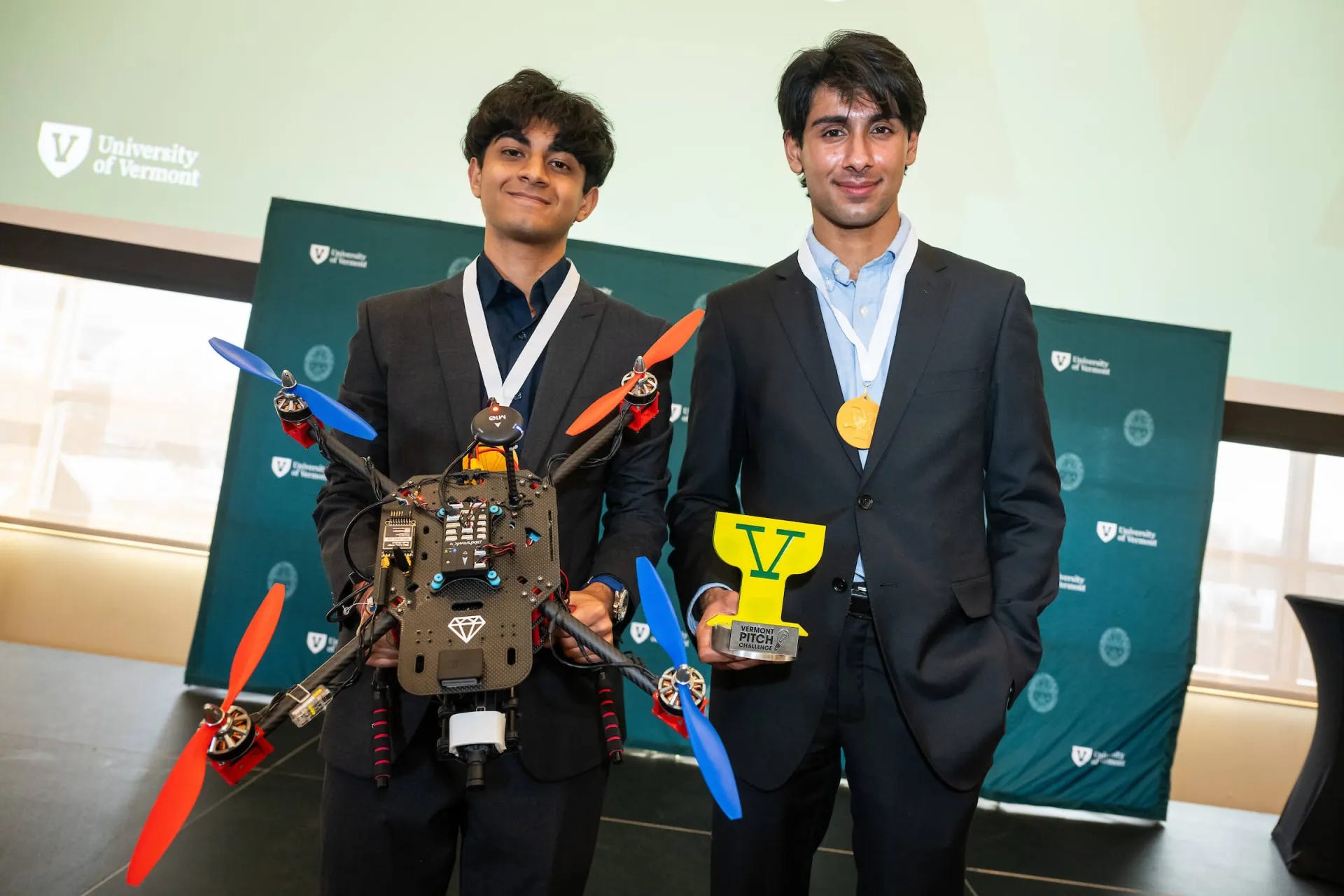
When two high school students from New Jersey stepped onto the stage at UVM’s Davis Center on April 7 and pitched an affordable search and rescue drone kit, they probably didn’t know they were describing a solution to one of Vermont’s most pressing — and least discussed — public safety gaps.
Aarav Upadhyay and Ayden Pinto, from Asbury Park and Englishtown, New Jersey, won the third annual Vermont Pitch Challenge — and with it, full-tuition scholarships to UVM — for their venture called Yevla. The concept: a modular, AI-powered drone kit with thermal imaging and two-way communication that they say can deliver professional-grade search and rescue capability at less than half the cost of traditional enterprise systems.
According to UVM, their pitch beat out more than 100 teams from 24 states. And it landed in a state where the need for exactly this kind of technology has never been greater.
The Problem Yevla Is Trying to Solve
Search and rescue is primarily a volunteer function across the country, and Vermont is no exception. The Vermont State Police Search and Rescue Team has primary operational responsibility for backcountry SAR under the Department of Public Safety, but it partners extensively with volunteer teams, local first responders, ski patrols, Fish & Wildlife wardens, and others to locate and evacuate lost hikers, hunters, skiers, and elderly subjects in some of the most rugged terrain in the Northeast.
Vermont State Police already know drones work. The agency’s Unmanned Aircraft Systems Program deploys drones for search and rescue, flood response, storm damage assessment, crash reconstruction, and crime scene documentation. According to a February 2026 legislative report, roughly 10 Vermont police agencies now use drones, and state police logged 160 drone deployments last year alone.
The problem isn’t whether the technology works. It’s whether teams can afford it.
The DJI Drone Ban Changed Everything
Until late 2025, most law enforcement and SAR teams in the United States relied on drones manufactured by DJI, the Chinese company that controlled roughly 70% of the global consumer drone market. A capable DJI enterprise drone could be purchased for around $7,000 on the high end.
That changed on December 22, 2025, when the Federal Communications Commission added all new foreign-made drones to its national security “Covered List,” effectively blocking new DJI models from receiving FCC equipment authorization — and therefore from being legally imported, marketed, or sold in the United States going forward. Existing DJI drones remain legal to fly, but the pipeline for new equipment is shut off.
The cost impact is immediate and significant. A Vermont State Police sergeant told WCAX that a DJI drone that cost $7,000 on the high end now has to be replaced by a U.S.-made alternative that runs three to four times that price — potentially $21,000 to $28,000 per unit.
For Vermont State Police, with more than 20 drone operators and multiple aircraft platforms positioned across the state, absorbing that cost increase is challenging. For smaller municipal departments and volunteer SAR teams operating on shoestring budgets? It may be prohibitive.
Why This Matters More in Vermont
Vermont’s geography makes drone SAR capability especially critical. Dense forest cover, rugged mountain terrain, flood-prone river valleys, and backcountry that stretches far from paved roads — these are exactly the conditions where thermal-equipped drones can locate people that ground teams cannot.
Private drone SAR operators already serve Vermont. Companies like Vermont Drone and Green Mountain Aerial Solutions offer thermal imaging search services — but at rates of $375 to $675 for the first two hours, with additional hours running $150 to $300 each. That’s a cost structure that reflects the reality of expensive equipment and specialized training. It’s also a cost structure that puts aerial SAR capability out of reach for many of the communities that need it most.
The Vermont Association of Conservation Districts has also invested in enterprise drone technology through a USDA Conservation Innovation Grant, acquiring a Matrice 300 RTK platform with multispectral and thermal sensors. But that system serves agricultural and conservation purposes, not emergency response.
The gap is clear: Vermont needs more affordable drone SAR capability, and the federal government just made affordable harder.
Enter Yevla
This is what makes the Yevla pitch more than a feel-good student entrepreneurship story.
Upadhyay and Pinto say more than 500 U.S. search and rescue teams use drones but most can’t afford professional systems. They can either buy expensive enterprise drones or cheaper consumer models that aren’t built for the field. Yevla’s kit-based approach — modular, with thermal imaging and two-way communication built in — is intended to split the difference.
“We want to use everything that we learned today in order to refine this and get this into the hands of people that need this the most,” Upadhyay told WCAX after the win.
Whether Yevla ultimately delivers on that promise remains to be seen. The venture is early-stage, and the path from pitch competition to functional product serving real SAR teams is long. But the problem they identified is real, the timing is right, and now at least one of the founders will be attending UVM — putting the venture’s development squarely in Vermont.
The Competition Itself
The Vermont Pitch Challenge, now in its third year, is a UVM admissions initiative that functions like a Shark Tank for high schoolers. Students submit business plans online, UVM entrepreneurship students narrow the field, and finalists pitch in person to a panel of judges in Burlington. The first-place team receives full tuition to UVM.
In 5th Place was Elegant Grace Apparel: Naba’a Hussein (South Burlington, VT) — $1,000. A modest fashion boutique serving Vermont’s Muslim community with hijabs, abayas, and everyday modest wear, with a focus on in-person community shopping and sustainability.
Hussein was the lone Vermont finalist — and the only competitor building a business explicitly rooted in the state. Elegant Grace Apparel aims to fill a gap that online retailers can’t: a welcoming, community-centered in-person shopping experience for Vermont’s Muslim community.
“All of these business ideas don’t have the sole purpose of making money,” said Moses Murphy, UVM’s executive director of undergraduate admissions and new student orientation. “They’re really centered on making a positive impact.”
The 2027 Vermont Pitch Challenge opens for submissions in October 2026.
The Bigger Question
Vermont’s SAR infrastructure — like much of its public safety infrastructure — runs on a combination of state resources, volunteer labor, and equipment that agencies can afford to maintain. The federal drone ban just raised the floor on what “affordable” means for one of the most promising technologies in backcountry rescue.
If a pair of high school students can build a drone kit that genuinely delivers professional SAR capability at half the price, that’s not just a good business idea. For a state like Vermont — rural, mountainous, and perpetually budget-constrained — it could be the difference between having aerial search capability and not having it.
The founders are headed to Burlington. The need is right outside the door.
The Vermont Pitch Challenge is hosted by the University of Vermont. More information about Vermont State Police drone operations is available from the UAS Program.