


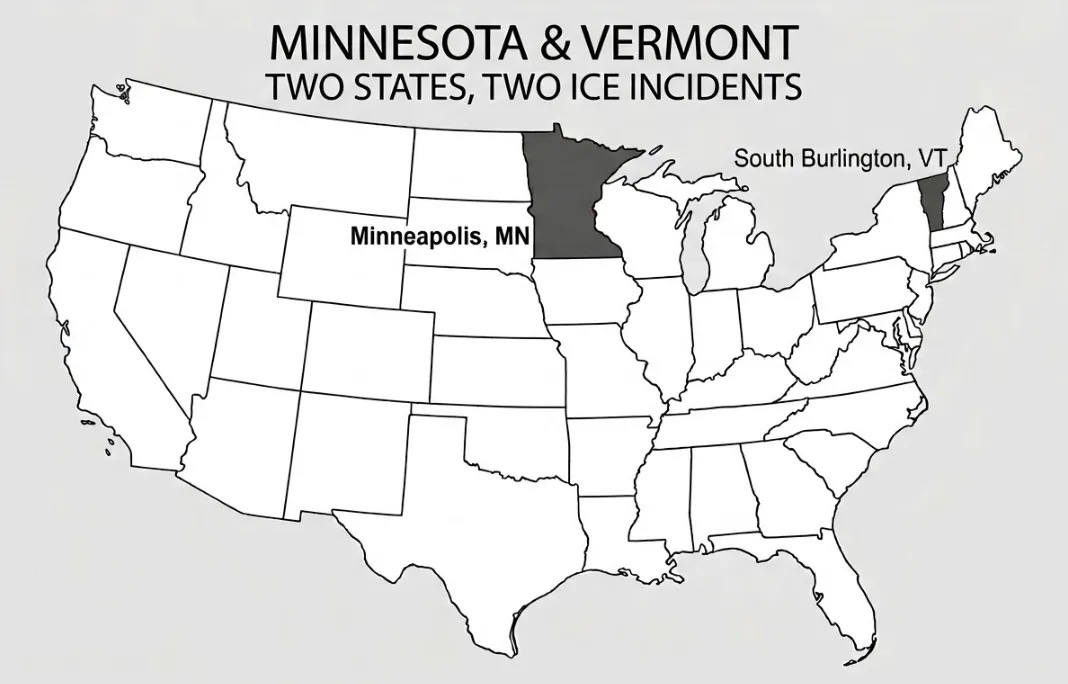
A note on this article: What follows is a factual comparison of two ICE enforcement incidents — one in Minneapolis, Minnesota, and one in South Burlington, Vermont — with a specific focus on the role local and state police played in each. It does not tell you what to conclude. It presents documented facts, sourced throughout, so that Vermont readers can consider both situations and decide for themselves how they feel about them.
The Short Version
Between January 7 and January 24, 2026, two American citizens — Renee Good, 37, and Alex Pretti, 37 — were shot and killed by federal immigration agents during ICE enforcement operations in Minneapolis. A third person was also shot and wounded. Minneapolis police were not cooperating with ICE and were largely absent from the enforcement scenes. The federal force operating in Minnesota numbered approximately 3,000 agents — five times the size of the Minneapolis Police Department.
On March 11, 2026, ICE conducted an enforcement operation at a home on Dorset Street in South Burlington, Vermont. Vermont State Police and local departments from South Burlington, Burlington, Williston, and others responded to the scene and were present throughout the day-long standoff. Chemical munitions were deployed by ICE agents. Eight protesters were temporarily detained and released. One Burlington officer is under review for use of force. No one was shot. No one was killed.
The question this article asks is a simple one: What role did local and state police play in each situation, and what were the outcomes? Readers can form their own view of what, if anything, that comparison means.
Minnesota: A Federal Operation, Without Local Partnership
How It Began
The Trump administration launched Operation Metro Surge in December 2025, deploying a force of roughly 3,000 federal agents — from ICE, Border Patrol (CBP), and other DHS components — into the Minneapolis-St. Paul metro area. The stated purpose was immigration enforcement, with the administration specifically citing the area’s Somali American population. The operation was the largest single deployment of immigration agents in U.S. history to a single city.
Minneapolis had passed a city ordinance in December 2025 barring its police from cooperating with immigration enforcement. Mayor Jacob Frey issued an executive order barring federal agents from operating on city property. Minnesota Governor Tim Walz did not deploy state police to assist ICE operations. The Minneapolis Police Department policy does not allow officers to assist ICE in immigration enforcement actions.
As a result, ICE and Border Patrol agents operated largely without local law enforcement present at their enforcement scenes.
January 7: Renee Good
At approximately 9:30 a.m. on January 7, 2026, ICE agents approached a Honda Pilot driven by Renee Nicole Good, 37, a U.S. citizen and mother of three, on Portland Avenue in south Minneapolis. Good’s vehicle was stopped, blocking traffic. Agents ordered her to exit. Video shows her window was down; she told one agent, “That’s fine dude. I’m not mad at you.” An agent attempted to open her door while another reached through her window. Good reversed slightly, then began to pull away, turning the wheel to the right — away from the agents. ICE agent Jonathan Ross, standing at the front-left of her vehicle, fired three shots through the driver’s window, killing her. Her vehicle had been turning away from him at the time of the shots.
Good was not a target of any immigration action. City officials said she was acting as a legal observer. Her mother said she was simply in the area. No Minneapolis police officers were at the scene when the shooting occurred. After the shots were fired, ICE agents blocked emergency vehicles — ambulances and fire trucks — from reaching Good for approximately 15 minutes, forcing paramedics to walk through ICE vehicles on foot.
Minneapolis Police Chief Brian O’Hara called the killing “predictable and preventable.” Mayor Frey called it “bullshit” that the agent acted in self-defense, stating: “Having seen the video myself, I want to tell everybody directly that is bullshit.” Governor Walz called the shooting “totally predictable and totally avoidable.”
The FBI took over the investigation. The Minnesota Bureau of Criminal Apprehension — the state’s own investigative body — was blocked by federal authorities from accessing case materials.
January 24: Alex Pretti
On January 24, 2026, Border Patrol agents assigned to Operation Metro Surge fatally shot Alex Pretti, 37, a U.S. citizen, ICU nurse at the Minneapolis VA hospital, and lawful gun owner with a valid permit to carry. DHS stated that Pretti approached agents with a firearm and violently resisted when they tried to disarm him. Bystander video showed Pretti holding a cellphone, not a gun, in his outstretched hand. A CNN video analysis appeared to show an agent removing Pretti’s gun from him just before other agents shot him. Two witnesses filed sworn federal court statements saying Pretti did not brandish a weapon. Minneapolis Police Chief O’Hara confirmed Pretti had a lawful permit to carry and no criminal record beyond traffic violations.
No Minneapolis police officers were present at the scene when Pretti was shot. ProPublica identified the two shooters as Border Patrol agent Jesus Ochoa and CBP officer Raymundo Gutierrez, both assigned to Operation Metro Surge. The DOJ Civil Rights Division opened an investigation.
A third person, a Venezuelan man, was shot and wounded in a separate incident in Minneapolis in the same period.
What Minneapolis Police Actually Did
Minneapolis Police were not at ICE enforcement scenes and did not assist with enforcement actions. They were, however, overwhelmed by the aftermath. In the two days after the Renee Good shooting, MPD officers worked more than 3,000 hours of overtime at an estimated cost to taxpayers of more than $2 million — responding to the public safety needs created by the federal operation. Chief O’Hara described the city’s situation as “chaos,” noting that his understaffed department was vastly outnumbered by both federal agents and protesters. Officers were deployed to maintain public order at protest scenes — work the chief distinguished clearly from assisting ICE operations.
Governor Walz activated the Minnesota National Guard not to assist ICE, but to help local police maintain public safety at protest sites. Guard members wore neon reflective vests to distinguish them from federal agents.
On January 12, Minnesota Attorney General Keith Ellison, along with Minneapolis and St. Paul, filed a federal lawsuit against DHS, alleging the operation violated the Tenth Amendment and constituted “commandeering” of local law enforcement resources. The suit alleged federal agents had engaged in “warrantless arrests” and described “a pattern of unlawful conduct.”
Vermont: A Federal Operation, With Local Police Present
How It Began
On the morning of March 11, 2026, ICE agents were surveilling a home at 337 Dorset Street in South Burlington, seeking Deyvi Daniel Corona-Sanchez, a 24-year-old Mexican national who had been deported in 2022, allegedly re-entered the country, and was charged with drunk driving in Middlebury in January 2026. When a car parked outside the home pulled away, an ICE agent — believing one of the occupants was Corona-Sanchez — initiated a pursuit. A multi-vehicle crash followed near South Burlington High School. According to ICE, the driver fled on foot and entered the Dorset Street house. (Migrant Justice has disputed this account, stating that Corona-Sanchez was never at the scene and that the men in the car were driving a vehicle he formerly owned.)
South Burlington Police received no advance notice of the ICE operation and became aware of it only because of the crash. Migrant Justice, a Vermont immigrant advocacy organization, activated its rapid response network, and a crowd of approximately 150 people gathered outside the home to block ICE agents from entering.
The Decision to Deploy State and Local Police
South Burlington Police Chief Bill Breault established a command post at city hall and, according to his March 19 legislative testimony, repeatedly urged his federal counterparts to reconsider executing the warrant that day. ICE officials told Breault: “I have Washington on the phone. They reiterated that we’re moving forward with the plan.”
Breault said he was told ICE intended to execute the warrant “by any means necessary” and that the agency planned to bring additional federal resources from out of state if local police did not assist. Vermont State Police, Burlington Police, Williston Police, the Fish and Wildlife Warden Service, and other agencies responded. Vermont Public’s earlier reporting described the dilemma Vermont law enforcement said they faced: stand aside and allow ICE to act alone, or be present and have some influence over how force was used.
After a roughly nine-hour standoff, a federal judge signed a criminal warrant for Corona-Sanchez. Vermont State Police tactical officers physically cleared protesters from the front door. ICE agents broke down the door with a battering ram and entered the home.
What They Found — and Didn’t Find
Corona-Sanchez was not in the house. The U.S. Attorney for the District of Vermont confirmed this the following morning. The person ICE had been seeking for the entire nine-hour operation had not been present. He remains at large.
Three people who had nothing to do with the warrant were detained: Jisella Johana Patin Patin, 31, an Ecuadorian asylum seeker and mother of two children aged 4 and 8 enrolled in South Burlington schools; her sister Daysi Camila Patin Patin, 20, also an asylum applicant; and Cristian Humberto Jerez Andrade, a Honduran national. All three were detained under civil immigration authority — because the criminal warrant’s subject was never there, the legal basis shifted from criminal enforcement to civil immigration detention, the precise category Vermont’s Fair and Impartial Policing Policy bars local police from facilitating.
What Happened to the Three Detainees
As ICE vehicles attempted to leave at approximately 7 p.m., protesters surrounded them in the street. ICE agents deployed pepper balls, flashbangs, and chemical irritants to disperse the crowd. Eight protesters were detained and released at the scene.
On March 16 — five days after the raid — U.S. District Judge Geoffrey Crawford ordered Johana Patin Patin released on bail. On March 19 — the same day law enforcement officials were testifying before the Vermont Legislature defending the operation — Cristian Jerez Andrade was granted bond and released. Daysi Camila Patin Patin, 20, remained in custody as of publication, with a hearing scheduled for March 20 at the federal court in Burlington.
The Outcomes in Vermont
No one was shot. No one was killed. One Burlington Police officer is under departmental review for use of force against a protester. Vermont State Police and South Burlington Police have opened no internal affairs investigations. Governor Phil Scott, who was not directly involved in the decision to deploy state police, called ICE’s tactics “totally unnecessary” and criticized the agency’s “lack of training, coordination, leadership, and outdated tactics.”
A Direct Comparison
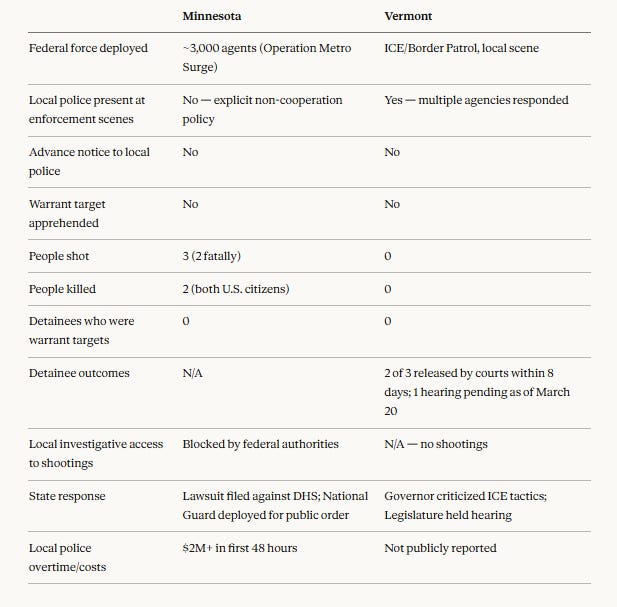
What Is Not Resolved By This Comparison
This comparison does not answer every question Vermonters may have.
It does not resolve whether Vermont police violated the Fair and Impartial Policing Policy. That legal question — centering on whether the criminal warrant’s collapse into civil detentions changed the officers’ obligations — remains contested and is the subject of ongoing legislative review. The Vermont House passed H.849, the Constitutional Accountability Act, on March 12, 97–39, creating a state-level right to sue government officials for civil rights violations; the bill was referred to the Senate Judiciary Committee on March 18, 2026.
It does not establish that the presence of local police caused the better outcome in Vermont, or that their absence caused the worse outcome in Minnesota. Other variables — scale of federal deployment, duration of operations, crowd size, geography, prior community tension — all differ between the two situations.
It does not tell Vermonters whether their local and state police made the right call. South Burlington Police Chief Breault testified that without local police, ICE would have acted more violently on their own. Sen. Tanya Vyhovsky, who was present at the Dorset Street scene for hours, testified that she witnessed state police initiate the first acts of violence. Both accounts are on the public record.
What it does provide is the factual basis for that conversation.
Editor's note: This article originally stated that Daysi Camila Patin Patin had been released. That was incorrect. Her hearing was scheduled for March 20; her status at the time of publication remains in custody. We regret the error and have corrected the article.]
Sources for this article include court documents, Vermont and Minnesota legislative records, statements from elected officials, and reporting from VTDigger, Vermont Public, Seven Days, the Minnesota Reformer, ProPublica, the Minneapolis Star Tribune, MPR News, the Associated Press, CNN, NPR, PBS NewsHour, Al Jazeera, and the City of Minneapolis. Full source links are embedded throughout.
I sincerely hope that the federal government is going to pay for the cost of having Vermont law enforcement officers on scene, as well as the damage they did to this person's home. Unbelievable!