


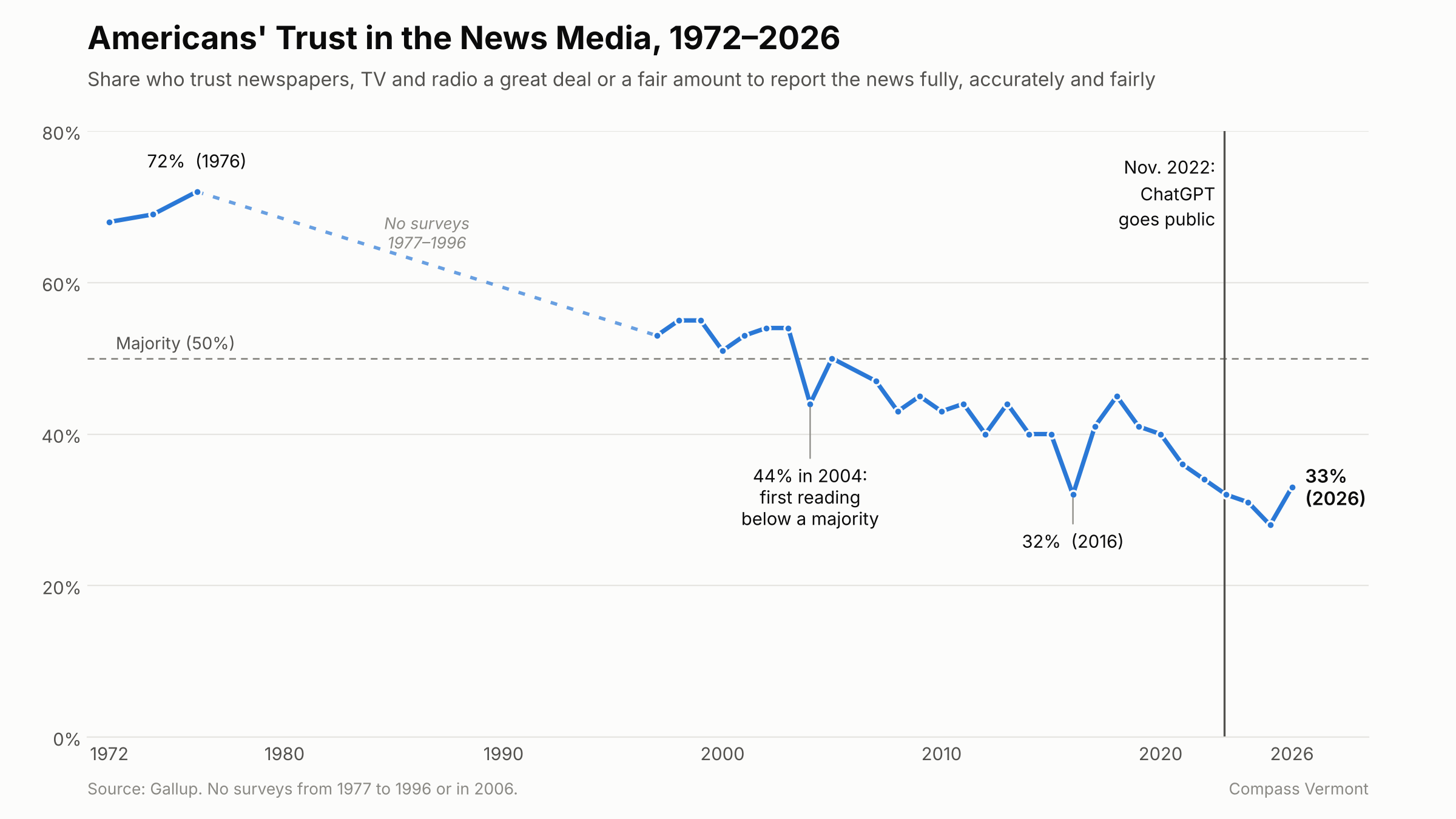
A third of Americans trust the mass media to report the news fully, accurately and fairly. In the 1970s, about seven in 10 did. Nearly all of that trust was gone before any reader had typed a question into a chatbot.
Gallup has asked the same question for more than 50 years. Here is the share of Americans who said they trust newspapers, television and radio a great deal or a fair amount:
1970s: between 68 and 72 percent (Gallup)
1997: 53 percent
2004: 44 percent, the first reading below a majority, and trust has not returned to a majority since
2016: 32 percent, a record low at the time (Gallup)
2022: 34 percent. ChatGPT, the first chatbot most people ever used, went public at the end of November that year
2025: 28 percent, the first time it fell below 30
2026: 33 percent, with another 33 percent saying they have “not very much” trust and 33 percent saying “none at all” (Gallup)
The argument against newer outlets usually goes like this: traditional newsrooms have gatekeepers, the new tools don’t, and trust in news is at risk. The numbers say the risk came first. The new tools didn’t break public trust in news. It was broken before they arrived, and the gatekeepers were in charge the whole time.
Readers didn’t lose faith in a vacuum. They watched stories turn out to be wrong. They noticed coverage that leaned one way, with the quotes lined up on one side. If “trust us, we know better” still worked, two-thirds of the country wouldn’t be saying they don’t.
The Faith Traditional Journalism Asks Readers to Take
Traditional journalism asks readers to take a great deal on faith every day.
Anonymous sources. “People familiar with the matter” and “sources close to the situation” appear in news stories constantly. There are real reasons for that, including protecting whistleblowers who would lose their jobs. But protecting a source doesn’t prove the source said what was reported, and the reader has no way to check.
The reporter’s notebook. A conventional story draws conclusions from interviews and documents the reader never sees. You can’t ask the reporter who else they talked to, what got cut, or where you can read it for yourself.
The letters page. Editors choose which letters to the editor run and which don’t.
What Compass Does Instead
Compass uses digital research tools, the same kind the Wall Street Journal, the New York Times and many other newsrooms now use, to find and read far more public records, budgets, testimony and data than one reporter could get through alone. A person checks what those tools find against the records themselves, and the records are linked in the story so you can read them too.
We show the documents. If a story says a budget went up, the budget is linked. If a story says a statistic was misstated, the original source and what it actually says are linked.
We interview when an interview adds something the records can’t. That might be a decision-maker’s reasoning, a person’s own experience, or a response to what the records show.
We don’t go shopping for quotes when the data already tells the story. A reporter who has the numbers and then goes looking for comment is often looking for someone to say what the reporter wants said. It’s easy to find three voices on one side and one on the other, and the reader comes away thinking that’s the balance of the evidence.
We don’t aggregate. Aggregation is collecting other outlets’ stories and repackaging them. When another outlet has covered something, Compass sometimes goes back to the records to tell the part that wasn’t told, or to tell it more completely. That’s reporting. When we point readers to another outlet’s story, we say so and link it.
When someone shows Compass an error with evidence, the story is corrected and an editor’s note says what changed. The note stays on the story for anyone to see.
Technology Does Not Ensure Balanced Reporting
A link doesn’t guarantee balance, and neither does a research tool. Whoever chooses which documents to show is still making choices, and a fully sourced story can still lean.
That’s because people are involved in every part of a Compass story:
deciding what to cover
choosing which records to pull and what questions to ask of them
checking everything the tools turn up against the original documents
deciding what the story says, what it leaves out, and what the headline says and promises
deciding what gets corrected when a reader shows us something we missed
Every one of those is a human decision, the same way it is at any newsroom. Compass doesn’t claim to have taken judgment out of journalism.
What Compass changes is whether you can see the choices. When the documents are linked, a reader who disagrees with how a story frames them can open them and decide. When the material lives in a reporter’s notebook, that reader is out of luck. Both models ask for trust. Only one lets you check.
Why It’s Worth Paying For
Showing the work costs more. It takes more records, more reading and more time, and it means publishing what the records say even when they don’t fit a tidy story.
That’s what a Compass subscription pays for: the whole picture, laid out so you can make up your own mind.
We hope you’ll consider a paid subscription for our work.