


ANALYSIS — When a Vermont brewery says it's the only one making non-alcoholic beer in-state, the interesting story may not be the beer. It's what the claim quietly admits about the category's economics.
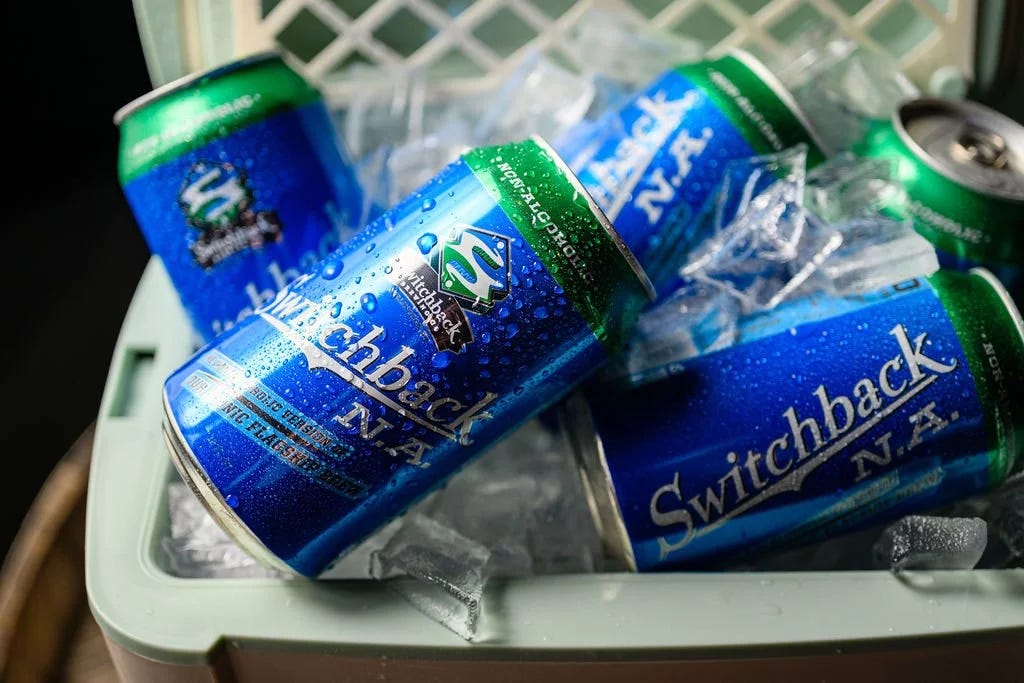
Switchback Brewing Co. spent the early part of this year installing a de-alcoholization system and telling anyone who would listen that it had become the only brewery producing non-alcoholic beer onsite in Vermont. As best Compass can determine, the claim holds. It’s also more revealing than the cheerful press release intends, because it’s true only by a count of one — and it became true precisely because the state’s non-alcoholic pioneer went the other direction.
That tension is the whole story of non-alcoholic beer right now, in Vermont and nationally. The demand is real. But the category is also small, its growth is slowing, it has one dominant player, and it’s flanked by substitutes growing far faster. Which raises a question worth taking seriously before anyone else pours capital into it: if this is such a good bet, why is it so hard to tell?
The demand is genuine — and the base is tiny
Start with what’s true. Americans are moderating. Nearly half — 49 percent — said they planned to drink less in 2025, up from 41 percent in 2024 and 34 percent in 2023, according to NCSolutions, with the share running far higher among younger drinkers (65 percent of Gen Z). The Brewers Association’s State of Non-Alc reports that non-alcoholic beer reached about 2.5 percent of U.S. beer volume in 2025, more than double its 1.1 percent share in 2021. Over five years, volume rose 111 percent and dollars 159 percent. That’s a real trend, not a Dry January novelty.
But note the size of the thing that doubled. At 2.5 percent of volume — or roughly 1.3 percent of total beer by S&D Insights’ measure — non-alcoholic beer is still a sliver. And it isn’t a separate population of teetotalers: more than 90 percent of non-alcoholic buyers also buy alcohol, according to the Adult Non-Alcoholic Beverage Association. This is a behavior layered onto existing drinkers, not a new sober market conjured from nothing.
The growth is slowing, and the industry is saying so
Circana put non-alcoholic beer sales at roughly $583 million for the 52 weeks ending December 28, 2025 — up 22.1 percent in dollars and 23.9 percent in cases, as reported by Beverage Industry. Double digits, still. But the caution is coming from inside the industry, not from skeptics outside it. S&D Insights CEO Brian Sudano notes that despite expanding spend and distribution in 2025, the category grew only about 20 percent, and asks the uncomfortable trio of questions directly: is it losing steam, is new-consumer recruitment slowing, and is the category approaching saturation? He isn’t alone in seeing a step-down — NIQ’s Kaleigh Theriault, who still expects double-digit growth, describes the rate sliding year over year, from roughly 35 percent to 30, 25, and 20 as the base gets bigger. When the analysts tracking a boom start clocking the deceleration, that belongs in the story.
The shelf is filling faster than sales
Here the Brewers Association makes the point better than any critic could. NIQ counted 213 companies producing non-alcoholic brands in 2025, up 134 percent from 91 in 2021, and 484 distinct brands, up 180 percent from 173. The BA’s own read: brand growth has outpaced sales growth, meaning the rush of market entrants doesn’t mean they’ve all found success. Translated, the aisle is filling faster than the register is ringing. A newcomer isn’t paddling into open water — it’s entering a field that already holds 213 producers and 484 brands.
And one player has an outsized lead
Because the water is already occupied. Athletic Brewing holds roughly a fifth of the U.S. non-alcoholic beer market and has driven about a third of the category’s growth, according to NielsenIQ figures the company cites — a number worth flagging as company-supplied. Athletic has poured more than $100 million into brewing capacity and hands out roughly a million samples a year. The top five producers — Athletic, Heineken, Anheuser-Busch InBev, Carlsberg, and Molson Coors — together hold close to half the market, per Global Market Insights. This is a winner-take-most category wearing a craft costume.
The faster-growing threat isn’t another beer
The competition that should worry a would-be non-alcoholic brewer isn’t the next non-alcoholic IPA. It’s everything else competing for the same moderation occasion — and the fastest-growing option has a difference non-alcoholic beer can’t match: it does something, rather than merely removing something.
THC beverages hit an estimated $1.0 to $1.3 billion in U.S. sales in 2024, per Whitney Economics, and NielsenIQ — which only began tracking the category in 2025 — clocked it growing about 135 percent year over year in the latest 52 weeks. Set against non-alcoholic beer’s roughly 20 percent, the gap is stark — even allowing for the fact that THC is growing off a far smaller base, so the percentage spread overstates the real-dollar one. More pointed still, the substitution shows up in behavior, not just intention: nearly 40 percent of drinkers say they also use cannabis, CBD, or THC, and more than 60 percent of those say it directly affects how often they drink alcohol, per Datassential’s January 2026 non-alcoholic beverage report.
The honest caveat, which belongs in the piece because a careful reader will raise it: NielsenIQ frames much of the THC-beverage surge as incremental — new demand rather than a straight swap out of the beer cooler. And the pressure isn’t only cannabis. Circana’s own analysts say the greatest competition to non-alcoholic beer is non-alcoholic wine and spirits, with the mocktail space maturing right behind. The moderation occasion is getting crowded from every direction at once.
So why is anyone still betting on it?
Because there are two different bets here, and one looks a lot smarter than the other.
As a consumer-brand play — launch a can, fight for shelf space, out-market Athletic — the math is brutal: a small category, slowing growth, a dominant incumbent, a flooding shelf, and faster-growing substitutes. As a production-infrastructure play, the logic inverts. When de-alcoholization has advanced far enough that its makers claim their beers win medals and hold up in blind judging against full-strength competitors — a vendor claim from BrewVo’s manufacturer, Sustainable Beverage Technologies, worth some salt — good-tasting non-alcoholic beer starts to look like table stakes rather than a differentiator. And once flavor is no longer the moat, some of the durable value migrates to whoever can produce the stuff well and cheaply — not just to whoever prints the prettiest label.
That’s the bet Switchback appears to be making. But it isn’t a free one, and an honest reader should weigh the other side. The shovel is expensive: Founders Brewing reportedly spent about $3 million to install its own de-alcoholization line, and while Switchback says it managed the cost with a mix of new and used equipment, contract-scale N.A. capacity is a serious capital commitment. That cuts two ways. An asset-light brand — Rescue Club having its beer made under contract at Two Roads, for instance — has no machinery on its books and can pivot or exit fast if the category cools; Switchback will be amortizing a costly system regardless. And in a fiercely proud beer state, a “brewed in Vermont” label may carry a psychological premium that pure scale math misses. Whether Switchback’s shovels-not-six-packs wager pays off depends on execution, not just category logic.
Which brings the national story home to two Vermont breweries that made opposite production choices.
The Vermont tell: two breweries, two directions
As best Compass can determine — and consistent with prior reporting by Seven Days — Vermont’s non-alcoholic beer field comes down to two breweries. Zero Gravity’s Rescue Club, launched in January 2021, was the first non-alcoholic beer from a Vermont brewery. Switchback became the second last year with Switchback N.A., and has since extended its own line with a hop-forward Krush N.A. IPA. From obtainable research, Compass could identify only these two. If another Vermont brewery is making N.A., we haven’t found it — and we’ll update.
Then they split. Zero Gravity, unable to make the margins work in-house and unable to keep up with demand, moved Rescue Club’s production to Two Roads Brewing in Connecticut, according to Seven Days, which reported the beer is still made there. In a fiercely local beer culture, the state’s non-alcoholic pioneer moved production out of state. Switchback went the other way — bringing production in-house on a BrewVo system — and is pitching itself as an East Coast contract producer for other breweries that want into non-alcoholic beer without building the capability themselves.
That second move is the one worth watching. Switchback isn’t only wagering that it can out-velocity Athletic on the shelf; it’s positioning to be a production option for everyone else’s non-alcoholic ambitions — selling shovels in a gold rush where hundreds of companies are already digging and few can do it economically. Whether the contract customers actually materialize is the open question, and the one a follow-up would chase.
All of this is unfolding against a craft-beer market in contraction. Nationally, brewery closings have outpaced openings two years running, and Vermont brewers are bracing for the same squeeze, according to Seven Days. Non-alcoholic beer is a bright spot in a shrinking pie, which is exactly why it draws the press-release enthusiasm.
The category’s boosters are right that the demand is real. The catch is that real demand and a good bet aren’t the same thing. In a small category with slowing growth, a strong incumbent, a crowded shelf, and faster-growing alternatives, the rational play may not be to make another non-alcoholic beer at all. It may be to own the machine everyone else needs to make theirs. To boldly brew, in other words, where others have brewed before — and charge admission.