


ANALYSIS
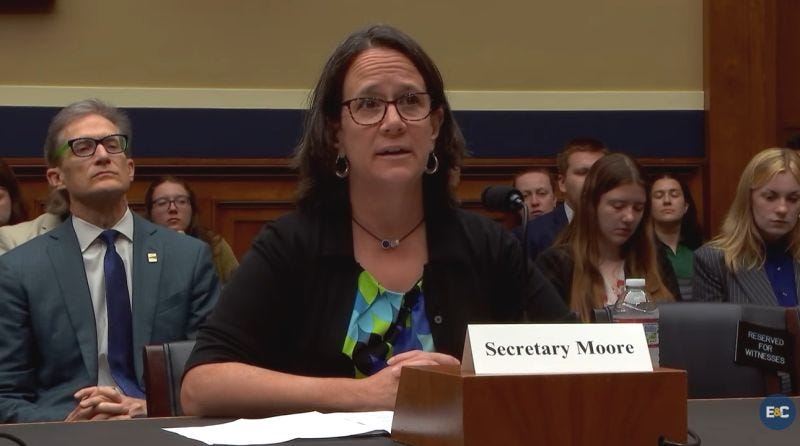
Vermont Agency of Natural Resources Secretary Julie Moore spent nine paragraphs before a congressional subcommittee on Sept. 3 arguing about a drinking water loan fund. She spent two clauses on data centers, in the closing paragraph, prefaced by “before closing, I just want to touch briefly.”
Those two clauses were read as a contradiction of Gov. Phil Scott’s veto of Vermont’s data center bill. They are not.
“The federal proposal I discussed in my testimony and H.727 are different proposals with different scopes and requirements,” Moore told Compass in a written statement this week. “My testimony should not be interpreted as a change in the Scott Administration’s position on H.727 or the reasons Governor Scott vetoed that bill.”
The documents say the same thing. The water protection Moore endorsed in Washington appears nowhere in the bill Scott vetoed — not in the House version, not in the Senate version, not in the one that reached his desk. Both documents have been public since before she testified.
What she went there to do
Moore appeared before the U.S. House Energy and Commerce Subcommittee on Environment not as a data center witness but as vice chair of the water committee at the Environmental Council of the States, the association of environmental agency heads from every state, the District of Columbia and the territories. The subject was reauthorizing the Safe Drinking Water Act.
Nearly all of her testimony concerned the Drinking Water State Revolving Fund — the federal pot that lends states money to fix pipes, wells and treatment plants, with repayments cycling back in to lend again. Moore asked the subcommittee to treat the bill’s $1.126 billion figure as a floor, and made the case with Vermont numbers: project demand this year running at 185% of 2021 levels, loan agreements 255% higher than four years ago.
The money she went to Washington to argue about is money Vermont water systems are already not getting. Congressionally directed spending — earmarks — comes off the top of the fund before states see any of it, which shrinks both the pool available for loan forgiveness and the share states keep to pay the staff who inspect systems, certify operators and help small towns directly. Vermont’s loss runs about $2.3 million a year. That share has paid for asset management plans at the state’s smallest municipal systems and for leak detection that found and fixed leaks totaling more than 115,000 gallons a day.
Moore also described a bind. Communities that need the work most cannot take on more debt, but forgiven loans never return to the fund, and many states will not issue a loan at all if it would push a system’s rates above 1.5% of local median household income. “It feels like a death spiral,” she told the subcommittee.
Then, at the end, the two clauses. She said she supports requiring owners and operators to help pay for the water infrastructure impacts they create, and supports source water vulnerability studies coordinated with states.
What the federal draft does
The bill she was referring to is the Water Cost Accountability Act of 2026, a discussion draft the same subcommittee is weighing. It does two things.
First, it makes a condition of the revolving fund: a state taking a grant must prohibit a public water system from recovering, from any customer other than the data center’s owner or operator, the incremental cost of connecting that data center or of expanding the system’s source, treatment, storage or distribution capacity to serve it. In plain terms — if a data center needs a bigger water main, the data center pays for the bigger water main, not the households on the same system.
Second, it orders EPA to report within 18 months on where data centers get their water, covering facilities that average more than 200,000 gallons a day over any 30-day stretch.
That is a rule about who gets the bill. It creates no permit, mandates no technology, reviews no site. It decides which customer pays for a pipe.
What H.727 contained
Vermont’s bill did none of that.
Its protection against cost-shifting was about electricity. Any data center of 20 megawatts or more would have had to sign a “large load service equity contract” approved by the Public Utility Commission, insulating other ratepayer classes from all costs of the facility’s deployment — new generation, transmission and distribution infrastructure, energy capacity and resource adequacy costs.
Its water provisions did something different:
Required closed-loop cooling, meaning a sealed system that recirculates the same water rather than continuously drawing fresh supply.
Stripped the exemption that lets groundwater withdrawals under 57,600 gallons a day proceed without a permit.
Required a surface water withdrawal permit, with withdrawals halting during drought.
Required every applicable ANR water quality and water resource permit, plus a state water quality certificate.
Required PFAS monitoring and prohibited the addition of PFAS to discharged water.
Triggered additional environmental assessment above 150,000 gallons a day of surface water.
Nothing in the bill addresses what a public water system may charge its other customers. The provision Moore endorsed in Washington is not a weakened version of something in H.727. It is absent from it.
Asked whether ANR or its departments have received any inquiry from a developer about water supply or wastewater capacity for a data center in Vermont, a spokesperson said she did not believe so, and was checking with agency staff.
Scott vetoed the bill May 28. The House fell seven votes short of an override, 83 to 52.
The administration’s position
Moore’s statement placed her comments inside a position the administration says it has held throughout.
“At the federal level, I expressed support for the principle that families and other ratepayers should not be expected to bear infrastructure costs created by a large new water user such as a data center,” she said. She pointed to Kerrick Johnson, commissioner of the Department of Public Service, raising the same concern about electric ratepayers during testimony on H.727. Johnson appeared before the House Committee on Energy and Digital Infrastructure on Feb. 12.
Scott’s veto letter made a broader version of the argument: that Vermont law already provides substantial regulatory authority to prevent harmful impacts, citing Act 250, Public Utility Commission oversight, environmental permitting requirements, energy siting rules and municipal zoning. “The last thing Vermont should do is worsen our economic challenges by adding new and unnecessary regulatory systems,” he wrote.
The letter also proposed a path. If the Legislature wants a data center bill, Scott wrote, it should start with something closer to the version the House passed, with additional and substantial changes to prevent unintended economic consequences in other sectors.
That House version was narrower than what reached his desk. It had no energy transformation payment, no virtual power plant requirement, and a definition of a facility that reached only a single site or adjacent ones. But it carried the same water provisions — the same cooling mandate, the same permitting requirements, the same PFAS prohibition.
On water, the starting point the governor named and the bill he vetoed say nearly the same thing.