



Vermont’s General Assembly did not finally adjourn on Friday, May 8, 2026.
That date had been listed by legislative-session trackers as Vermont’s planned adjournment. The chambers passed it without acting. They took the weekend off under J.R.S.52, a joint resolution relating to weekend adjournment on May 8, 2026. The chambers do not meet again until Tuesday morning.
As of Saturday morning, based on a review of the Legislature’s bill database, no 2026 joint resolution setting a final adjournment date or a veto-session reconvening date had appeared.
The absence of any analogous 2026 resolution at this point is one clear procedural sign that the session’s endpoint remains unsettled. Leadership has not committed in writing to when this session ends or under what conditions it could be called back.
Why It Did Not Happen
The central unresolved issue is H.955, the House’s education transformation package.
Until the Senate produces a version that the House and the governor can both accept, the budget cannot reach the governor’s desk in a form that will be signed, the Yield Bill that sets statewide property tax rates cannot be finalized, and lawmakers cannot go home.
The House passed H.955 on April 17, 2026, on a 79-62 roll-call vote. That margin falls well short of the two-thirds supermajority the House would need to override a veto. Governor Phil Scott has stated repeatedly that the bill, which builds around voluntary district mergers facilitated by seven new Cooperative Educational Service Areas and which delays a new education foundation funding formula from 2028 to 2030, does not go far enough. The Senate now controls what version becomes law.
The Senate Education Committee has held the bill since mid-April. The committee has six members — three Democrats and three Republicans, a structurally even split unusual on a Senate where Democrats hold a 16-13-1 overall margin. Chair Seth Bongartz, D-Bennington, told Vermont Public in March that “reams of testimony” from rural Vermonters had convinced him districts should be permitted to merge voluntarily. “We’re really trying to listen to the needs of rural Vermont, and the notion of losing contact with their district is something that really scares people a lot,” Bongartz said. “I think what we’ve heard a lot of is, ‘Let it happen organically.’”
H.955 appears next on the agenda Tuesday, May 12 at 3:00 p.m., with one staffer — Legislative Counsel Beth St. James — listed and no outside testimony scheduled. Wednesday, Thursday, and Friday afternoons are listed as “TBA.” The committee will be in Room 10 — the larger committee room — all week.
What Is Left
The unfinished business divides into four categories.
There are the must-pass money bills. H.951, the FY27 “Big Bill” state budget at $9.4 billion, passed the Senate April 29 and is heading to a conference committee. Differences include a Senate proposal to draw $15 million from the Higher Education Endowment Trust Fund — including $12 million for the proposed UVM Multipurpose Center — and a $700,000 Read Vermont literacy program funding fight.
Senate Appropriations Chair Andrew Perchlik, D/P-Washington, told VTDigger Friday that the literacy money “has been spent” in the Senate version and that adding it back “makes it a substantial change” of the kind conference committees procedurally are not supposed to make.
H.949, the Yield Bill that sets statewide property tax rates, passed the Senate at a projected 3.8 percent average increase, against a 6.7 percent figure in the version the House had earlier passed. That spread, plus disagreement about how much one-time General Fund money to use to buy down rates this year versus next, will be resolved in conference. H.944 (FY27 Transportation Program) and H.952 (capital construction and state bonding) are also still in motion.
There is the political headliner: H.955, sitting in Senate Education as described above. Resolving it is the gating condition for adjournment.
There are bills that moved this week and now await one more procedural step. Six advanced; the table below summarizes status.
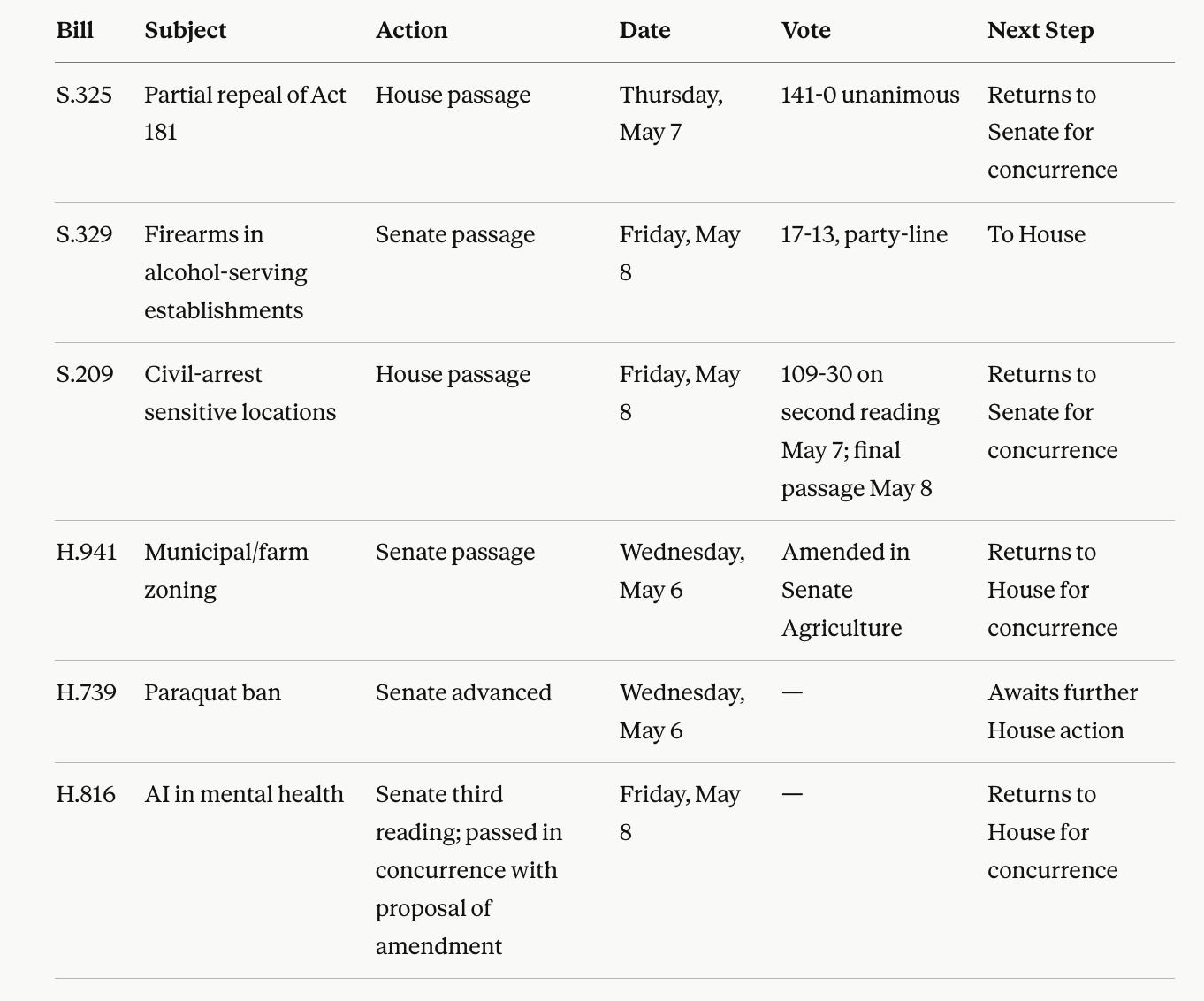
S.325 partially repeals Act 181, eliminating both the “road rule” — which subjected certain road-construction projects to Act 250 review — and the conservation-focused Tier 3 designation. S.329 sponsor Senate President Pro Tempore Phil Baruth, D/P-Chittenden Central, has been pursuing similar legislation as a Burlington charter change since the 2025 session; Governor Scott has previously said he would veto a similar Burlington version.
The S.209 expansion adds public libraries, polling places, healthcare facilities, places of worship, state buildings and offices, social services establishments, licensed children’s camps, and travel to and from school to the locations where civil arrests, which include some immigration arrests, are prohibited in Vermont; courthouses are already protected, and Scott has not said whether he would sign the bill.
H.941 follows a 2025 Vermont Supreme Court ruling, originating in an Essex Junction zoning dispute over backyard ducks and cannabis cultivation, that municipalities could enforce local zoning against farming activities not meeting the state’s required agricultural practices definition.
H.816 — the first Vermont attempt to restrict how mental health professionals may use artificial intelligence with patients — would require the Office of Professional Regulation to issue further rules by January 15, 2027.
Bills in Motion
And there are bills still in motion. H.606, banning machine guns and conversion devices including “Glock switches,” is expected on the Senate floor next week.
H.775, a housing production package, is awaiting a final Senate committee vote. A separate data privacy bill is being finalized in the House Commerce and Economic Development Committee.
S.190, on reference-based pricing and Green Mountain Care Board authority, continues moving through the House and is part of an emerging healthcare cost-containment package alongside S.197 on primary care payment reform and Ways and Means premium-assistance language.
Several smaller bills remain in committee or awaiting final votes, including S.323 on miscellaneous agricultural subjects, H.542 on terminating PCB testing in schools, S.214 on prekindergarten in geographically isolated districts, S.255 on a Windham County law-enforcement governance pilot, S.198 on tobacco regulation and taxation, and H.957 on amendments to the Williston town charter.
One bill was killed this week. Governor Scott vetoed S.218, an act to reduce chloride contamination in state waters by curbing road salt use, on Wednesday, May 6. Scott’s veto letter said the bill could increase liability for municipalities and businesses sued over slip-and-fall injuries. The override math is unfavorable; an override is unlikely.
ANALYSIS: What the Historical Pattern Says About Timing
The historical record offers four reference points for what comes next.
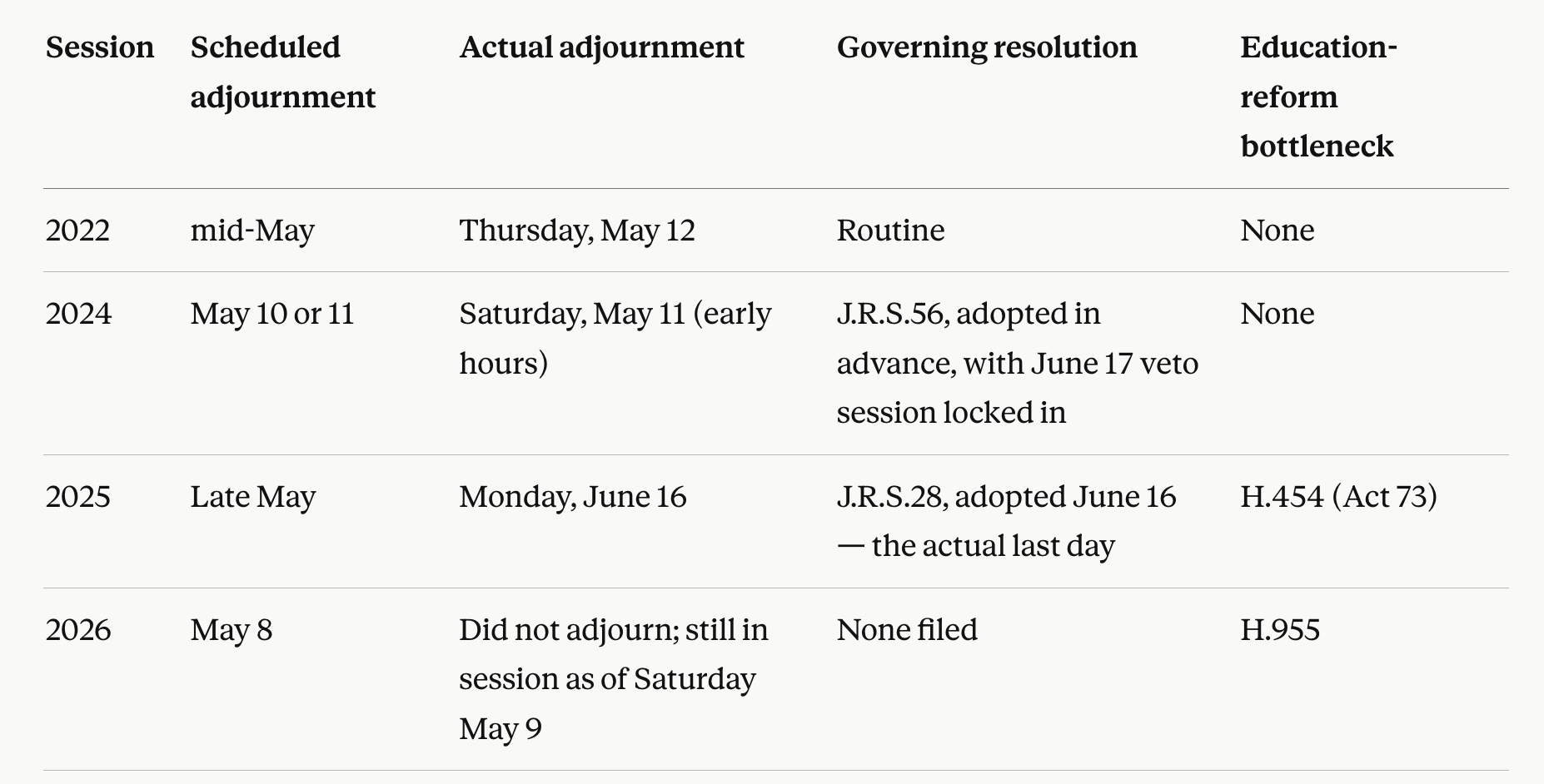
Memorial Day this year falls on Monday, May 25. For final passage of H.955 by Memorial Day, the Senate Education Committee would need to vote out a bill, the Senate would need to schedule second and third readings on different days under regular rules, the bill would need to receive any further committee referrals required, the House would need to either concur in the Senate version or refuse and send the bill to a conference committee, and any conference committee would need to file a report that both chambers then approve.
That path appears procedurally possible if Senate Education votes a bill out by Wednesday or Thursday next week. Each day past that compresses the path.
The harder outer deadline is July 1, the start of the next state fiscal year. Joint Fiscal Office Deputy Fiscal Officer Emily Byrne told House lawmakers Thursday that if there is no enacted budget by July 1, the state government would shut down, with significant uncertainty about which state employees would continue to work, when contractors would be paid, and how Medicaid and SNAP benefits would be administered during the gap. A shutdown could also affect Vermont’s bond rating, increasing future borrowing costs.
What to Watch Next Week
The next substantive action on H.955 is scheduled for Tuesday, May 12, at 3:00 p.m. in Room 10 of the State House, livestreamed at the Senate Education Committee’s YouTube channel. Floor sessions in both chambers begin Tuesday morning under regular rules.
The other indicator worth watching is whether a final adjournment joint resolution gets filed and adopted. The 2025 version (J.R.S.28) and the 2024 version (J.R.S.56) followed the same template: one document setting both an adjournment date and a reconvening provision. A 2026 equivalent has not yet appeared in the bill database.
If H.955 has not cleared Senate Education by the end of next week, Memorial Day final passage is no longer realistic and the session resembles the 2025 timeline more than the 2024 timeline. The reasonable projection from the current record is that final adjournment lands somewhere between late May and mid-June, with a veto session likely on top of that.
Compass Vermont. We bring the data. You form the opinions.
.........."Leadership is the ability of an individual, group, or organization to influence, guide, or inspire others toward the achievement of shared goals. It is a social process involving mindset, behavior, and actions that foster collaboration and trust rather than just holding a position of authority."..........That doesn't sound like Montpelier to me......