


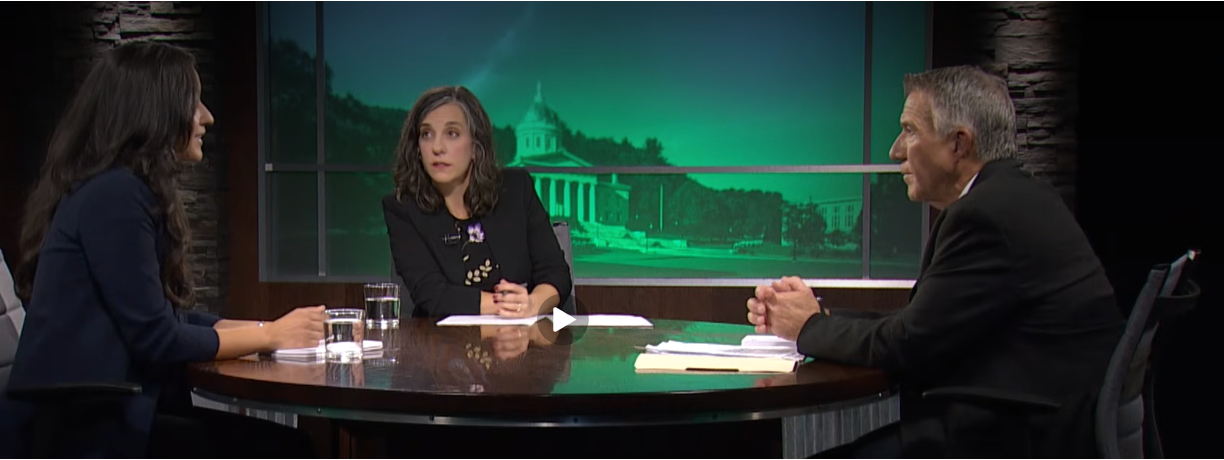
Phil Scott and Amanda Janoo offered competing approaches to Vermont’s affordability problems in the October 21 gubernatorial debate. But many of the changes voters are being asked to consider require agreement from people who were not answering questions at the candidates’ table: Vermont’s lawmakers.
A governor can propose tax relief, education reform, or a new healthcare program. Getting those proposals enacted requires legislative votes. Financing them requires legislative appropriations.
That makes the election a test of more than the candidates for governor. House and Senate candidates are also seeking authority over whether those promises become law, what compromises they require, and when Vermonters might see results.
Their record matters when assessing Scott’s years in office. Their commitments matter when assessing what Janoo could change.
The governor cannot supply the votes
Vermont’s governor has substantial authority to manage the executive branch, propose policies, negotiate legislation, and approve or veto bills. But the office does not carry independent authority to finance an entirely new statewide agenda.
The Vermont Constitution requires legislative appropriations before money can be drawn from the Treasury. Changes to tax statutes and major statutory programs also require legislation.
Janoo’s proposed publicly funded primary-care system would therefore require lawmakers to approve its financing and structure. Scott’s proposed tax changes would face the same legislative requirement.
The Legislature can also proceed over a governor’s objections. An override requires two-thirds of the members present in each chamber.
That distinction matters when assigning responsibility. Some consequential policies became law despite Scott’s opposition. Others reflect agreements he signed. Still others depend on decisions that future lawmakers have yet to make.
Democrats and Progressives have held the numbers
Throughout Scott’s tenure, Democrats and Progressives together have held legislative majorities. During some sessions, their combined membership also exceeded the threshold needed to override a veto with everyone present.
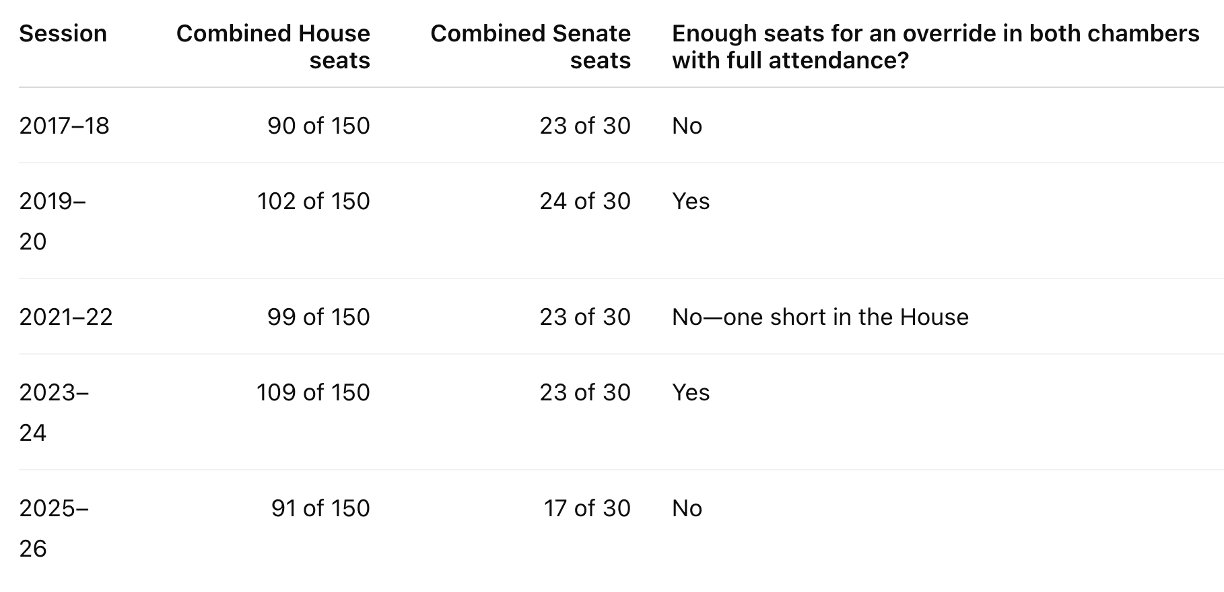
Opening-session figures. House totals are calculated from the House clerk’s historical statistics. Senate totals are supported by contemporaneous composition records for 2017, 2019, 2021, 2023, and the 2025–26 legislative roster. Independents are excluded; cross-endorsed members are counted once.
These figures describe potential voting strength, not unanimous agreement on every bill. Attendance can also change the override threshold.
In January 2025, Representative Troy Headrick changed his affiliation from Progressive to independent, reducing the formal combined House count to 90. His affiliation change does not, by itself, establish a change in voting behavior.
The larger point is that Scott has governed under different political conditions. His ability to stop legislation—and the majority’s need to negotiate with him—has changed.
Lawmakers exercised that power
The 2024 school-property-tax legislation provides a direct example.
Scott vetoed H.887. Lawmakers enacted it anyway, overriding him 103–42 in the House and 22–7 in the Senate.
The bill set education-property-tax yields and rates and changed aspects of education financing. Its enactment was a legislative decision made over the governor’s objection.
That does not make lawmakers the sole source of the underlying education costs. Local school-budget decisions and the statewide financing system also shaped the amount that needed to be raised. It does establish who supplied the votes for that financing decision.
Housing offers another example. Lawmakers overrode Scott’s veto of the 2024 Act 250 legislation, H.687, 107–38 in the House and 21–8 in the Senate.
Whether those policies were effective requires examining their provisions and results. Their enactment establishes that the legislative majority helped determine policy independently of the governor.
Cooperation happened—and left decisions unfinished
The record also contains major agreements.
Scott signed the 2023 HOME Act, which included housing regulatory changes. He signed the education overhaul, H.454, in 2025 and its follow-up, H.955, in June 2026.
Those agreements complicate a blanket assertion that nothing changed or that the branches never worked together. But passing a law and delivering lower costs are different milestones.
The 2026 education law requires a district-merger study process, with recommendations due in September 2027 and votes on recommended mergers scheduled for March 2028.
It also delays major foundation-formula provisions to July 2029, subject to conditions. Those include additional enacted legislation addressing matters such as special education funding, rural sparsity, prekindergarten funding, and existing district obligations.
The next Legislature therefore inherits decisions that neither gubernatorial candidate can settle alone.
Primary care already has a legislative starting point
An existing healthcare agreement also deserves attention.
On June 18, Scott signed Act 173, which states the Legislature’s intent to establish universal primary care and directs work on payment reform and possible approaches to implementation.
The law does not establish Janoo’s proposed system or approve her proposed income-tax financing. It requires additional work, including recommendations due in January 2027.
That gives legislative candidates a specific question: Which financing and delivery arrangements would they actually approve?
Scott’s record also includes rejecting a legislative healthcare approach. He vetoed S.190, concerning reference-based hospital pricing and the Green Mountain Care Board, in June 2026. His stated objection included concern that its approach would distribute anticipated savings too narrowly.
Disagreement runs in both directions. Assessing responsibility requires examining what each branch proposed, accepted, rejected, and implemented.
The other decisions on November’s ballot
A governor can influence priorities, negotiations, and the administration of state government. Electing a different governor can change those priorities substantially.
But legislative candidates are also seeking authority over the taxes, spending, and statutory changes needed to carry out an affordability agenda.
For voters, the useful questions extend beyond whether a candidate supports more housing, stronger schools, or accessible healthcare. What would the candidate vote for? How would it be paid for? What compromises would be acceptable? When should results become measurable?
Whoever wins the governorship will face those questions in January. The lawmakers elected alongside that governor will help determine the answers.