


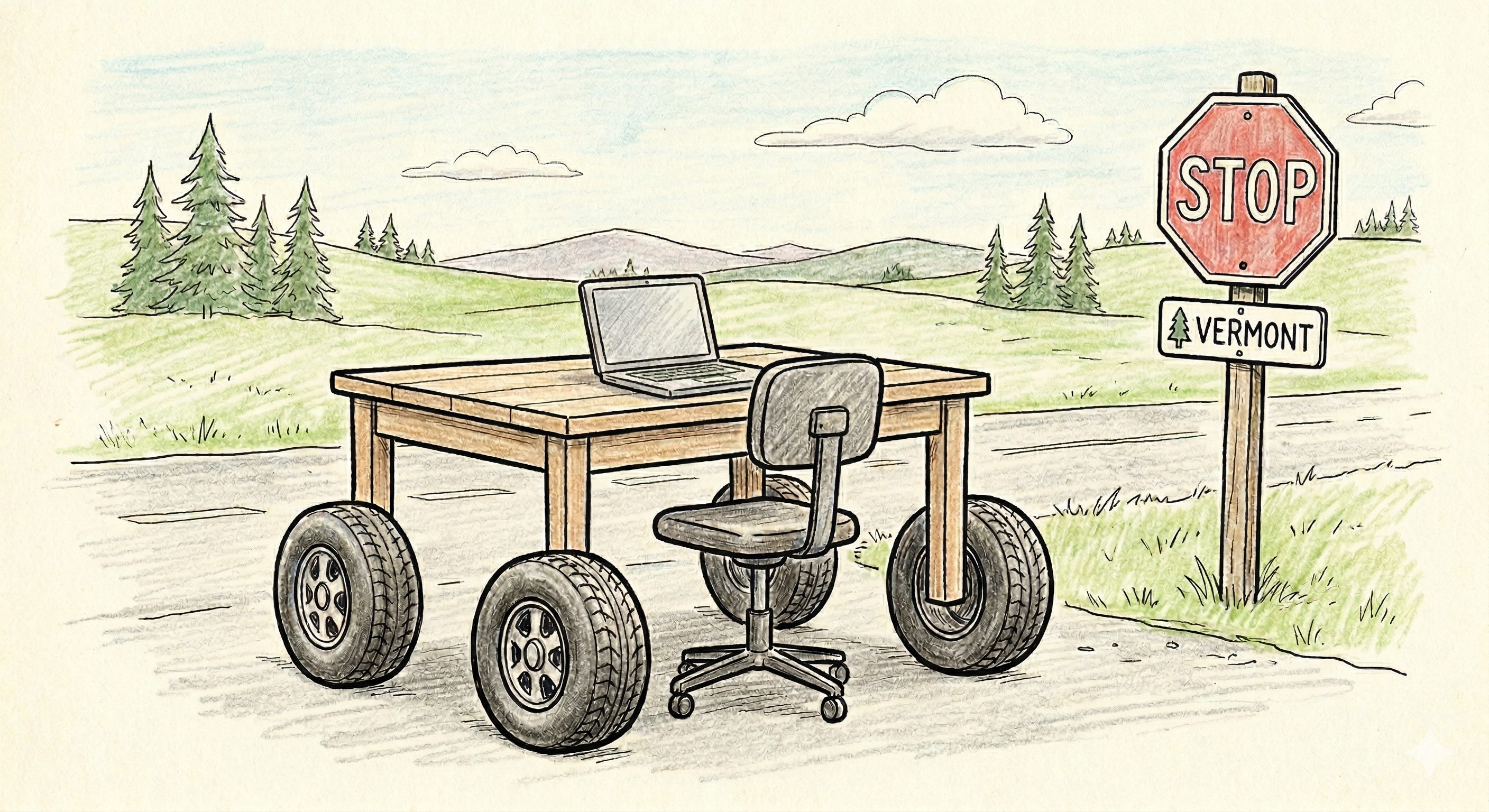
As of April 2, 2026, according to Governor Scott’s statement, roughly 3,000 Vermont state employees are still coming into their offices three days a week. The Vermont Labor Relations Board ruled April 1 that they don’t have to. Governor Scott said he expects a stay, so nothing has changed yet — and the mandate remains in effect unless and until the Vermont Supreme Court or the board rules otherwise on the stay request.
The appeal asks the court to resolve a legal question: did Scott have the right to issue the mandate without collective bargaining? It will not resolve the more important question: was the mandate actually good for Vermont?
The administration has not publicly released productivity data to justify the mandate. That gap — between what was argued and what was never measured — is what Vermont taxpayers are now funding a Supreme Court appeal to resolve.
What the fight is actually about
Strip away the legal procedural arguments and two positions remain.
Scott’s position, as stated repeatedly by his administration: state employees should be in their offices at least three days a week because in-person work improves collaboration, preserves institutional knowledge, and makes government more accessible to Vermonters.
The union’s position, as stated in its VLRB filings: the pre-December status quo should be restored — meaning individual department heads make telework decisions case by case, as they did before the mandate took effect.
Both positions have merit. Neither is grounded in data about Vermont’s specific workforce. And the research literature has reached a fairly consistent conclusion — one that neither side is proposing.
What the research actually says
The Bureau of Labor Statistics published research in October 2024 finding a statistically significant positive association between remote work and total factor productivity across 61 private-sector industries — roughly a 0.08 percentage point productivity gain for every one percentage point increase in remote workers.
A 2025 peer-reviewed study by economists Fenizia and Kirchmaier, examining government workers processing crime cases, found a 12% productivity boost for roles with clear, measurable outputs when performed remotely, driven by fewer interruptions and more personalized work environments. Notably, that study focused on government workers — not tech employees or private sector knowledge workers — making it directly relevant to the Vermont debate.
Scott’s instinct about in-person work isn’t entirely wrong either. A 2021 study published in Nature Human Behaviour tracking approximately 61,000 Microsoft employees found that fully remote work causes professional networks to become more siloed, with employees forming fewer new connections outside their immediate team — a finding with real implications for mentorship, institutional knowledge, and the kind of cross-agency collaboration Vermont’s administration says it values.
So remote work is associated with higher individual output. Full remote hurts professional networks. Both findings are real. They point in the same direction: toward structured hybrid arrangements tailored to job type — not toward either blanket position in this dispute.
The most striking evidence for that conclusion comes from Gallup’s ongoing research, which reveals a paradox that cuts against both sides. Fully remote workers report higher engagement than any other group — 31%, compared to 23% for hybrid workers and 19% for fully on-site workers. Yet those same fully remote workers are less likely to be thriving in their lives overall — 36% — compared to hybrid workers at 42%. They also report higher rates of loneliness and lower overall life satisfaction. The highest engagement and wellbeing scores, taken together, belong to hybrid workers. Not remote. Not in-office.
Stanford economist Nicholas Bloom, whose randomized experiments on remote and hybrid work span more than a decade, has consistently found hybrid schedules produce output equivalent to or greater than full in-office work across a wide range of job types. The weight of the research is not that remote work wins or that offices win. It is that the question itself is wrong. Job type, structure, and management quality matter far more than location.
What the board actually ruled — and what it found
The dispute began in the fall of 2025 when Scott’s administration formally notified the Vermont State Employees’ Association in September that beginning December 1, roughly 3,000 state employees would be required to return to their designated offices at least three days per week. The union filed a complaint with the VLRB on November 10.
In a 60-page decision issued April 1, the board found the state had “refused to bargain in good faith,” ruling that telework is a mandatory subject of bargaining under the State Employees Labor Relations Act and that unilateral imposition while under a duty to bargain is a per se violation.
The board’s finding went further than a procedural ruling. Vermont’s existing telework policy — negotiated with the union — explicitly delegated authority over remote work decisions to individual department heads and agency secretaries, not to the Governor. By issuing a blanket mandate, Scott effectively bypassed not just the collective bargaining process but his own department heads, centralizing a decision the existing policy had deliberately kept at the department level.
Vermont’s workforce makes the blanket mandate especially blunt
Vermont’s state executive branch employs roughly 8,500 people — the FY2025 Workforce Report documents 8,661 total executive branch employees — across agencies that range from the Department of Public Safety to the Agency of Human Services to the Department of Environmental Conservation. Some of those jobs are genuinely public-facing — a DMV counter, a child protective services field visit, a state police patrol. Those jobs cannot be done remotely and were not the target of the mandate.
The 3,000 employees the mandate actually affected are desk workers — human services administrators, environmental regulators, financial analysts, IT staff, program coordinators. Vermont’s own FY2025 Workforce Report shows the classified executive branch workforce is approximately 52.5% female, concentrated heavily in human services and administrative roles. Research by Vermont’s Public Assets Institute found that women fill roughly three-quarters of Vermont’s jobs in human services, healthcare, office administration, and social services — precisely the desk-based positions most amenable to remote work.
For these jobs — focused, individual, output-measurable — the research consistently favors remote or hybrid flexibility. The Gallup finding that fully remote workers report higher loneliness and lower life satisfaction than hybrid workers points toward the same conclusion: the answer is not full remote, it is structured hybrid — which is precisely what neither side proposed.
The gender stat that doesn’t mean what it was claimed to mean
During the dispute, the union cited survey data showing 67% of employees affected by the mandate were female or nonbinary — framing it as a gender equity concern, according to VSEA survey data cited in Vermont Labor Relations Board proceedings. The figure was reported uncritically by some of Vermont’s major news outlets.
But Vermont’s own FY2025 Workforce Report shows the classified executive branch workforce is already approximately 52.5% female. And Vermont’s workforce is heavily occupationally segregated, with women filling roughly three-quarters of human services, healthcare, office administration, and social work roles, according to the Public Assets Institute — precisely the desk-based positions most amenable to remote work.
The 67% figure, measured against a 52.5% baseline, represents a gap of roughly 14-15 percentage points. That gap is more simply explained by the fact that women disproportionately hold the kinds of jobs that can be done remotely than by any discriminatory intent in the mandate’s design. The stat, as presented without its baseline, was advocacy dressed as analysis. None of Vermont’s major news outlets noted the missing context.
What the public sector research specifically shows
Vermont is not alone in this fight. Texas, Nebraska, and California have all grappled with state employee RTO mandates, with mixed results, according to VTDigger reporting. What the public sector research consistently shows is that the stakes are higher for government employers than private ones.
The federal Office of Personnel Management found, as cited in a GAO report, that remote job announcements at federal agencies received 366 applications on average, compared to 51 for non-remote postings for similar positions — a seven-to-one ratio in applicant interest. At the state and local government level, 67% of HR leaders report that hybrid work improves both productivity and recruiting, according to 2025 data from the Public Sector HR Association. Vermont already struggles to fill state positions — its vacancy rate was 9.5% as of FY2025, with some departments significantly higher, according to the FY2025 Workforce Report. A mandate that drives away qualified applicants compounds a problem Scott’s own workforce data already documents.
University of Pittsburgh research analyzing millions of LinkedIn employment histories found that return-to-office mandates produce higher turnover specifically among women, highly skilled workers, and senior tenured employees. Those are not the employees any government can afford to lose.
The cost question — and who created it
Scott has warned that taxpayers could face significant costs if the ruling stands — commuting reimbursements, child care expenses, and other losses incurred since December. According to the board’s ruling, that liability exists because his administration implemented a major change to working conditions without following the collective bargaining process Vermont law requires.
The state had already committed to a five-year, $2.3 million lease for 22,000 square feet of office space at the Pilgrim Park complex in Waterbury to accommodate the returning workforce, according to lease documents reviewed by VTDigger — space that may now sit empty. The mandate also created an impossible compliance problem for the roughly 753 state employees who lived outside Vermont as of late 2025, some of whom had been hired during the pandemic as explicitly fully remote workers and some of whom lived as far away as California. The board’s order to reimburse workers for “any monetary losses” covers this population as well, and the potential restitution liability remains unquantified.
The state has filed a notice of appeal with the Vermont Supreme Court and requested a stay while the appeal proceeds.
The question nobody is litigating
The Vermont Supreme Court appeal asks whether Scott had the legal authority to issue his mandate without bargaining. It will not answer whether the mandate was wise, effective, or worth its cost.
That second question — the one that actually matters for Vermont taxpayers and state services — remains entirely unaddressed. The administration has not publicly released productivity data to justify the mandate. The union’s primary evidence was a survey of state employees asking whether they preferred remote work — a survey whose results were never seriously in doubt given who was asked. The VLRB’s 60-page decision found the administration’s justifications unconvincing.
Both sides spent months arguing about process. Neither side proposed what the research recommends: sit down, define which jobs require in-person presence and why, negotiate a structured hybrid framework job category by job category, measure outcomes, and adjust.
That approach would have been harder than issuing a mandate. It also would not have cost $2.3 million in office leases, according to lease documents reviewed by VTDigger, an unknown amount in employee restitution, and whatever the Supreme Court appeal ultimately runs.
What comes next
If Scott gets his stay — which he expects — the three-day mandate remains in effect while the Supreme Court considers the case. If the stay is denied, employees revert to the pre-December patchwork of department-by-department decisions.
Either way, the underlying policy question is unresolved. Vermont’s state workforce will eventually need a telework framework — one negotiated in good faith, grounded in job-specific data, and built around what actually produces good government services.
The research on how to get there is not hard to find. It has been sitting in the Bureau of Labor Statistics, the Government Accountability Office, and the Stanford economics department, available to anyone willing to read it before issuing a mandate.
Compass Vermont is an independent, reader-supported news outlet. If this kind of accountability reporting matters to you, please consider subscribing or making a contribution.
I think these stats about loneliness in remote workers are largely qualitative and shouldn't be part of the discussion.
Also keep in mind, this is Vermont. Many state employees would have to move closer to Montpelier to be able to reasonably commute in the winter, and this area simply does not have the housing for all of these employees.
Here is an alternative article for those interested in this issue.
https://thehill.com/opinion/technology/5829206-scott-administration-telework-fiasco/