


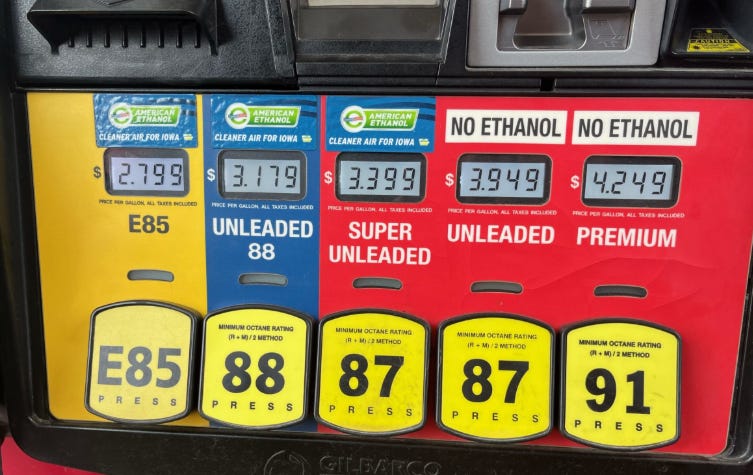
The EPA issued an emergency fuel waiver on March 25 allowing nationwide summer sales of E15 — gasoline blended with 15 percent ethanol, up from the standard 10 percent at most pumps.
The move takes effect May 1 and is designed to ease gas prices that have surged since the Iran conflict disrupted global oil markets and closed the Strait of Hormuz.
You’re unlikely to find E15 at your local Vermont gas station — no public E15 pumps are currently mapped in the state. But if you’re driving through New York, the Midwest, or anywhere the blend is sold at more than 3,000 stations nationwide, you’ll encounter it. And what you pump matters — especially if you’re towing a boat, hauling a mower in the truck bed, or driving an older vehicle.
What’s Actually Happening
Under normal summer rules, E15 is restricted in about half the country because higher ethanol blends increase evaporative emissions that contribute to smog. Every summer since 2022, the EPA has used emergency waivers to override that restriction. This is the fifth consecutive year. Congress has yet to pass a permanent fix.
The waiver initially runs 20 days — the legal maximum — but the EPA is expected to renew it on a rolling basis through the summer driving season.
Who Benefits
The waiver is framed as consumer relief, but the loudest applause comes from corn country. Ethanol is made from corn, and permanent year-round E15 sales would increase domestic corn demand by roughly 2.4 billion bushels a year, according to the American Farm Bureau. Every major agriculture trade group issued statements supporting the waiver within hours of the announcement.
E15 currently sells at an average discount of about 28 cents per gallon compared to regular gasoline, according to the Renewable Fuels Association. That’s real money at the pump — but it comes with a footnote the industry statements don’t mention.
Ethanol contains roughly a third less energy per gallon than gasoline. Increasing the blend from 10 to 15 percent reduces fuel economy by an estimated 1.7 to 2 percent. At $4.00 per gallon, that efficiency loss costs the equivalent of about 7 cents per gallon in reduced mileage. At the current 28-cent discount, most drivers of compatible modern vehicles still come out ahead — but the savings are smaller than the sticker price suggests. If the discount narrows below about 8 cents, E15 actually costs more per mile than E10.
There’s a broader trade-off, too. A University of Minnesota professor told PBS that diverting more corn to ethanol means less available for animal feed — potentially trading lower costs at the pump for higher costs at the grocery store. Whether the ledger nets out as a benefit for consumers is, as he put it, “difficult to see.”
What It Can Damage
Your car — maybe. The EPA approves E15 for all vehicles from model year 2001 and newer, covering more than 95 percent of cars on the road. Most major manufacturers — Ford (2013+), GM (2012+), Toyota and Honda (recent models) — have followed suit. Subaru, Vermont’s most popular brand, began approving E15 for some models starting in 2019, including the Ascent, Crosstrek, and Impreza. But older Subarus carry an explicit manufacturer warning against E15 use. Check your owner’s manual before you pump.
Your boat, mower, snowmobile, or chainsaw — definitely. This is the part that matters most for Vermonters heading out of state with equipment in tow. The Outdoor Power Equipment Institute says it is illegal to use E15 in lawnmowers, chainsaws, leaf blowers, and snow throwers. These engines can’t adjust for ethanol’s oxygen content and can overheat and fail. The National Marine Manufacturers Association warns that E15 can cause vapor lock, fuel tank corrosion, and phase separation in boat engines — where water and ethanol bond and sink to the bottom of the tank, leaving low-octane gasoline on top. Snowmobiles and ATVs face the same risks. No manufacturer covers E15 damage in these engines.
What to Do
Look for the orange-and-black EPA label at the pump. If it says “Contains up to 15% ethanol,” make sure your vehicle is approved before you fill up.
Never put E15 in a boat, mower, snowmobile, ATV, or chainsaw. Carry a fuel can with E10 or ethanol-free gas if you’re traveling with equipment.
If you’re filling a vehicle that sits for long stretches between uses, ethanol-free gasoline remains the safer choice. Ethanol attracts water, and higher blends increase the risk of phase separation during storage. Several Vermont retailers — including Stewart’s Shops and select Maplefields locations — continue to offer ethanol-free premium.
The pump price discount on E15 is real but not as large as it looks. Do the math for your vehicle before making it a habit.
The EPA’s emergency fuel waiver takes effect May 1, 2026, with an initial 20-day authorization. Extensions are expected through the summer.
Great Article Compass. Hopefully, people will pay attention....