


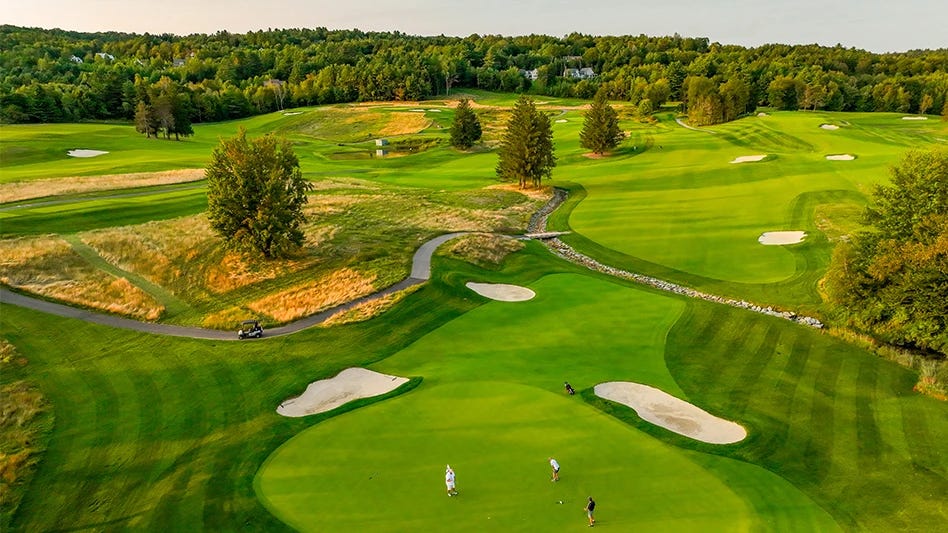
For most of its life, Stowe Country Club was a public-access course. Public listings show it open to the public and bookable online — one traveler noted it was the only course in the area they could reserve online while planning a vacation.
In 2021, GolfPass’s Golf Advisor list ranked it 17th in the country for pace of play — a public-course virtue if there ever was one.
This summer, that course comes back rebuilt. By the club’s own account, it also comes back private.
Two years of rebuilding
Stowe Country Club has completed a multi-year, full-course redesign led by Beau Welling Design, the firm headed by architect Beau Welling. The club says the work broke ground in May 2024 and ran in two phases — the front nine first, the back nine through 2025 — with the full 18 opening for the 2026 season and the back nine set to open around July 10. According to the club, the redesign reimagined all 18 holes: greens and tees rebuilt, fairways reshaped and regraded, bunkers reconstructed with the Better Billy Bunker system, a complete re-grassing to bentgrass with a Kentucky bluegrass-and-fescue rough, expanded fescue landscapes, a long-term tree plan, and upgraded irrigation and drainage. The club also built a new golf facilities area and named Kevin Komer its director of agronomy. Its stated design priorities: walkability, sustainability, and playability for all levels.
The design language is deliberate. Welling has framed the goal as a course that stays true to its setting while giving players more variety and flexibility — approachable for all ages and abilities, with a challenge held in reserve for stronger golfers. That is the modern-redesign approach: more tee options, strategy over penalty, so a beginner can finish a round and a strong player still gets tested. In short, the course was rebuilt to play more forgiving. LINKS Magazine named it one of nine notable American redesigns since 2020.
A private members’ club
The harder-to-get-onto part is the business model underneath it.
The club now describes itself, in its own words on its guest-play page, as “a private members’ club.” General manager Michael Harger says the model is already running: the club reports welcoming more than 200 new members across Stowe Country Club and the affiliated Club at Spruce Peak since the transformation was announced.
For a non-member, the open, book-online public tee sheet no longer appears. In its place, the club’s guest page lays out two routes. One is to request a spot through what the club calls its Unaccompanied Guest Play program — a very limited number of tee times, the page says, granted at the club’s discretion after a review by its golf staff. The other, which the club presents as the more reliable way in, is a qualifying stay at the Lodge at Spruce Peak. During the 2025 construction season, the club offered temporary “public preview play” on the redesigned front nine — billed in its own materials as a preview of what would become a private experience. Based on the club’s current posted rules, a non-member can no longer simply book a round at Stowe Country Club; they can request a discretionary guest time or qualify through a resort stay.
The redesign is one piece of a larger private-club build. The club’s completion announcement identifies the course’s owner as the Mt. Mansfield Company, the developer behind the Spruce Peak resort community, and the golf work sits alongside a new clubhouse, practice facility, racquet sports, aquatics and a planned residential community. The company pairs the redesigned village course with its existing Mountain Course at Spruce Peak — a separate Bob Cupp design on the mountain that has long been limited to members and resort guests — giving members a two-course, 36-hole club. What is new is that Stowe Country Club, the one down in the village, is being folded into that same private model.
The club frames the new era as a gathering place. Announcing the finished course, Mt. Mansfield president Sam Gaines described it as somewhere “members, guests, and local residents can gather” to enjoy the landscape and the game. The club’s own guest page describes what that gathering looks like for a local resident who is not a member: an online request form for a discretionary, limited guest time, or access tied to a paid stay at the resort.
The course opened in 1950, a nine-hole layout designed by William F. Mitchell and built by local lodge owners hoping to draw summer business to Stowe, on the grounds of the former Le Liberté dairy farm. It grew to 18 holes in 1962, expanded by Walter Barcomb, and today it is owned by the Mt. Mansfield Company. From that first summer until it closed for its two-year rebuild, it operated as a public course.
Which generation the third era is built for is the question the reopening leaves open. By the club’s own account and its designer’s, the redesigned course is more forgiving for a newcomer and more testing for a strong player. It is also, for the first time since it opened in 1950, a course a non-member cannot simply book — access now runs through membership, invitation, a discretionary guest approval, or a qualifying resort stay.
Just went to their web site to see how much for membership. Not listed. Have to inquire through e-mail. lol! Why not show the price???