


Kalshi, the betting site regulated as a federal exchange, is marketing a new kind of winter protection to ski-town businesses: a bet that Stowe Mountain Resort won’t get much snow before Christmas.
Kalshi is a prediction market. People buy contracts that pay $1 if something happens and nothing if it doesn’t. The price, in cents, works out to roughly the crowd’s odds. Kalshi’s Stowe market asks how much snow the resort will record by Dec. 24. Kalshi says a lodging owner or restaurant can use it as a hedge, a bet placed to offset a loss somewhere else.
In a marketing email this week, Kalshi pointed to Adam Farr, who runs Ascend Properties, a vacation-rental manager in Big Sky, Montana. According to Kalshi, Farr bet “No” on Big Sky getting more than 55 inches of snow before Christmas. If the season starts slow, the bet pays and offsets lost bookings. If it snows, he loses the bet, which Kalshi called “a cheap risk management tool.” The email closed by noting the same market is live for Stowe.
Why a slow start matters in Stowe
Christmas week, New Year’s week and the Presidents Day holiday are typically Stowe’s busiest stretches, according to the Stowe Reporter. In the thin-snow winter of 2015-16, skier and rider visits fell 18 to 20 percent for the season. That happened even though snowmaking kept dozens of trails open top to bottom all season.
When the mountain loses visitors, the inns, rental managers and restaurants down Mountain Road lose them too. That is the risk Kalshi is selling against.
How the Stowe bet works
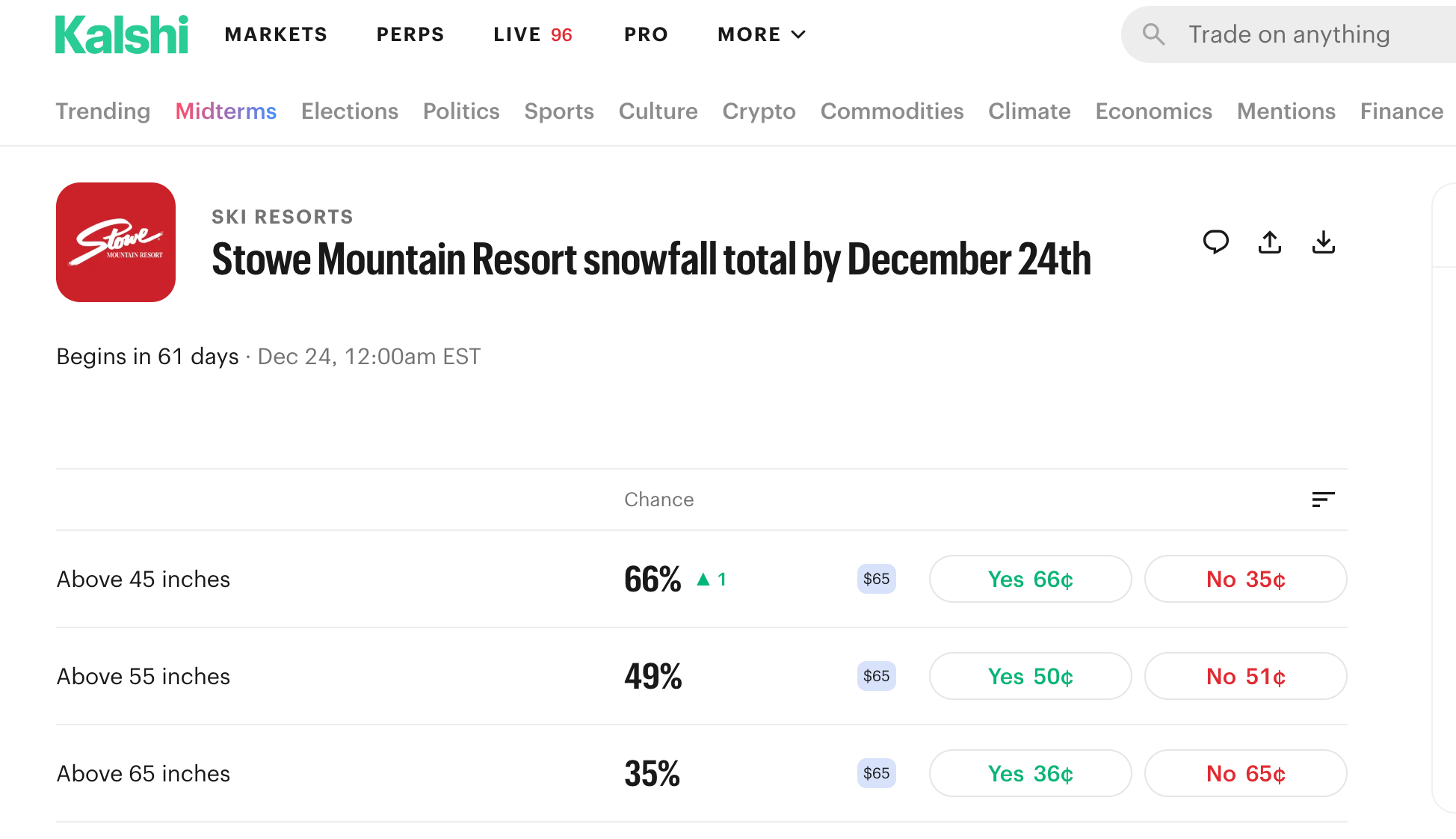
As of Oct. 23, Kalshi listed three main lines for Stowe. Buying “No” on each one pays $1 if the resort records that much snow or less by Christmas Eve:
45 inches: “No” cost 35 cents. It pays only in a slow start.
55 inches: “No” cost 51 cents. It pays in a below-average start.
65 inches: “No” cost 65 cents. It pays unless the start is well above average.
Here is the bottom line at the 55-inch line. To collect $10,000 in a slow start, a business would spend about $5,100 before Kalshi’s trading fees. If the snow comes in normal, it loses the $5,100. If the start is slow, it nets about $4,900.
That is not cheap, and the reason is that 55 inches is a normal year. Stowe averages about 20 inches of snow in November and about 45 in December, according to OnTheSnow’s historical records. That works out to roughly 55 inches by Christmas Eve, so the market is a coin flip. The cheaper protection is at the 45-inch line, at 35 cents on the dollar, but that bet pays only when the start is genuinely bad.
Kalshi’s weather business is growing fast
Kalshi is putting real money and advertising behind the weather side of its business:
Trading volume: Kalshi’s weather markets drew $564 million in trading through July, more than in all of 2025, Benzinga reported citing the Wall Street Journal. Kalshi expects about $1.1 billion for the year.
Data partnership: In August, Kalshi signed a partnership with The Weather Company, which now helps verify outcomes for some weather markets. The two companies are exploring markets on local ski conditions.
New ski markets: In September, Kalshi filed with federal regulators to list snowfall markets at more ski resorts, including Snowbasin in Utah and Banff Sunshine Village in Alberta.
Business interest: Kalshi told Claims Journal it is seeing more companies approach it about hedging risks.
The federal government is on board. Michael Selig, chairman of the Commodity Futures Trading Commission, the federal agency that regulates Kalshi, has defended prediction markets in part because companies can use them to protect against weather risk, Semafor reported.
Where the snowfall bet falls short
Vail Resorts owns Stowe, and its CEO doesn’t use these markets. Rob Katz told Semafor that what hurts the business is when the snow falls and how warm it gets before and after, not just the total. He said building a clean weather hedge is “not as simple as it might look.”
The same holds for a Stowe innkeeper. A business can win the bet and still have a good December if snowmaking carries the mountain. It can lose the bet and still have a bad one if a big storm is followed by rain.
The market also pays out on the resort’s own snow report, so the number that settles the bet comes from the company whose business depends on snow.
Is it legal in Vermont?
Yes. Kalshi operates under federal regulation, and no state action against it is on record in Vermont.
State lawmakers have debated it. Rep. Tom Stevens, D-Waterbury, and 12 co-sponsors introduced H.913 this year, a bill that would have banned certain prediction-market contracts in Vermont, including bets on elections. The House Government Operations and Military Affairs Committee heard the bill in April but took no further action. The Department of Liquor and Lottery called the effort a distraction from more pressing issues, WCAX reported. Vermont hasn’t joined other states’ lawsuits against prediction markets, though Attorney General Charity Clark has backed states’ right to regulate them.
Vermonters are wary. As Compass reported Sept. 29, a UNH poll in March found most Vermonters have heard of Kalshi and Polymarket, but very few have used them. A majority supported more federal regulation.
Kalshi’s pitch is that small businesses will come to use weather markets the way big companies use insurance. Whether Stowe’s businesses agree will show up in the market itself, in how much money is on those lines by Christmas Eve.