


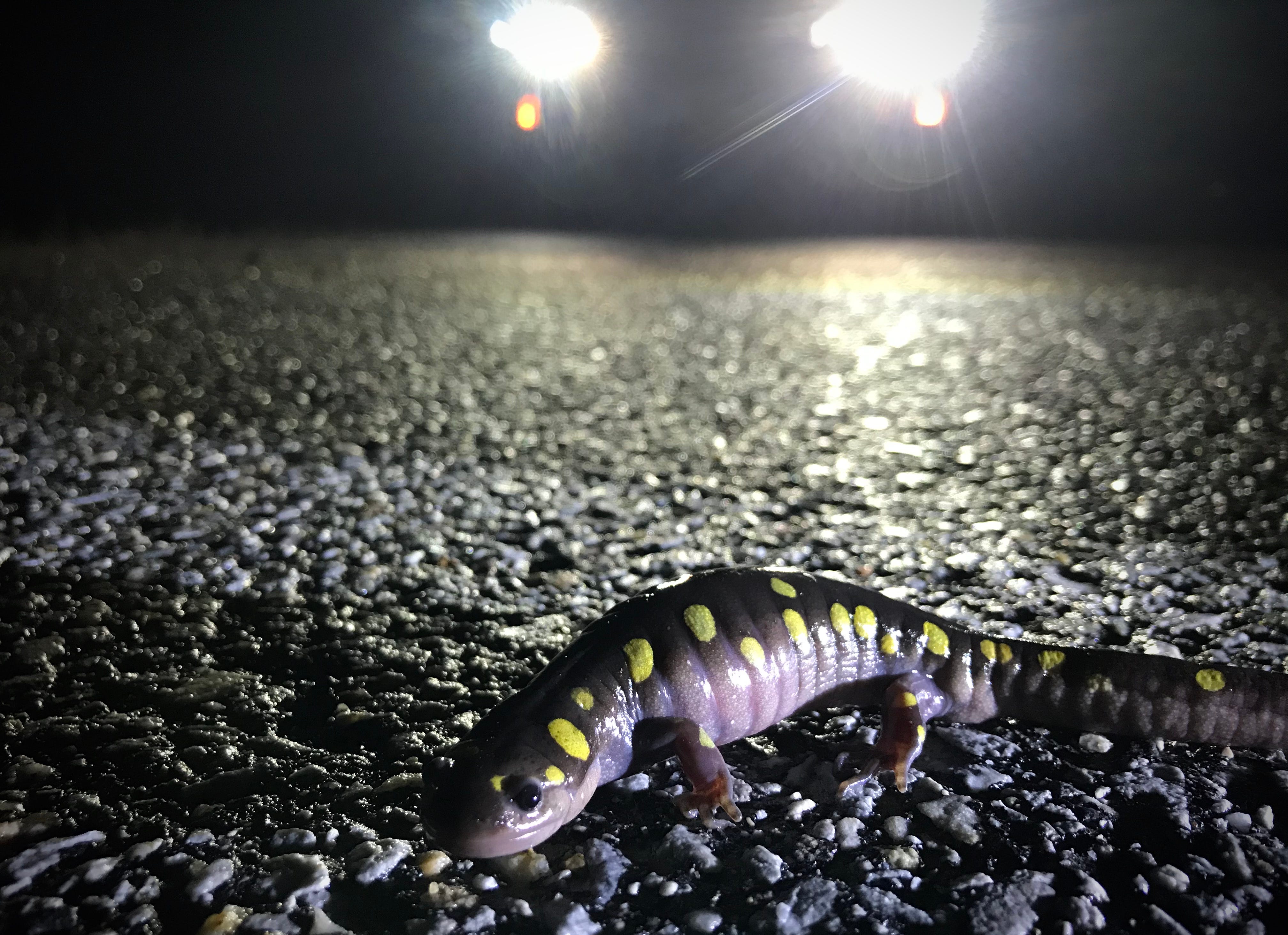
Every spring, Vermont Fish and Wildlife issues the same advisory: slow down for frogs and salamanders. The department issued it again this week. On a handful of warm, rainy nights, thousands of spotted salamanders and wood frogs emerge from underground and cross roads to reach breeding pools. Vermonters who’ve volunteered at crossing sites know the basics.
What most don’t know is what the research actually shows — about how close these populations are to collapse, what Vermont would lose if they disappeared, and how wide the gap is between the science and the state’s response.
These aren’t rare curiosities. They run the forest.
The animals on the road on Big Night are among the most abundant vertebrates in eastern forests. A 2024 USGS study measured salamander densities of 1,950 to 34,300 per hectare across northeastern woodlands. In many study plots, salamander biomass exceeded that of all birds and mammals combined.
That matters because of what they do. According to a U.S. Forest Service synthesis, salamanders regulate forest food webs in several ways: as mid-level predators, they control invertebrate populations along both grazer and decomposer pathways. Their seasonal migrations move energy and nutrients between aquatic and terrestrial ecosystems. Through their association with underground burrow systems, they contribute to soil dynamics. And they serve as a high-quality, slowly available food source for predators throughout the food chain — shrews, snakes, barred owls, and dozens of other species.
One of their least-appreciated roles involves carbon. By preying on the invertebrates that shred leaf litter, salamanders slow decomposition and promote the conversion of leaves into humus — building soil and trapping carbon that would otherwise return to the atmosphere. Research from California’s redwood forests found that reduced salamander populations in logged areas correlated with measurably lower nutrient cycling and carbon storage capacity.
Amphibians also suppress pest insect populations — mosquitoes, midges, gnats — at both larval and adult life stages. Lose the amphibians and you lose a layer of biological pest control that’s been operating in Vermont’s forests for millennia.
In short: if these populations collapse, the consequences ripple through soil health, carbon storage, insect regulation, and the food web that supports Vermont’s woodland wildlife from weasels to hawks. This isn’t about losing a charming species. It’s about losing a load-bearing piece of the ecosystem.
10% road mortality is enough to push them toward extinction
The foundational study on this question is Gibbs and Shriver (2005), published in Wetlands Ecology and Management. Their population modeling found that annual adult road mortality exceeding 10% puts spotted salamander populations on a trajectory toward local extinction. For 500 breeding pools in Massachusetts, the median annual mortality rate was 17–37% — well above that threshold.
The math works against them. Spotted salamanders live 20–30 years. Females don’t breed until age 5–7. Over 90% of offspring die before metamorphosis. The species depends on long-lived adults breeding across many seasons. Kill the adults and the demographic buffer disappears.
A Danish study measured kill probability per crossing at 0.34–0.61 on a road carrying roughly 3,200 vehicles per day. Gibbs and Shriver concluded roads carrying more than 250 vehicles per lane per day are functionally impassable. At some Vermont crossing sites, over 50% mortality has been documented.
A 2025 PLOS ONE study found road salt contamination extending 170–250 meters from roadways caused a 14% decline in spotted salamander pool occupancy and 29% smaller populations. Vermont is a heavy road-salt state. The salt doesn’t just kill animals on the pavement — it poisons the pools they’re trying to reach.
During the first spring of COVID-19, a Maine study found that a 15–20% reduction in rural traffic produced roughly 50% less amphibian road mortality. Fewer cars on a few critical nights made a measurable difference.
Vermont has built one tunnel. It works.
Vermont’s sole purpose-built amphibian crossing sits on Monkton-Vergennes Road. After volunteers counted over 1,000 dead amphibians in two nights in 2006, two concrete tunnels with wing walls were installed in 2015. Cost: $342,397.
A 12-year before-and-after study led by UVM ecologist Matthew Marcelino, published in the Journal for Nature Conservation in May 2025, found total amphibian road mortality dropped 80.2%. For salamanders, wood frogs, and toads, mortality fell 94%. Bobcats, bears, and mink also used the passages.
No additional amphibian crossings have been built in Vermont since. The state’s most ambitious wildlife crossing proposal — spanning Route 2 and I-89 near Waterbury — was shelved when the $50 million cost proved unfundable.
Meanwhile, Keene, New Hampshire has closed roads during Big Night since 2018 and in 2025 received a $375,000 grant for permanent tunnels. Amherst, Massachusetts has operated amphibian tunnels since 1987 and officially closes Henry Street during migration. Vermont has zero road closures for amphibian migration.
For cost context: a single moose-vehicle collision carries an estimated $42,000–$44,500 in economic damages. The 2021 federal infrastructure law created a $350 million competitive grant program for wildlife crossings.
The volunteers can’t solve this
Vermont’s crossing guard network is impressive. The North Branch Nature Center in Montpelier has engaged over 500 volunteers. The Hartford Salamander Team has mapped roughly 100 Upper Valley crossing sites. At the Salisbury crossing, volunteers regularly move over 1,000 amphibians in two hours on peak nights.
But before the Monkton tunnels were built, even with volunteers present, half the animals were dying. UK and Italian long-term studies found that despite active patrol programs, 64–70% of monitored populations still declined. There is no peer-reviewed evidence that annual “slow down” advisories change driver behavior at any measurable scale.
The real value of volunteers may be indirect: feeding the citizen science pipeline. The Vermont Reptile and Amphibian Atlas has accumulated over 123,000 observation records from more than 7,000 contributors, with roughly 5,000 vernal pools mapped statewide. That data feeds directly to VTrans and Fish and Wildlife for crossing prioritization — but has resulted in one built crossing in three decades.
A new law, and an old gap
Act 47 (H.231), signed June 5, 2025, makes Vermont the first state to extend legal protections to all amphibians and reptiles, effective January 1, 2027. The law bans intentional killing or collecting without authorization and doubles fines to $2,000.
Vermont’s long-term monitoring on Mt. Mansfield — running since 1993 — shows spotted salamanders relatively stable in that protected, roadless habitat. But the boreal chorus frog hasn’t been heard in the state since 1999. Fish and Wildlife acknowledges that total salamander numbers are decreasing statewide.
The most actionable finding in the research may also be the simplest. The Maine COVID data suggests that temporary road closures on 2–3 critical nights per year at identified hotspots could roughly halve mortality at those sites — for essentially zero cost. Keene did it. Amherst did it.
Vermont, with 123,000 citizen science records identifying exactly where the crossings occur, has not.
How to participate
Report amphibian crossings to the Vermont Reptile and Amphibian Atlas. Volunteer through the North Branch Nature Center (Montpelier), the Hartford Salamander Team (Upper Valley), the Bonnyvale Environmental Education Center (Brattleboro), or Otter Creek Audubon Society (Addison County).
To predict Big Night: look for evenings with steady rain and temperatures above 40°F after snowmelt has opened bare ground. The migration typically runs mid-March through mid-April depending on elevation. Multiple events may occur in a single season.
Donations to support non-game wildlife conservation can be made through the Nongame Wildlife Fund on Vermont state income tax forms.
........" Vermont has zero road closures for amphibian migration.".......That's not really true. Pond Rd in Shelburne does this. This link will help..... https://docs.google.com/document/d/1r09VHjCuYrCqirhd2o_fk1E9u66G6_YSZQqrNaRG2JI/edit? It's rather fascinating to see if you never have...