


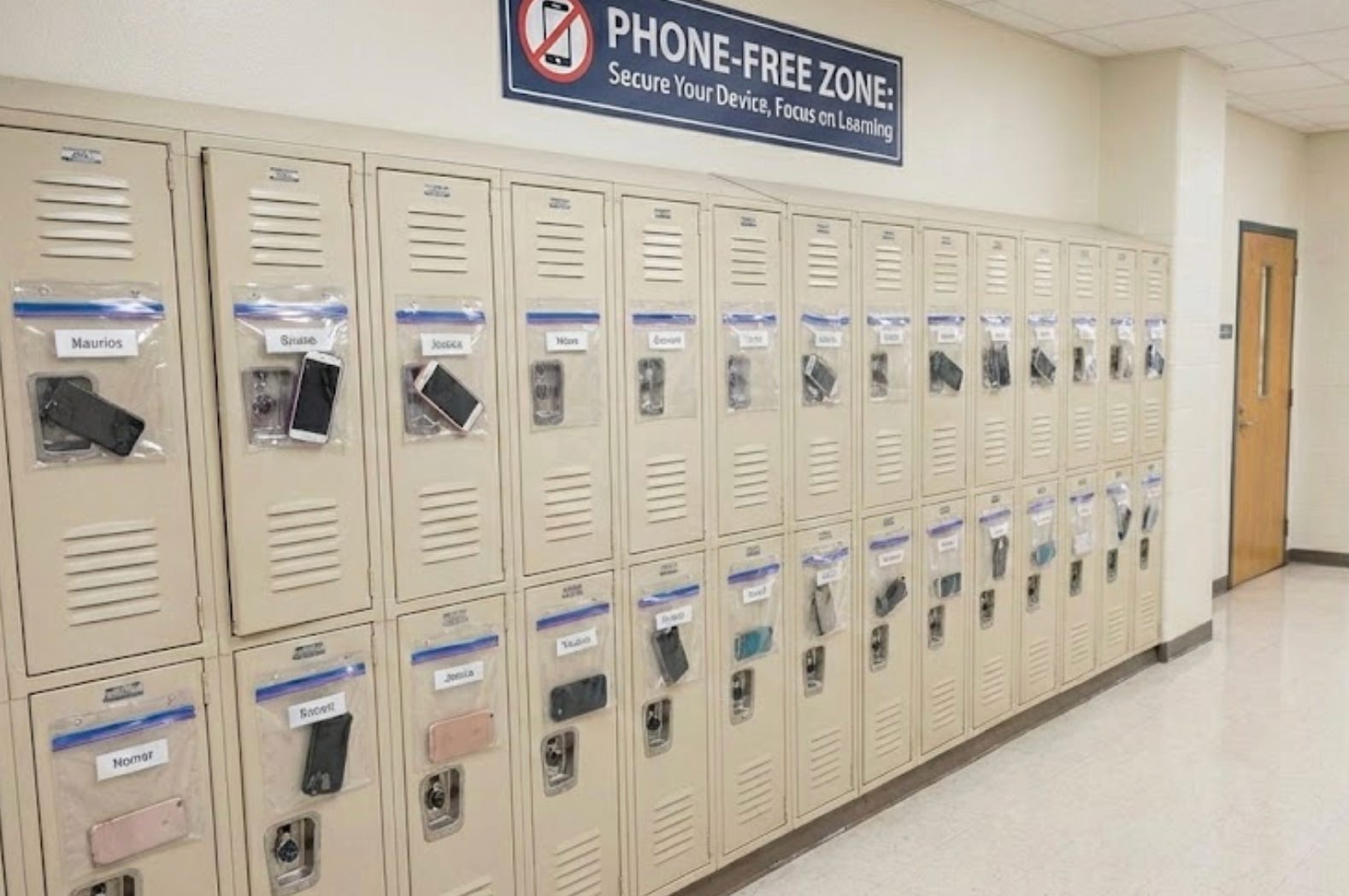
By the start of the 2026-2027 school year, nearly every public school hallway in Vermont will sound different. Under Act 72, signed by Governor Phil Scott earlier this year, districts across the state are moving toward “bell-to-bell” bans on cellphones and smart devices. While the mandate has sparked intense debate in town halls and Facebook forums, a wave of new data from early adopters suggests that the Green Mountain State is on the right side of history.
For parents and educators wondering if the logistical headache is worth it, the answer from national studies and local pilot programs is a qualified “yes.” Evidence shows that removing the digital tether improves grades and mental health—but it requires navigating a bumpy transition period first.
The Florida Benchmark: Proof It Works
Until recently, arguments for phone bans were largely anecdotal. That changed with a groundbreaking 2025 study from the National Bureau of Economic Research (NBER). Researchers David Figlio and Umut Özek analyzed a massive urban district in Florida that implemented a strict ban, providing the first rigorous look at the results.
The findings were statistically significant. Schools that enforced bans saw student test scores improve by 2-3 percentiles by the second year. While that might sound small, in the world of education policy, it is a massive shift—roughly equivalent to adding an extra hour of instruction per week.
Crucially, the study identified why grades went up. It wasn’t just that students were paying attention; they were actually showing up. The bans led to a significant reduction in unexcused absences. It appears that without the ability to coordinate truancy via text, or retreat into a device during the day, students re-engaged with the physical school environment.
The “J-Curve” of Discipline
However, the data also offers a warning: it gets worse before it gets better. The Florida study revealed a “J-curve” effect, where suspensions spiked by 16% in the first year as schools cracked down on enforcement.
This burden was not shared equally. The data showed that the spike in exclusionary discipline disproportionately affected Black students. This suggests that if Vermont districts rely solely on punishment to enforce bans, they risk exacerbating equity issues. However, the data also shows that after the first year, discipline numbers leveled off as the student body accepted the “new normal.”
The Vermont Laboratory: Local Success Stories
Vermont has the advantage of learning from these national experiments, and early results from local districts suggest we may be finding a smoother path than Florida.
At Harwood Union High School, which implemented a phone-free campus using magnetic pouches, the administration reported a reduction in minor behavioral incidents. This contrasts sharply with the suspension spikes seen elsewhere. The difference likely lies in the method: by using pouches to physically secure the phones, Harwood removed the “power struggle” between teachers and students.
Similarly, in the Winooski School District, educators have noted a profound cultural shift. Co-principal Kate Grodin described the high school cafeteria as notably “quiet”—not because of suppression, but because the digital noise was gone. Students were reportedly engaging in face-to-face conversation rather than “parallel play” on their screens.
The Pouch vs. The Policy
One of the key takeaways for Vermont school boards is that how you ban matters as much as if you ban.
Districts that rely on teachers to confiscate phones often face high conflict and teacher burnout. Conversely, districts that invest in infrastructure—like the Yondr pouches used at Harwood or “Generation Faraday” lockers—tend to see better compliance.
Data from the Sierra Sands Unified School District in California supports this. After implementing physical pouches, they reported a 70% drop in incidents and suspensions in just ten weeks. The physical barrier acts as a neutral third party, allowing teachers to focus on teaching rather than policing.
The Parental Safety Paradox
The biggest hurdle to Vermont’s rollout isn’t the students; it is often the parents. In an era of anxiety regarding school safety, many parents view the phone as a lifeline to their children.
While 74% of adults support bans in theory, implementation often faces pushback regarding emergency contact. However, safety experts and school resource officers consistently argue that cellphones can be detrimental during active emergencies—distracting students from instructions and potentially revealing hiding spots through noise or light.
School leaders who have successfully navigated this transition report that parental anxiety follows a curve similar to student discipline: an initial uproar followed by acceptance once clear communication protocols are established.
What Happens Next
As Vermont moves toward the July 1, 2026 deadline set by Act 72, communities should expect a transition period.
Spring 2026: Most school boards will finalize their specific policies, deciding between “bell-to-bell” physical restrictions (pouches/lockers) or policy-based rules.
Fall 2026: The mandate takes full effect statewide. Based on the data, schools should anticipate a rocky first semester characterized by student resistance and potential discipline spikes, followed by a measurable improvement in academic focus and social climate by Year 2.
Vermont is joining 37 other states in this shift, but the local data suggests that with the right implementation, the state is well-positioned to reclaim the classroom.