


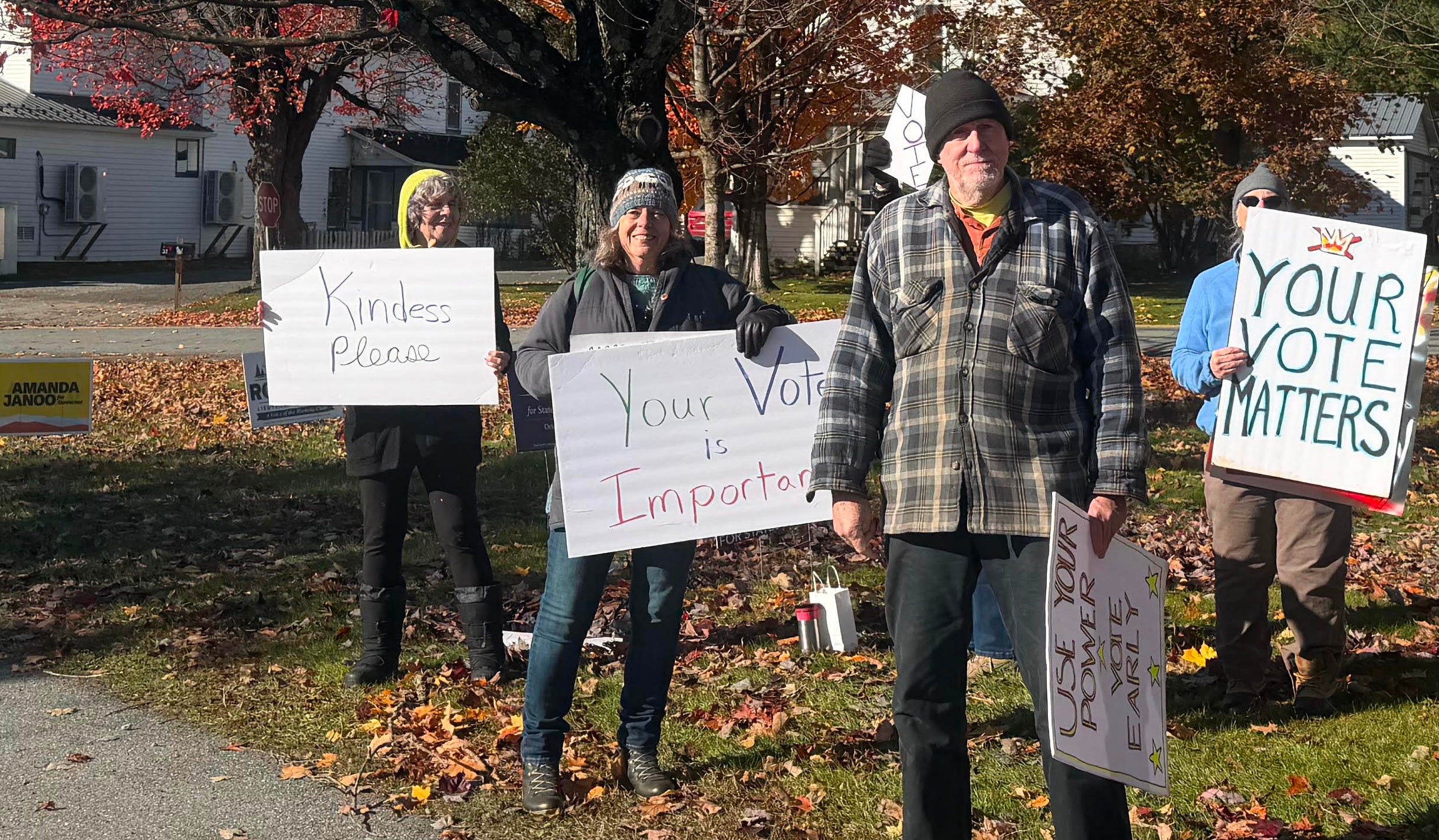
Shelley Martin grew up with a Republican father, a Democratic mother and competing arguments about how the country should be run.
Her father was from Tennessee and served in the military. Her mother was from Chicago. Both voted, Martin recalled, and her mother had a particularly clear explanation for why she was going to the polls.
“I’ll be damned if he gets a vote and I get none,” Martin recalled her mother saying.
She was going to cancel her husband’s vote.
Martin said she heard both parents make their cases before initially following her father into the Republican Party and becoming active as a young Republican.
“I had them both talk to me, and my father had a better argument,” she said.
Today, Martin calls herself an independent. Her approach to hearing Republicans and Democrats was to join both.
“I joined both parties. I paid dues to the Republicans and the Democrats,” she told Compass Vermont. “Because I’m an independent, and I want to hear both sides.”
A place to disagree
For Martin, participation came with something she valued: a chance to push back.
“And I learned that as a Republican, I could stand up to the Republicans and say the things I didn’t like,” she said.
She believed being part of the group helped her objections get a hearing. She wanted to question what she heard and understand how people arrived at their positions.
In her view, both parties put their own slant on information. Going into their meetings gave her a way to hear their arguments directly and challenge them.
“The only way you’re ever going to figure out what you want to see and hear and learn is if you hear both sides and how they’re approaching it, and then you can argue with them,” she said.
A union president in the Republican room
That approach also shaped how Martin described her work as president of the Vermont State Employees’ Association.
Union leaders lean toward Democrats, she said. But she felt responsible for members across political lines. She recalled others from the union going to Democratic caucus meetings at the Statehouse while she went to Republican gatherings.
“I was really there representing Republicans in my group,” she said.
Martin credited Vince Illuzzi, who served as a Republican state senator, with helping introduce her at Republican meetings. She remembered an initially chilly reception when people learned she was a union president. In her account, Illuzzi helped explain that she represented Republican members, too.
She said it took time for people to accept why she was there.
Martin now leads the Vermont Retired State Employees’ Association, which is separate from VSEA and its retirees’ chapter. She emphasized that the association is not the union and said its board includes people with management and nonmanagement backgrounds.
“So I get a huge variety of opinions and ways of looking at things,” she said.
Her argument for hearing both parties comes back to what people can learn before making a decision.
“If we learn both sides, we can reach a great decision,” she said.
How to “join” one or both parties in Vermont
Vermont does not register voters by political party. Following a party, contributing money and holding a committee seat are different kinds of involvement.
Democrats: The Vermont Democratic Party offers a “Become a Member” page for its Dem Club. For local meetings or help getting on its mailing list, contact the party at info@vtdemocrats.org or 802-229-1783 and ask to be connected with your town or county organization.
Republicans: Use the “Join Us” email form or find your county organization. The state party also has a contact form for questions about meetings and involvement.
To hear both: Request information from each party separately. Before attending a meeting, ask whether visitors may attend and when they may ask questions. Signing up for messages does not establish committee membership or a right to speak at every meeting.
To contribute: Both parties provide official donation pages: Democrats and Republicans. Review the contribution terms and whether a payment is one-time or recurring. A contribution is separate from election to a party committee.
For a formal committee role: Ask the local chair about joining. State law allows town committees to elect additional members at any meeting, so participation need not wait for the next biennial reorganization. The committee decides whether to elect someone.
Where “both” has limits: Vermont law prohibits simultaneously serving on committees of more than one party, and prohibits voting in town, county or state caucuses of different parties within the same 12-month period. In a primary election, a voter may cast only one party’s ballot.