


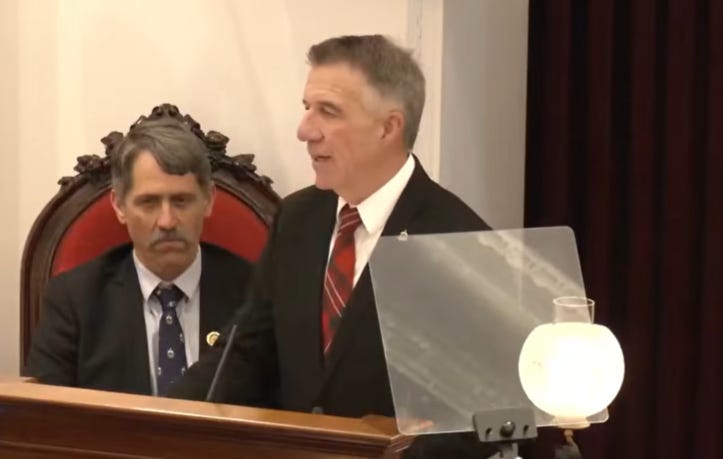
Governor Phil Scott’s Fiscal Year 2027 budget address, delivered January 20, marked a clear shift from the pandemic-era abundance of federal aid back to a more constrained fiscal environment. The proposal outlines how the administration intends to manage slowing revenue growth, rising costs, and long-standing structural problems—without raising broad-based taxes—while pressing the Legislature to make significant policy changes in education, housing, energy, healthcare, and public safety.
A Smaller Margin for Error
The governor proposed a $9.4 billion all-funds budget for FY2027. While large in absolute terms, he emphasized that more than one-third of that total comes from the federal government, and future federal funding is increasingly uncertain.
Recent revenue downgrades, including an $8 million reduction in the General Fund forecast, set the tone for the address. Scott noted that maintaining current services alone will cost an additional $139 million next year due to inflation and cost growth.
Unlike recent budgets, the FY2027 proposal reflects what the governor described as a return to pre-pandemic fiscal discipline, after several years of federal stimulus from COVID relief, ARPA, infrastructure funding, and disaster recovery programs.
General Fund Pressures and Pensions
The General Fund, which supports most state operations, is projected at $2.53 billion. One of the largest and fastest-growing pressures remains pensions.
Scott highlighted a 9.7% increase in pension costs in a single year. In FY2027, pensions will require $331 million from the General Fund and nearly $550 million across all funds, crowding out spending on other priorities. He framed this as evidence that prior efforts focused too heavily on funding levels rather than addressing underlying structural issues.
Transportation: A Structural Mismatch
The Transportation Fund is projected at $317 million, about $9 million less than last year, and faces a $33 million structural deficit. The governor attributed this to long-term trends, including improved fuel efficiency and increased electric vehicle use, which have eroded gas tax revenues.
Scott was explicit that he will not support raising the gas tax. Instead, he argued that the core problem is that transportation revenues are still diverted to other purposes.
To address this, he proposed:
Continuing efforts to unwind past transfers from the Transportation Fund.
Reducing the transfer of Purchase and Use tax revenue to the Education Fund by $10 million, with a longer-term goal of ending the transfer entirely.
Education Costs and Property Taxes
Education dominated a significant portion of the speech. The Education Fund will require $2.56 billion in FY2027, a 39% increase over five years, alongside a 41% rise in property taxes during the same period.
Scott noted that total education spending is nearing $3 billion annually for roughly 80,000 students, placing Vermont among the highest per-pupil spenders in the nation.
In addition to property taxes, education is funded by:
All sales tax revenue
Lottery proceeds
Portions of the Purchase and Use tax
A share of the Rooms and Meals tax
Together, nearly $800 million in state tax revenue is directed to education each year, with an additional $248 million from the General Fund paying for teacher pensions and benefits.
The governor rejected proposals to simply shift costs to income taxes or second-home owners, arguing that those revenues already support other programs. He stressed that full implementation of Act 73 is essential to addressing what he described as a failing system.
Property Tax Relief—With Conditions
To blunt near-term impacts, Scott proposed $105 million in one-time property tax relief, intended to cut projected increases roughly in half.
He warned, however, that this funding is meant to ease taxpayer burden, not to create room for additional school spending. He cited concerns that similar relief last year led some districts to increase budgets, undermining the goal of stabilization.
As a longer-term measure, he urged lawmakers to consider an education spending cap proposal to prevent future tax spikes.
Housing: Supply as the Central Solution
Housing was framed as both an affordability issue and a driver of broader economic challenges. The administration estimates Vermont needs about 30,000 new homes over the next four years.
Since 2020, the state has invested nearly $800 million in housing-related initiatives, including programs such as the Vermont Housing Improvement Program (VHIP), Manufactured Home Improvement and Repair, the HOME Act, and the Community Housing Infrastructure Program.
Scott argued that progress has been slowed by outdated regulations and called for further reform, including:
Extending interim housing-related Act 250 exemptions through 2030
Adjusting exemption requirements to give smaller towns more local control
Repealing the Road Rule, which he said adds unnecessary barriers to development
He also proposed making VHIP funding permanent, citing its relatively low cost per unit, and continuing Downtown and Village Tax Credits, which he said leverage private investment and revitalize community centers.
Homelessness and the Hotel-Motel Program
The governor stated that the hotel-motel program has not worked as intended, arguing that it has warehoused people without providing stability or adequate support.
The FY2027 budget shifts funding away from hotels and motels and toward:
Emergency shelters
On-site services
Pathways to permanent housing
The stated goal is to reduce prolonged instability rather than manage it indefinitely.
Energy Costs and Climate Policy
Affordability concerns extended to energy policy. Scott cited data showing that low-income Vermonters face the highest energy burden in the nation, with utility disconnections up 31% since 2022.
He argued that prior climate policies increased costs without delivering proportional benefits and proposed a different approach that:
Credits existing clean energy sources
Allows broader use of solar, hydro, and nuclear power
Aims to reach 100% clean energy by 2030 at lower cost than current standards
The administration framed this as a way to reduce emissions while lowering household and business energy costs.
Healthcare Reform and Costs
Turning to healthcare, Scott criticized Vermont’s post–single-payer regulatory framework, saying it has resulted in high costs and limited consumer choice.
He outlined principles for reform:
Affordability for families, employers, and taxpayers
Expanded choice in coverage
Emphasis on value, prevention, and accountability
Proposals include expanding insurance options, using reinsurance to reduce premiums, and investing nearly $1 billion over five years—with new federal funding—to strengthen rural healthcare and rebuild the workforce.
Public Safety and Accountability
The governor described Vermont’s criminal justice system as out of balance, with repeat offenders accounting for a large share of court backlogs and insufficient consequences for failing to appear or comply with conditions of release.
Key proposals include:
Repealing the “raise the age” law for 19-year-olds
Allowing prosecutors to charge certain violent offenders under 19 in criminal court
Restoring accountability for individuals ages 19 to 22
Expanding and reforming pretrial supervision statewide
He also highlighted investments in addiction treatment, recovery housing, and employment programs, noting a sharp decline in overdose deaths last year.
Accountability Courts as a Model
Scott pointed to Burlington’s Community Accountability Court as evidence that coordinated approaches can reduce backlogs and improve outcomes. The FY2027 budget includes funding to replicate this model in other counties.
Targeted Investments, Not Broad Expansion
While rejecting broad spending increases, the budget includes targeted initiatives such as:
Eliminating certain agricultural fees
Continued investment in outdoor recreation through VOREC
Support for a new University of Vermont multi-purpose center, without using General Fund dollars
Federal stimulus funding will continue to support housing, broadband, weatherization, and flood mitigation projects already underway.
What Happens Next
The governor framed the FY2027 budget as an opportunity to modernize systems built decades ago, before fiscal pressures become more severe. Over the coming months, the Legislature will review the proposal through committee hearings, revise spending levels, and debate the policy changes tied to education funding, housing regulation, energy standards, healthcare reform, and public safety.
Final decisions on tax relief, structural reforms, and program funding will determine whether the budget remains close to the governor’s vision of restraint paired with transformation—or moves in a different direction as lawmakers adjourn later this spring.
The question continues and remains the same, how much is enough??? And relying on the Fed for Financial support is not a good Idea...