


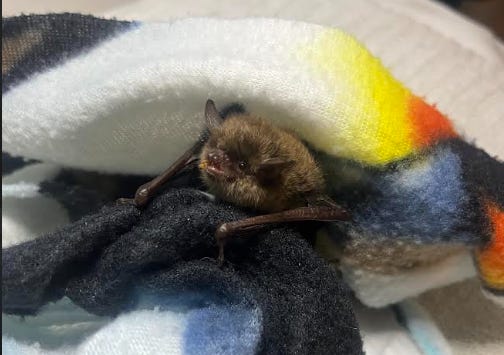
Vermont has lost 90 percent or more of its little brown bats.
To understand a collapse like that, to work out what the disease does, why a few animals survive it, and whether anything can be done, scientists need to read everything written in the animal’s DNA. Until recently, getting that meant killing one and taking it apart.
A study published last week says they don’t have to anymore. And a University of Vermont researcher helped prove it.
A Hole the Size of an Ear Piercing
The tool is a punch three millimeters across, pressed through the wing membrane, a layer of skin a fraction of a millimeter thick. The bat is weighed, measured, and let go. It flies off with a small hole that heals.
The skin left behind on the punch is the whole point. Put those few cells in a dish and they multiply into far more tissue than the animal could ever have spared. From that supply, scientists can assemble the animal’s complete genetic blueprint in a matter of weeks, then keep running experiments on the cells long after the bat has gone back to its cave.
The technique is not new, and it is not limited to bats. Researchers have grown the same kind of cell colonies from skin clipped off free-swimming humpback whales, and from the pulp inside a growing feather, the living tissue at the base of the shaft, which lets them test how pollutants affect wild birds that go on flying.
What was missing was proof that the gentle version was good enough to replace the old one.
The Gentle Way Worked Better
That proof arrived on Aug. 26 in a study published in Nature. A team assembled the complete genetic blueprints of eight related bat species and used them to trace how bats evolved unusually long lives, resistance to cancer, and an immune system that shrugs off viruses that would kill other mammals.
One of the study’s two lead authors is M. Elise Lauterbur, now an assistant professor of biology at the University of Vermont. She did the work while at the University of Arizona, on a project based jointly there and at the University of California, Berkeley.
Most of the eight blueprints were built from wing punches. Two were built the old way, from the tissue of animals that had been killed.
Asked about that by Compass Vermont, Lauterbur said both of those samples had been collected before the new method was fully developed. Since the material already existed, the team used it as a test. Having it on hand, she wrote, “provided the opportunity to test the quality and reliability of the novel cell-line method.”
The wing punches won. The blueprints built from living, growing cells were the higher-quality ones.
That is the part that makes this more than a story about being kind to animals. Nobody had to trade accuracy for mercy. The method that leaves the animal alive produced the better result, and produced it faster.
There Is a Catch
A wing punch gives you wing cells, and wing cells mostly tell you about wings. If a question depends on how a liver behaves, or a brain, a piece of skin will not answer it.
“While that is relevant for many purposes, it can’t be used for everything,” Lauterbur told Compass Vermont, adding that “organ tissue sampling is still the standard for studying organ-specific processes.” For that kind of work, researchers still take the organ, which still means taking the animal.
The thing that could eventually close that gap is already in the works, though it isn’t ready. Scientists can now take an ordinary adult cell and chemically wind it backward into a blank, flexible state, one that can then be pushed to grow into a liver cell, a nerve cell, or nearly anything else the body makes. If that ever becomes reliable, a punch of wing skin could stand in for an organ nobody had to remove. Lauterbur said the technology holds “the promise to open vast new possibilities for non-lethal research,” but needs a good deal more development first.
It Has Already Been Used on Vermont’s Bats
White-nose syndrome is a cold-loving fungus that eats into the skin of hibernating bats, wakes them in midwinter, and sends them out into the cold to starve. It reached Vermont in 2008. The Fish & Wildlife Department’s latest figures show the little brown bat down 90 percent or more, along with the northern long-eared and tricolored bats, all three now endangered in this state. Across the Northeast, the department counts more than 5.7 million bats dead since 2006, though estimates of the regional toll vary and none is exact.
For years nobody could say precisely how the fungus killed. Then in 2024, researchers at the University of Wisconsin-Madison published a study in Science using a cell colony grown from a little brown bat. They recreated hibernation conditions in a dish and watched.
The fungus turned out to be a burglar rather than a bruiser. It shuts off the infected cell’s alarm, the mechanism a cell uses to kill itself rather than let an invader spread, then slips from cell to cell, jamming the cell’s garbage disposal so it survives inside and grows again when the bat drops back into hibernation.
That is a step-by-step account of how Vermont’s bats are dying, worked out in a dish. Lauterbur, who noted that kind of lab work is outside her own specialty, pointed to that study as proof the method already applies here, and called it “a fruitful avenue of future research to protect endangered species.”
Hundreds of Thousands of Animals Are in the System
In fiscal 2025, research facilities registered with the U.S. Department of Agriculture reported 751,355 animals used or held. That is more animals than there are people in Vermont, and it covers dogs, cats, rabbits, guinea pigs, monkeys, and a long list of wild species. It does not include mice, rats, or birds bred for laboratory use, which the reporting law leaves out and which make up the bulk of the work.
The same shift is already under way in drug testing. Botox potency used to be measured by injecting mice and counting how many died, until the FDA approved a cell-based replacement in 2011. Injectable drugs were once screened for contamination by injecting rabbits, then by using horseshoe crab blood, and now increasingly by a synthetic version of the one crab protein that does the work. Since April 2025 the FDA has been running a formal plan to reduce animal testing in drug safety work, and reported a year of progress this spring. The argument is not sentimental. According to news coverage of the FDA’s plan, more than 90 percent of drugs that clear animal testing never make it to approval anyway.
New England’s Largest Bat Colony Winters in a Cave in Dorset
Most Vermonters have never heard of it. Deep inside a mountain in Dorset is the biggest concentration of hibernating bats in New England, and one of the first places in North America where white-nose syndrome turned up. The floor is littered with small bones.
But not every bat there died. Alyssa Bennett, a small mammals biologist with Vermont Fish & Wildlife who has worked on the disease for more than a decade, told PBS NewsHour that an estimated 70,000 to 90,000 bats still winter in the Dorset cave. That is down from 300,000 to 350,000 or more in the 1960s, the last time anyone surveyed it. It is also a group that made it through, and Bennett said the hope is that those survivors seed a recovery across New England.
It will take a while. A female little brown bat has one pup a year, and only 60 to 70 percent of pups survive their first twelve months.
Why those particular bats lived is written in their DNA. Reading it means taking something from animals that are, by definition, the last ones anybody can afford to lose. Now that can be a piece of skin the size of an ear piercing, and the bat can go back to the cave.
At Compass Vermont, our only advocacy is for the reader’s right to the complete picture. Please consider a paid subscription for only $5.00 per month.