


At the bottom of this story: how to see how much of your own tax bill goes to your town, and how to check whether your town already charges a local option tax.
Most of the property tax Vermonters pay goes to schools. Statewide, about 70 cents of every property tax dollar assessed goes to education. About 30 cents pays for everything else towns run: roads, plowing, police, fire and the town office.
In 2025, Vermont property taxes assessed before credits totaled $2.4 billion. According to the Tax Department’s annual property report, $730 million of that was municipal taxes, the town share, including villages and special districts such as fire districts. The split varies from town to town.
That 30 cents is what the Vermont League of Cities and Towns wants the Legislature to look at. Its newly released 2027 legislative priorities leave school spending off the list and focus on the town share.
What’s happened to the town share
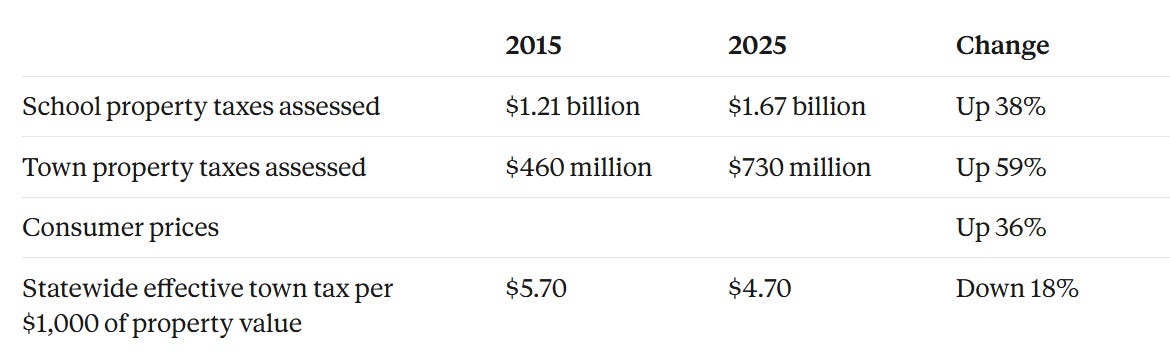
Here’s what that table means:
The town money stays in town. Town taxes are what Vermonters pay their own towns, under budgets that local voters or councils approve. The state isn’t taking it.
Town taxes grew faster than prices. Over the decade, national consumer prices rose about 36 percent. School property taxes roughly kept pace. Town property taxes grew well beyond that.
Property values grew faster still. Measured against what property is worth, the statewide effective town tax went down, from about $5.70 per $1,000 of value in 2015 to about $4.70 in 2025.
School taxes still added more dollars. School taxes rose $460 million over the decade. Town taxes rose $270 million.
So the numbers don’t show that towns are short of money, or that residents are overpaying. They show that town property taxes assessed statewide were higher in 2025 than in 2015. VLCT’s argument is that towns lean on property taxes because state law gives them few other ways to raise money.
Why the town share gets less attention
The Legislature controls the school tax formula, and that’s where the fight will be when lawmakers return Jan. 6. The tax commissioner’s next school tax forecast is due Tuesday, Dec. 1, and Compass reported Friday that the state used $100.9 million in one-time money to hold down this year’s school tax bills and set none aside for next year. WCAX reports that affordability, property taxes and education reform are the central issues for the coming session.
VLCT does have a position on schools: its broader municipal policy calls for a cap on how much the Legislature can raise education tax rates in a single year. But its 2027 list is about the town share.
What towns want
More ways to raise money besides property taxes. About 40 towns already charge a 1 percent local option tax on sales, meals, rooms or alcohol. VLCT wants to let towns add one more percentage point. In a town that has adopted it on meals, the meals tax is 10 percent, and one more point would make it 11. VLCT also wants towns allowed to tax tickets, hotel stays and short-term rentals, as Rutland City already does on rooms, meals and entertainment.
A cut of state taxes collected in town. That means a share of the state’s land gains, property transfer and cannabis taxes, sent back to the town where the sale happened.
The state paying more for assessing property. Every town has to keep its property values current, and the state’s education tax is billed on those values. The state pays towns $8.50 per parcel a year to keep their property lists up to date. When a town does a full reappraisal, the state pays up to $66 per parcel or two-thirds of the estimated cost, whichever is less. Towns also pay to defend their assessments when an owner appeals. VLCT says the state isn’t covering its full share.
Help when owners don’t pay. Towns collect the state’s education tax on the same bill as the town tax. State law requires each town to make its education tax payments to the state, based on taxes assessed, by Dec. 1 and June 1. VLCT says that when owners fall behind, towns end up covering the gap, and that cost lands on other taxpayers. It wants the state to offer towns interest-free loans in the meantime.
State help with roads and bridges, including new funding and a revolving loan fund.
Fewer obstacles to housing. That means fewer permit appeals, less overlapping permitting, and a narrower three-acre rule. The three-acre rule requires a state stormwater permit for properties with three or more acres of pavement and roofs that don’t already have a permit meeting current standards. VLCT wants town roads and residential neighborhoods left out of it.
A permanent way to pay for emergency dispatch, in place for the budget year that begins July 2028.
Help hiring, including a state income tax exemption for municipal workers’ pensions and an option for police recruits to train without living at the academy in Pittsford.
Also on the list: funding for homeless shelters and case management, and permission for town EMTs to give buprenorphine, a medication that treats opioid withdrawal and addiction.
Where it could reach your wallet
Housing is where VLCT and lawmakers come closest. House Democrats have named housing and homelessness among their priorities, and VLCT says housing has been the top concern in its member surveys for several years. VLCT’s approach to housing is mostly to loosen rules rather than to ask for spending. The main exception is a request for the state to match local tax breaks for housing built in already developed areas. When a town agrees to a tax stabilization deal, which fixes or phases in a new project’s town taxes for a set number of years, VLCT wants the state to give similar relief on the education tax.
Dispatch could bring some towns a new bill. In February, a state task force recommended developing and phasing in a dispatch fee for towns that now get dispatch without a direct charge. The fee could take call volume and other factors into account. The formula hasn’t been worked out yet.
Who would pay?
An extra meals tax is paid by people who eat out. A Joint Fiscal Office primer notes that Vermont already has the highest meals tax of its neighboring states, and that many towns wouldn’t raise much from a local option tax anyway.
Redirected state revenue leaves less for what it pays for now. Property transfer tax revenue, for example, already helps fund clean water work.
VLCT’s argument is that towns run elections, collect the state’s property taxes and deliver most of the services people use every day, with little power to raise money any other way. Whether a new local tax lowers anyone’s property tax bill depends on how the town uses the money. An extra meals tax, for example, would raise what diners pay.
What happens next
The Legislature convenes Jan. 6. As bills come up, there are two questions to ask about each one: which share of your property tax bill would it change, and where would the money come from?
Check the town side of your own bill
Compass gives you the information so you can decide for yourself whether these changes would help or cost you:
See your own split. Your property tax bill lists the municipal (town) tax and the education tax separately. The Tax Department’s guide to reading your bill shows where to find each one.
Check for a local option tax. The Tax Department lists every town that charges the 1 percent local option tax and when it started.
Read VLCT’s full list. The 2027 priorities are here.
Tell your legislators. You can look up your House and Senate members at legislature.vermont.gov.
From January through spring, lawmakers will make decisions that land on your tax bill. Compass will keep showing you which share each one changes and who pays, in plain English, so you can decide for yourself. Become a paid subscriber to keep that coverage coming.