


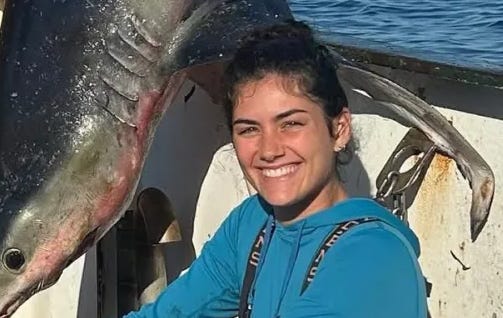
The University of Vermont community is mourning the loss of Jada Samitt, a 22-year-old recent graduate who was among seven people presumed dead after a commercial fishing vessel sank off the coast of Massachusetts on January 30, 2026. Samitt, who earned her Bachelor of Science in Natural Resources with a concentration in Ecology in May 2025, was working as a federal fisheries observer when the 72-foot fishing vessel Lily Jean foundered approximately 25 miles east of Cape Ann during extreme Arctic weather conditions.
The Incident
At approximately 6:50 a.m. on Friday, January 30, the U.S. Coast Guard received an emergency beacon signal from the Gloucester-based vessel. The beacon, known as an Emergency Position-Indicating Radio Beacon (EPIRB), was the only distress signal received—no verbal mayday call was transmitted by the crew, suggesting the vessel may have gone down rapidly.
Coast Guard search and rescue teams deployed multiple aircraft, helicopters, and surface vessels to the scene. Responders discovered a debris field and an empty life raft that had deployed but remained unoccupied. During the first day of searching, crews recovered one unresponsive individual from the water, later identified as the vessel’s captain, Accursio “Gus” Sanfilippo.
Extreme Weather Conditions
The vessel was operating in dangerous conditions as a severe nor’easter approached the New England coast. Air temperatures at sea were recorded at 12 degrees Fahrenheit, with water temperatures at 39 degrees. Wind speeds reached approximately 27 mph, generating waves that built from 4 feet to as high as 10 feet as the storm intensified.
These conditions created a significant risk for maritime icing, where freezing sea spray accumulates on a vessel’s structure. The accumulated ice adds weight to the upper portions of a ship, raising its center of gravity and potentially causing it to capsize. Local maritime experts suggested that icing likely contributed to the vessel’s sudden foundering, particularly since the boat was returning to port fully loaded with groundfish including cod, haddock, and pollock.
The Search Operation
Coast Guard crews conducted an exhaustive 24-hour search covering more than 1,047 square miles of ocean. However, officials suspended the search on Saturday morning, January 31, after determining that survival in the frigid conditions was no longer possible. In 39-degree water without survival suits, the Coast Guard noted that hypothermia typically occurs within one hour of immersion.
Who Jada Samitt Was
Samitt was originally from Richmond, Virginia, but moved to the Northeast to pursue her passion for marine ecology. At UVM, she was remembered as a student who was “brave and determined” with an “infectious smile and spirit”.
Following graduation, Samitt accepted a position with A.I.S. Inc., a company that partners with NOAA Fisheries to provide observer services on commercial fishing vessels. As a federal fisheries observer, her job involved collecting biological data on catch composition, gear performance, and the impact of fishing on non-target species—critical information used to manage federal fisheries sustainably.
Her family released a statement describing their “shattered hearts” and emphasizing that Jada viewed her work as a “dream” and a mission to protect the seas for future generations. She is survived by her parents, Julie and Jeff Samitt, her step-parents Stacey Samitt and Scott Firestine, and her siblings John, Charlie, and Nora.
The Other Crew Members
The Lily Jean was owned and operated by Captain Accursio “Gus” Sanfilippo, a fifth-generation commercial fisherman who appeared on the History Channel series “Nor’Easter Men” in 2012. His peers described him as a mentor who “taught everything he knew” to younger fishermen.
The tragedy was particularly devastating for the Beal family. Both 70-year-old Paul Beal Sr. and his son Paul Beal Jr. were working as deckhands on the vessel. The elder Beal had been fishing out of Rockport and Gloucester since the early 1970s.
The other crew members were 33-year-old John Paul Rousanidis of Salem, remembered for his passion for boxing and hard work; 44-year-old Sean Therrien of Peabody, described as a devoted father with a great sense of humor; and Freeman Short from the Marshfield/Scituate area.
Understanding the Observer Program
Fisheries observers like Samitt work in the same hazardous conditions as commercial fishermen, often spending days or weeks at sea. The NOAA observer program provides essential data for managing federal fisheries, but it places scientific personnel in high-risk maritime environments.
Following the tragedy, NOAA Fisheries announced a temporary suspension of observer deployments in the Northeast through at least February 4, 2026, citing both the loss and the severe weather conditions.
Gloucester’s Fishing Heritage
The loss of the Lily Jean represents another chapter in Gloucester’s long maritime history. Gloucester Mayor Paul Lundberg and Council President Tony Gross noted that while the community has experienced such tragedies before, “it is something we never get used to.” The city is perhaps best known for the 1991 disappearance of the Andrea Gail, memorialized in “The Perfect Storm.”
The city’s Fisherman’s Memorial will add seven new names to the thousands already inscribed on the monument commemorating those lost at sea since the 1600s.
What Happens Next
The U.S. Coast Guard is conducting a formal investigation into the sinking in collaboration with the National Transportation Safety Board. Rear Admiral Michael Platt, commander of the Coast Guard Northeast District, is leading the investigation with Lieutenant Commander Brett Igo serving as lead investigating officer.
Investigators will examine multiple factors, including vessel stability, the role of ice accumulation, cargo weight, and whether the crew had access to survival equipment. The investigation team includes experts in commercial fishing vessel safety, naval architecture, and maritime law.
The findings could lead to new safety regulations for fishing vessels operating in northern waters during winter months, potentially including requirements for de-icing systems or more frequent stability assessments. The tragedy has also sparked discussions about safety protocols for fisheries observers, with possible changes to weather criteria for deployments and enhanced survival training requirements.
At the University of Vermont, the loss has resonated deeply within the Rubenstein School of Environment and Natural Resources. The university community is discussing ways to honor Samitt’s legacy, potentially including memorial scholarships or enhanced safety training programs for graduates entering field-based environmental careers.
Memorial services have been held in Gloucester and surrounding communities for all seven individuals lost aboard the Lily Jean.