


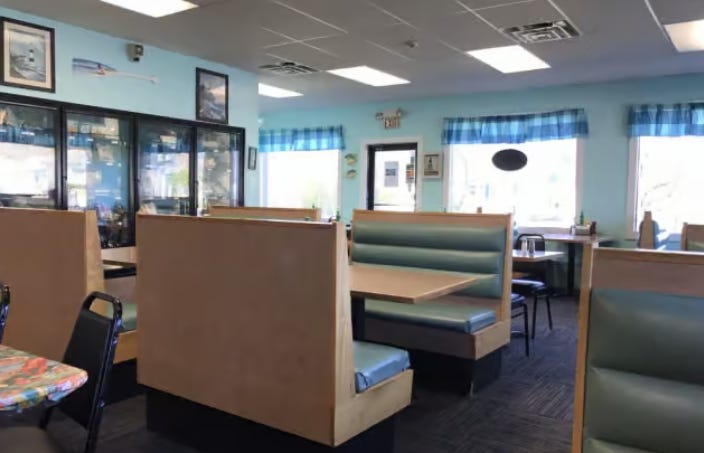
Ray’s Seafood Market & Restaurant posted a letter to customers this week announcing that it will close permanently on Sept. 12, 2026, at 7 p.m. The notice is signed “The Ray’s Seafood Market & Restaurant Family,” thanks customers for 74 years, and asks anyone holding gift certificates to bring them in and redeem them before the closing date. No reason is given.
Most Vermonters know Ray’s as one place: the market and restaurant at 7 Pine Crest Drive in Essex Junction, where you order the fried perch.
There is a second place, and it is not a restaurant.
At 49 North Street in Burlington’s Old North End, Ray’s runs a bait, tackle, and fish-buying counter. Buying does not mean buying from a wholesaler. It means buying fish caught by individual Vermonters — people who go out on Lake Champlain, catch more perch or bullhead than they intend to eat, and sell the rest. On Ray’s own website, under a page titled “Lake Fish,” the company puts it in two sentences: at its Burlington site, it buys fresh local fish year-round, and it sells live bait and fishing tackle.
The closing letter names 7 Pine Crest Drive. It does not address 49 North Street.
That distinction matters, because the Burlington side of Ray’s sits at the center of something Vermont has and almost no other state does.
The trade almost nowhere else allows
In most of the country, selling fish you caught with a rod and reel is illegal, and MeatEater’s 2022 survey of the rules found most states enforce that ban strictly.
Vermont is the outlier. Anyone with a Vermont sportfishing license can sell panfish — the state defines those as bluegill, bullhead, pumpkinseed, rock bass, and yellow perch, along with crappie until this year — subject to whatever daily limits apply to the water they came from. On Lake Champlain, there is no daily limit at all on those species. White perch, which is not in the panfish definition, is also saleable.
Shawn Good, a Fish and Wildlife biologist based in Rutland, told the outdoor publication MeatEater in 2022 that when a mail-order listing advertises wild-caught black crappie, the fish are coming almost exclusively from Vermont, and that he knew of no other state that permitted the practice. New York is the partial exception: it lets anglers sell some sunfish species, and lets them sell crappie only if the fish were caught in a state that allows it — which in practice means Vermont.
The reason sits in the statute. Vermont’s law protects a short list of gamefish from sale — salmon, trout, lake trout, walleye, northern pike, muskellunge, black bass — and leaves effectively everything else saleable. Good has described those statutes as at least 50 years old and out of date, and said changing the list itself takes an act of the Legislature.
But the same statute hands the Fish and Wildlife Board a key: it lets the Board add “any other fish specified by rule.” That clause matters later.
How the chain actually works
The structure of this trade is not what most people would guess:
Anglers sell buckets of fish to small bait shops around the state, most of which double as the licensed buyers.
Those shops resell to a large regional buyer — Ray’s.
Ray’s trucks the fish to processors in Ontario, on the north shore of Lake Erie.
The processors ship fillets to Boston, New York, Chicago, and to online retailers.
By the accounting in MeatEater’s 2022 report, a Vermont perch changes hands about four times between the hole in the ice and the plate.
Between 12 and 18 bait shops and fishmongers report purchases to the state in any given year, according to Fish and Wildlife data reported by VTDigger. So an angler with a bucket of perch is not out of options on Sept. 13.
The shops are the collection points. Ray’s is the place the collection points sell to.
What the trade is worth
Vermont’s own tally of buyer reports from 1998 through 2015 found that fish buyers statewide bought 7.11 million pounds of panfish over those 18 years — an average of about 394,772 pounds a year.
Anglers were paid a combined $13.18 million across that stretch, an annual average of roughly $732,471, or about $1.86 per pound.
Yellow perch carried the trade by weight, at 3.74 million pounds and $8.42 million in payments. Crappie moved the least weight of any tracked species but paid the most per pound, at $3.09 — roughly double what bluegill and pumpkinseed returned.
That last figure is the one to hold onto. The species the January rule banned outright was the most valuable pound-for-pound in the trade.
Spread across every angler who sold, that money was never a living. It was gas money, wiper blades, a way to make a February hobby pay for itself. But roughly $732,000 a year moving to Vermonters in cash, from a resource the state does not otherwise monetize, was not nothing either.
Two caveats on those numbers. They end in 2015, and Vermont has published nothing comparable since. And the state’s own view of them is skeptical: Good described the underlying annual reports as unaudited estimates, often written from memory, and probably minimums.
What changed in January
Buying fish in Vermont runs through a statute and a rule.
10 V.S.A. § 4611 makes it unlawful to buy or sell fish caught in Vermont without a permit issued by the Commissioner of Fish and Wildlife.
The Commercial Angling Rule, 10 App. V.S.A. § 123, builds out the machinery:
An angler cannot sell fish without a Vermont fishing license and a Fish Seller’s Endorsement.
A business cannot buy fish for resale without a Fish Buyer Permit, which runs January 1 through December 31 each year.
A permit holder must file quarterly reports listing pounds purchased by species and size group, with the Lake Champlain share broken out separately.
Those reports are due within 30 days of the close of each quarter.
The rule was amended effective January 1, 2026. The amended version banned the sale and purchase of black crappie and white crappie outright.
The department had wanted this for a long time. MeatEater reported in 2022 that Fish and Wildlife had opposed the panfish trade for years and went to lawmakers as recently as 2018 to try to end it, without success. Then-chief conservation warden Jason Batchelder put the obstacle plainly at the time: the department wanted the trade ended, and legislators kept telling them they had not shown a biological problem.
Batchelder became Commissioner of the Fish and Wildlife Department in 2025, after more than 22 years with the Agency of Natural Resources. Under 10 V.S.A. § 4611 and the Commercial Angling Rule, the Commissioner is the official who issues Fish Buyer Permits, sets the reporting the permits require, and can revoke a permit for noncompliance.
None of that is an accusation. It is a description of where authority sits — and the authority is not borrowed. The Legislature itself wrote the delegation into § 4611, letting the Board name additional prohibited species by rule. The department did not go around the General Assembly on crappie; it used a door the General Assembly built. What it could not do by rule was touch the gamefish list in the statute, and it did not try.
The people in the trade saw it differently. Paul Dunkling of Ray’s told MeatEater that most of the anglers selling to him were retired men who liked to fish and wanted to cover their gas — people who, in his telling, would be out there anyway. Vermont’s own angler surveys have found limited public appetite for ending the practice: in 2020, fewer than a quarter of resident anglers called angler-caught fish sales a problem at any level, and fewer than 9 percent called it a serious one.
That is the quiet structural story underneath a fish market closing: a trade the regulator has long wanted to end, narrowed by rule in January through authority the Legislature granted, with its main distribution point announcing in August that it is closing at least one of its two doors.
Compass draws no causal line between the rule and the closing, and none should be read into the sequence. The family has given no reason, and a business that has run for 74 years can close for any of a hundred reasons that have nothing to do with a rulebook.
What the record does not settle
Whether the Burlington fish-buying counter is closing. The family’s notice addresses 7 Pine Crest Drive. The two locations have separate phone numbers and, on Ray’s own website, separate descriptions. The notice does not mention Burlington either way.
Whether another business would take on the distribution role. Aggregating that volume and moving it to Ontario is a different business from buying a bucket at a bait shop counter, and the public record does not show who else does it.
What the quarterly reports show. The Q1 and Q2 2026 reports have come due under the amended rule — the first purchase figures the state has collected quarterly rather than once a year. The Q3 report is due within 30 days of Sept. 30.
One note for the record: the family’s letter dates the business to 1952, consistent with the 74 years it cites. Paul Dunkling has previously dated the family’s fish business to 1949, and Ray’s Burlington bait and fish-buying listing says 1951.
What to watch
Vermont spent years arguing about how tightly to regulate a fish trade that ran for decades with almost no reliable data attached to it. The rules took effect in January. The first full year of reporting under them is not finished.
Whatever happens on North Street, those quarterly reports will be the first time anyone can say with real numbers what this trade actually is — and whether the state started counting it on the way down.
Compass Vermont is independent and reader-supported.