


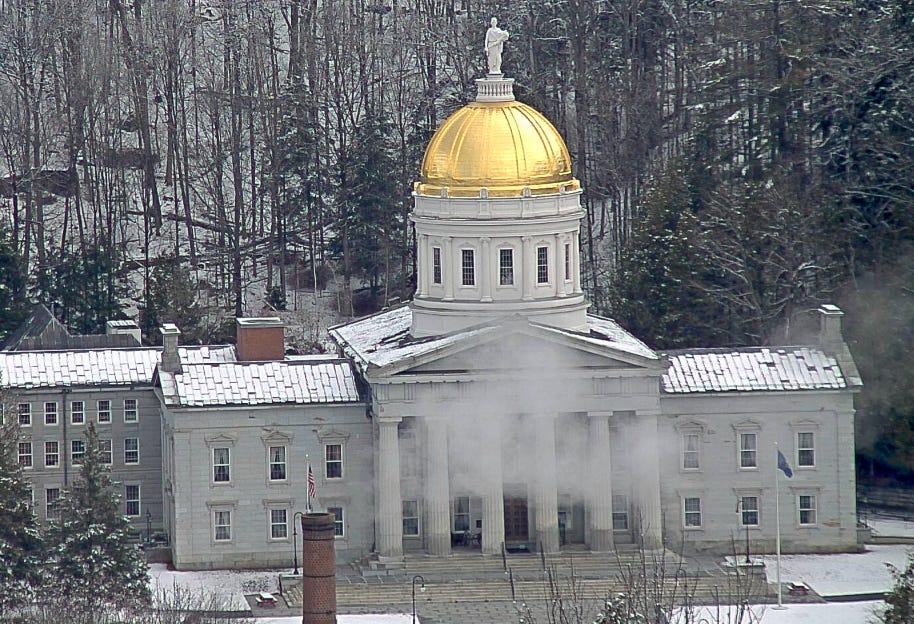
On Thursday, the House Ways and Means Committee voted 6-5 to advance legislation using approximately $52 million in one-time surplus funds to bring the average statewide property tax increase down to roughly 7% for fiscal year 2027.
The bill now heads to the full House, then the Senate, and then almost certainly into a wall.
Gov. Phil Scott has made his position unambiguous. “Vermonters can’t afford it, and I will not accept it,” he wrote on X Friday morning. He wants the legislature to spend an additional $52 million — drawing down reserves set aside for next year — to bring the average increase closer to 4%. After Republicans gained 17 House seats and 6 Senate seats in November 2024, they now hold enough votes in both chambers to sustain a veto — something Democrats could override as recently as last session. Whatever the legislature passes, it will likely need to satisfy Scott, or it won’t pass at all.
What neither side is saying loudly: neither approach fixes the underlying problem. And that problem is getting harder to paper over every year.
Why does this keep happening?
Vermont funds its public schools primarily through the Education Fund, which is fed by a statewide property tax. The state sets a tax rate for each district based on how much that district spends per pupil. Spend more, pay more.
The fund has been running a structural deficit for years. Education spending grows at 5–7% annually while revenue grows at roughly 1.7–2.6%. The gap between those two numbers is the engine driving your tax bill up year after year.
Several overlapping forces are pushing spending higher:
Teacher and staff healthcare costs have surged in recent years. According to the Vermont Superintendents Association, school districts absorbed a 16% health insurance increase in the FY25 budget cycle, followed by 12% the cycle before that. Health benefits have grown from less than 10% of school budgets in 2018 to approximately 15% today, and could reach 20%.
Enrollment is declining — Vermont has lost approximately 25,000 public school students over the past two decades, dropping from around 98,000 students in FY2005 to approximately 73,000 today — but costs don’t shrink proportionally. A school district with 400 students still needs a principal, a special education coordinator, transportation routes, and building maintenance. The cost-per-pupil rises as the headcount falls.
Vermont still operates 119 separate school districts for a state with approximately 73,000 public school students. Consolidation has been discussed for decades. Overhead — administration, legal, finance, HR — is duplicated across dozens of tiny supervisory unions.
Act 127 of 2022 revised the pupil weighting formula to direct more funding toward students in poverty, English language learners, and rural districts. The policy had equity goals, but it redistributed the tax burden across communities in ways that are still rippling through individual town tax bills — with wealthier towns often absorbing steeper increases.
Federal COVID relief funds (ESSER) pumped hundreds of millions into Vermont schools between 2020 and 2024. Those funds expired. The spending levels they supported did not always contract with them.
The buydown cycle — and why it creates its own problem
Three times in recent years, Vermont has responded to projected property tax spikes by injecting one-time surplus cash into the Education Fund to artificially lower the tax rate. The intent is to give Vermonters relief while longer-term reforms are worked out.
The problem: every dollar of one-time money spent this year is a dollar that isn’t there next year — and the underlying cost growth keeps compounding.
Last year, the legislature and Gov. Scott applied $118 million in surplus funds to hold the FY2026 average increase to just 1.1%. That was broadly popular. It was also the single largest contributor to the current problem. According to the state Tax Department’s December 2025 forecast, which projected a nearly 12% spike without intervention, roughly half of that projected increase traces directly back to the $118 million not being available to repeat.
The bill advanced Thursday would hold back $50–52 million in reserves explicitly to help soften next year’s increase. Rep. Rebecca Holcombe, a Democrat from Norwich who voted against the bill, put it plainly before the committee vote: “I am tired of hearing us talk about how unstable the system is when we are the source of much of the instability.”
The Joint Fiscal Office has modeled what it would cost to keep holding this line. To limit annual property tax increases to 5% through fiscal year 2029, Vermont would need to inject approximately $480 million in buydowns over just the next three years — a sum that dwarfs this year’s entire buydown debate.
What does “7% average” actually mean for your tax bill?
The 7% figure is a statewide average — and history shows that averages can be deeply misleading when it comes to what individual Vermonters actually pay.
Vermont calculates each town’s property tax rate based on that school district’s per-pupil spending, adjusted for local property values. Two neighboring towns with different school budgets — or different property assessment ratios — can face wildly different tax bill increases in the same year.
Consider what happened in FY2025, the year lawmakers applied the massive $118 million buydown that held the statewide average to roughly 1%. That average obscured a range that would shock most readers: the town of Windham saw a 39% increase that year. Granville saw 38%. Dozens of other towns absorbed double-digit increases that never made the headline number.
The FY2027 cycle is unlikely to be different. A 7% statewide average — or 4%, if Scott gets his way — will almost certainly mask a spread from low single digits to well above the average in some communities. Your actual tax bill increase will depend on what your local school board proposed, what voters approved at Town Meeting, how your town’s assessed property values compare to current market value, and how Act 127’s weighting formula redistributes costs across your district specifically.
At this year’s Town Meeting, Vermont voters approved 82% of school budgets statewide, with total spending coming in about 1.6 percentage points lower than the Tax Department had projected — a modest improvement that helped reduce this year’s intervention from the originally projected 12% to the current 7% baseline. Nineteen school budgets were defeated outright — a lower rejection rate than the historic 2024 cycle, but still above normal. Districts that passed high-spending budgets are likely to see above-average increases regardless of what the Statehouse does.
Where does this go from here?
The bill heads to the full House floor, then the Senate, and then to a governor who has already signaled he’ll reject it in its current form. The two sides are roughly $50 million apart on the buydown amount — but the real distance between them is philosophical.
The Democratic majority’s position, articulated by House Ways and Means Chair Rep. Emilie Kornheiser of Brattleboro, is that Vermonters need relief now, and holding some reserves for next year is responsible stewardship. Scott’s position is that a 7% average increase is unacceptable and the legislature should spend what it takes this year to get closer to 4%. Neither position addresses why the number keeps being so large in the first place.
The longer-term structural fix is Act 73, passed last year, which mandates consolidation of Vermont’s school districts, introduces a new foundation funding formula, and shifts to a uniform statewide education property tax rate beginning in FY2029. But the Act 73 redistricting task force recommended only voluntary consolidation in November 2025 — a significant retreat from the mandatory consolidation that was supposed to generate administrative savings. Scott has tied his broader budget cooperation to progress on mandatory consolidation. That fight is running in parallel with the buydown negotiation, and its outcome will matter far more to your long-term tax bill than whether this year’s increase lands at 4% or 7%.
The bottom line
Vermont’s education property tax keeps rising because school costs are growing significantly faster than the revenue base that supports them. Property taxes have risen more than 40% over the past five years even with repeated cash injections. The state has repeatedly chosen to cushion the impact with one-time money rather than restructure the system — a choice that buys time but makes the eventual reckoning larger. This year’s debate is nominally about $50 million. It’s really about whether Vermont is willing to confront a structural problem that a decade of buydowns has not solved.
For property owners, the practical takeaway is this: watch what your school district spends, not just what the Statehouse does. The deal lawmakers and the governor eventually reach will set a statewide floor. What your town voted on in March will largely determine where your tax bill lands within that range.
The Vermont Tax Department publishes annual education tax rate letters with town-by-town data. The Joint Fiscal Office’s February 2026 report on multi-year Education Fund projections is available through the Vermont Legislature’s website.