



When Vermont wants to craft progressive policy, state leaders often look west to California for inspiration—from climate initiatives to healthcare reforms. But when it comes to holding legislators accountable for accepting expensive, all-expenses-paid trips from foreign governments, Vermont’s approach looks nothing like the Golden State’s rigorous ethics enforcement system.
That contrast has taken center stage as five Vermont House members continue serving without public consequence six months after accepting a trip to Israel valued at approximately $6,500 per person, and two months after Jewish Voice for Peace Vermont-New Hampshire filed formal ethics complaints against them.
The Delegation and Its Aftermath
In September 2025, three Democrats and two Republicans traveled to Israel as part of an event titled “50 States, One Israel.” The delegation included Rep. Matthew Birong (Chair of Government Operations), Rep. James Gregoire (Vice Chair of Corrections), Rep. Sarita Austin (Education), Rep. Will Greer (Education), and Rep. Gina Galfetti (Health Care).
Organized by the Israeli Ministry of Foreign Affairs, the trip featured chartered flights and luxury accommodations. Prime Minister Benjamin Netanyahu described the initiative as an effort to recruit state leaders to “counter attempts to besiege Israel,” according to news reports.
The trip drew particular scrutiny after photographs emerged showing the legislators planting a Vermont state flag on the site of a destroyed Palestinian village. Four of the five participants are sponsors of H.310, legislation that adopts specific definitions of antisemitism that critics say were promoted by Israeli officials during the trip.
Renewed Calls for Accountability
This week, Jewish Voice for Peace held its second annual “Jewish Day of Advocacy for Palestine” at the Vermont State House, including a news conference, teach-in for legislators, and one-on-one lobbying sessions. The group represents the local chapter of what it describes as the largest progressive Jewish organization in the country.
“From our Jewish perspective, it is unconscionable for our Vermont legislators to accept a gift of a trip to Israel, all expenses paid, to get lobbied by Israel,” stated Liz Blum, a JVP member and Norwich resident. “We are seeking remediation for this behavior. Did they not see that their visit was happening during a genocide? Did they even request to see the West Bank and Gaza or speak to Palestinians?”
The speakers included teachers, students, education justice advocates, and a Vermont legislator. They called for the House Ethics Panel to sanction the five lawmakers and demanded increased protections for free speech in Vermont schools.
How Vermont Compares: The Ethics Gap
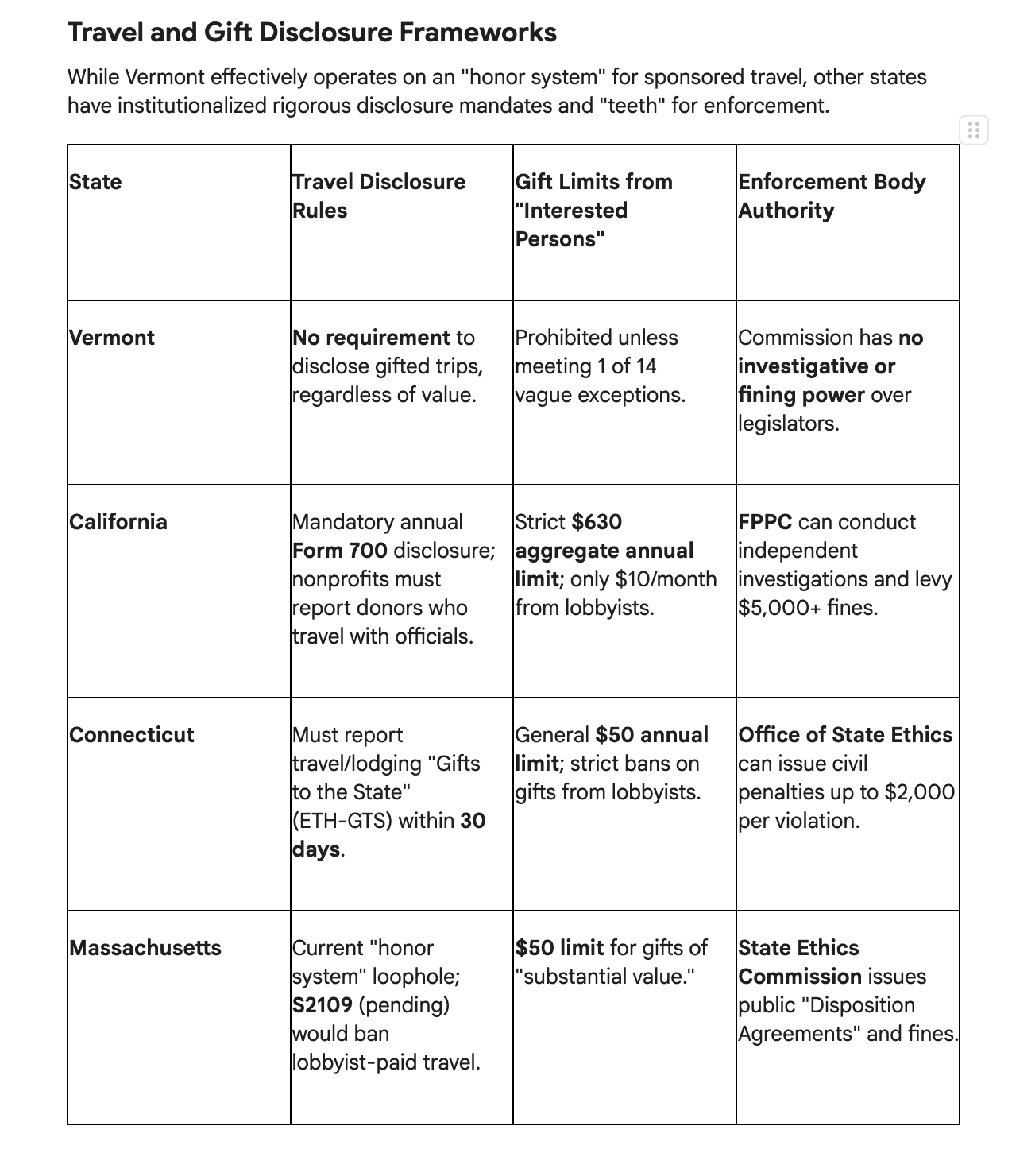
The differences between Vermont and other states—including those Vermont typically follows on progressive policy—are substantial. Here’s how Vermont stacks up against California and its New England neighbors:
The “Honor System” in Action
The contrast is especially striking given California’s enforcement track record. The California Fair Political Practices Commission can conduct independent investigations and has levied substantial fines for ethics violations. Vermont’s State Ethics Commission has no such power over legislators.
Even Vermont’s New England neighbors have stronger frameworks. Connecticut requires reporting within 30 days and can impose penalties. Rhode Island’s commission can fine up to $25,000 per violation. Massachusetts, despite currently having what critics call an “honor system” loophole, is actively working to close it through pending legislation that would ban lobbyist-paid travel.
Vermont stands alone as one of the only states with no statutory sanctions for ethics disclosure failures. The House Ethics Panel operates under strict confidentiality rules—members cannot even acknowledge whether an investigation exists.
The “Travel Loophole” and Ideological Selectivity
California has legislated bans on state-funded travel to over 20 states with laws deemed discriminatory against LGBTQ+ individuals—an ideological use of travel restrictions that has no parallel in Vermont’s system. Massachusetts lawmakers are currently moving to close what they call a “travel loophole” that allows organizations to fund trips like the Israel delegation, framing it as “a matter of good government that should be insulated from influence buying.”
Critics point to what they describe as selective enforcement in Vermont. In 2021, Northeast Kingdom legislators faced public condemnation from peers and local boards for voting against a resolution denouncing the January 6th Capitol riots. The legislature moved with emergency speed to enact protections for transgender healthcare in 2023 and restrict immigration arrests in 2022.
When Vermont Has Used “Restorative Justice”
Vermont’s institutional response to ethical controversies has increasingly relied on what’s described as a “restorative justice” model. When Rep. Mary Morrissey was caught on camera soaking a colleague’s bag in 2024, the House chose a private restorative justice process over formal censure or loss of committee seats.
In the Israel delegation case, despite expressions of concern from a Jewish coalition and several fellow legislators, the targeted individuals have faced no public consequences or loss of committee assignments. All five continue to serve on their respective committees, including those overseeing competing bills on antisemitism awareness and speech protection.
Competing Legislation at the Center of Controversy
The ethical questions surrounding the trip intersect directly with pending legislation. Four of the five trip participants sponsor H.310, the “Antisemitism Awareness” bill that adopts definitions critics say were promoted during the Israel trip.
Meanwhile, H.615 aims to protect speech in educational settings—legislation that Jewish Voice for Peace and other groups say is necessary to counter what they view as attempts to chill criticism of Israeli government policies.
What Happens Next
As of February 8, 2026, the status of the five legislators remains unchanged. While the State Ethics Commission referred the JVP complaints to the House Ethics Panel in January, no public findings have emerged. The panel’s confidentiality rules mean Vermonters may never know the outcome of any investigation.
The participation of trip attendees on committees considering both the antisemitism awareness and speech protection bills ensures the ethical controversy will remain central to the 2026 legislative session. Whether the House Ethics Panel breaks its silence or maintains what critics call a “culture of ambivalence,” the coalition calling for their resignation shows no signs of backing down.
For a state that often positions itself as a leader in progressive governance, the comparison to California’s enforcement mechanisms and Massachusetts’ pending reforms raises questions about whether Vermont’s citizen-legislature “honor system” remains viable in an era of increasingly expensive and ideologically targeted sponsored travel.
The “Honor System” needs to change...