


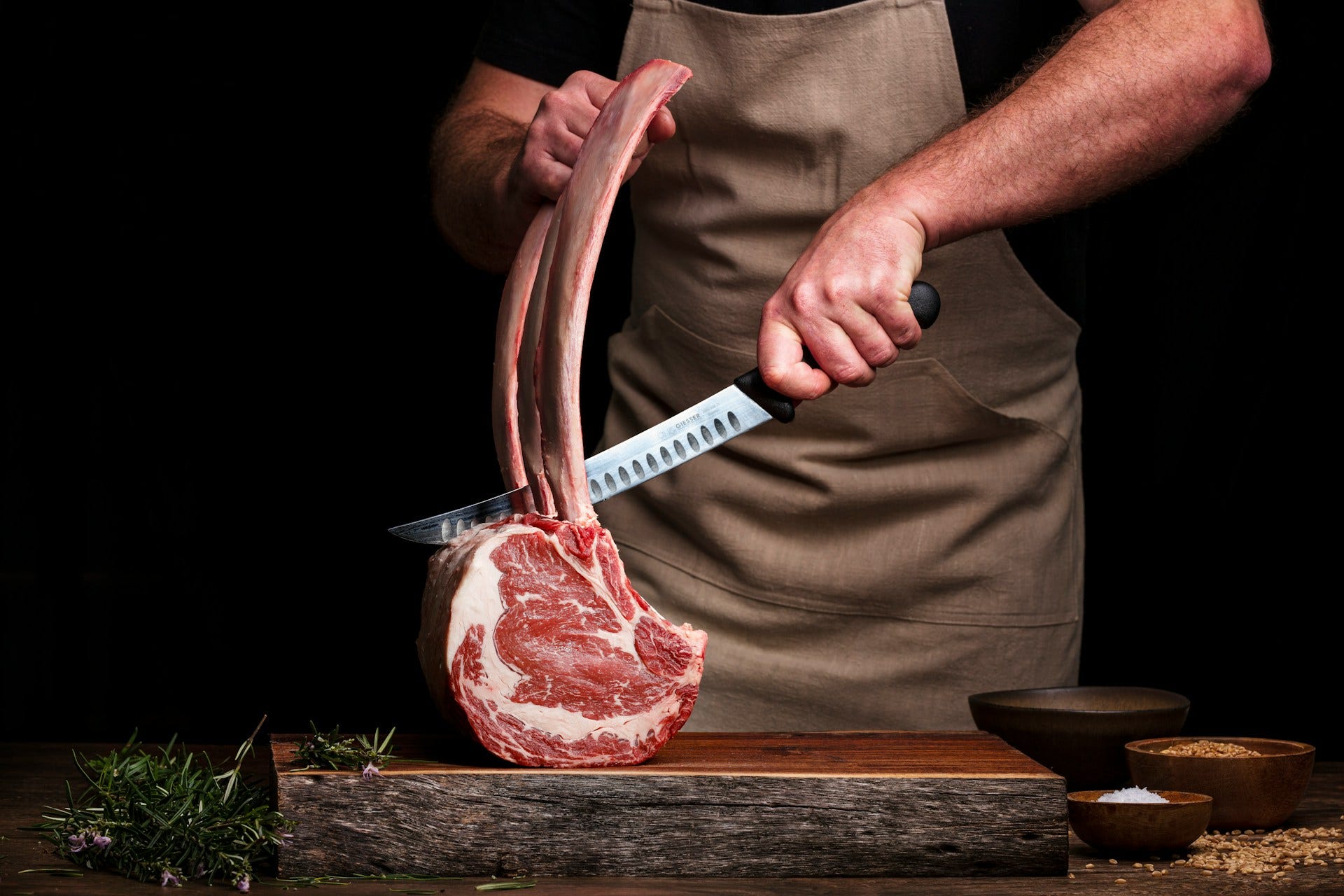
A sweeping new bill introduced in Congress on March 5, 2026, aims to break up the country’s largest meatpacking companies in what sponsors call an effort to lower grocery prices and give independent farmers more bargaining power. The legislation has direct implications for Vermont’s agricultural economy.
A Vermont Voice at the National Press Club
Senator Peter Welch joined Senate Democratic Leader Chuck Schumer at the National Press Club to unveil the Family Grocery and Farmer Relief Act, calling it a necessary intervention in a market dominated by four corporations that control roughly 85 percent of domestic beef processing.
“Those who create the wealth should get a reasonable share of the wealth they created,” Welch said at the event, framing the bill as a way to restore fairness to farmers squeezed by concentrated corporate power.
The legislation targets what sponsors call the “Big Four” meatpackers: Cargill, JBS, Tyson Foods, and National Beef. Under the proposed law, these companies would face mandatory breakups if they exceed market share thresholds or maintain processing operations across multiple types of meat.
What the Bill Would Actually Do
The Family Grocery and Farmer Relief Act contains several distinct provisions that would fundamentally reshape how meat is processed and sold in the United States.
The most transformative element is what the bill calls the “one-species rule.” Under this provision, major meatpacking conglomerates would be prohibited from controlling more than one type of meat processing business. A company like Tyson Foods, which currently maintains significant operations in beef, pork, and poultry, would be forced to choose a single line of business and sell off the others.
The bill also establishes hard caps on how much of the market any single company can control, both nationally and regionally. Supporters argue that national statistics often hide the reality that in some parts of the country, a single packer may be the only viable buyer for ranchers within hundreds of miles. If these caps are exceeded, the Federal Trade Commission would have authority to order targeted divestitures—forcing companies to spin off plants and facilities into new, independent firms.
Another key provision addresses what agricultural economists call “captive supply.” This refers to arrangements where packers own or contractually control livestock before animals are ready for slaughter, allowing them to bypass open-market auctions. The bill would limit the amount of cattle a packer can slaughter from any single large feedlot, an effort to revitalize cash markets where independent producers can secure transparent, market-driven prices.
The Economic Picture Is Complicated
While the bill’s sponsors point to high grocery prices as evidence that consolidation hurts consumers, the current market situation presents a more complex picture.
Throughout 2025, beef packers were consistently operating at a loss even as consumers paid record prices for ground beef. Data from industry trackers shows packer margins dipped into negative territory in September 2024 and remained there through 2025, with estimated losses of more than $165 per head of cattle processed.
Meanwhile, cattle producers and feedlot operators experienced an exceptionally profitable year. A shortage of market-ready cattle—driven by years of herd depletion—forced packers to pay record prices to secure supply. Cattle prices reached an all-time nominal high of $242 per hundredweight in August 2025.
This creates what economists might call a paradox: the “Big Four” meatpackers that the bill targets appear to be losing money, while the producers the bill aims to help are currently enjoying record returns.
Industry analysts point to several factors beyond consolidation that have contributed to high retail prices: the cattle herd is at its lowest point in decades, input costs for labor and utilities have risen, and disease outbreaks including Avian Influenza and H5N1 have disrupted production throughout 2025.
The Administration Has Taken Some Action
Senator Welch stated that “the Trump Administration will keep refusing to take action” on affordability and consolidation. However, the record shows the administration has pursued its own approach to these issues.
On November 7, 2025, President Trump directed the Department of Justice to launch an investigation into the largest meatpacking companies for potential price-fixing and collusion. Attorney General Pam Bondi and the DOJ’s antitrust chief partnered with USDA Secretary Brooke Rollins on what the administration called an effort to root out “illegal collusion” by foreign-dominated conglomerates.
The administration also rolled out a $12 billion aid package for farmers impacted by trade disruptions and market failures in late 2025.
Foreign Ownership Draws Bipartisan Concern
One area where the Welch-Schumer bill appears to align with administration priorities involves foreign ownership of American meatpacking operations.
The legislation addresses the dominant role of JBS USA, a subsidiary of Brazilian conglomerate JBS S.A. and the world’s largest meatpacker, as well as Smithfield Foods, the largest U.S. pork processor and a subsidiary of China’s WH Group since 2013.
Senator Schumer has raised concerns that foreign corporations with ties to the People’s Republic of China utilize state-backed financing to acquire American food companies, citing Smithfield’s recent $450 million acquisition of Nathan’s Famous.
President Trump has echoed similar concerns, stating on Truth Social that “Majority Foreign Owned Meat Packers” are artificially inflating prices and jeopardizing food security. The bill would empower the FTC to mandate divestiture of foreign-controlled meatpacking assets to domestic owners following national security reviews.
Industry Groups Push Back Hard
The meatpacking industry and associated trade groups have voiced strong opposition to the legislation.
Julie Anna Potts, President of the Meat Institute, called the bill “absurd” and “reckless election-year pandering.” The Institute argues that forcing major companies to divest will destroy efficiencies that keep processing costs manageable, ultimately raising consumer prices rather than lowering them.
The National Cattlemen’s Beef Association has suggested that Congress should focus on protecting herds rather than using the industry as a “political football,” arguing that the solution to high beef prices is encouraging herd rebuilding, which would increase supply and naturally moderate prices over time.
Industry groups also warn that the legislation’s labor provisions—which require any divestiture plan to maintain employment levels and honor collective bargaining agreements—could make restructuring more difficult and costly.
Support From Progressive Advocacy Groups
The bill was unveiled alongside the American Economic Liberties Project, an advocacy organization that promotes what scholars call “Neo-Brandeisian” antitrust enforcement—the idea that antitrust law should actively prevent concentration of economic power to protect democracy and small businesses, not just ensure low consumer prices.
The organization’s interim executive director previously served as the chief political advisor to Senator Bernie Sanders, and the group receives funding from progressive foundations including the Foundation to Promote Open Society and the Omidyar Network Fund.
What Happens Next
The Family Grocery and Farmer Relief Act faces significant hurdles before it could become law. As a Democratic bill introduced during a period of Republican control, it would need substantial bipartisan support to advance through committee and reach the Senate floor.
The bill’s sponsors appear to be positioning the legislation as a contrast to the administration’s approach ahead of the 2026 elections, offering voters a choice between structural breakups of large corporations and the administration’s focus on trade policy, deregulation, and targeted investigations.
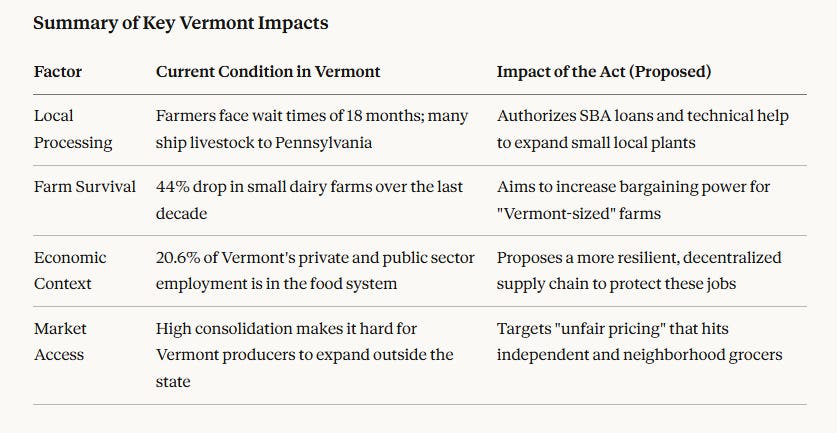
For Vermont farmers currently shipping livestock to out-of-state processors or waiting 18 months for local slaughter appointments, the bill represents one potential path toward expanded local processing capacity. Whether that path proves viable—and whether the proposed structural changes would actually lower grocery prices—remains a matter of intense debate among agricultural economists and industry observers.
The Department of Justice investigation into meatpacker pricing practices continues separately from the legislative effort and could produce findings that inform future policy decisions regardless of the bill’s fate in Congress.
.........."Senator Peter Welch joined Senate Democratic Leader Chuck Schumer at the National Press Club to unveil the Family Grocery and Farmer Relief Act, calling it a necessary intervention in a market dominated by four corporations that control roughly 85 percent of domestic beef processing."..........What does the DC club control? and this........."“Those who create the wealth should get a reasonable share of the wealth they created,” Welch said at the event, framing the bill as a way to restore fairness to farmers squeezed by concentrated corporate power.".........The DC Club has made a Fortune as well as Mr.Welch. Vermonters??? not so much. I have one simple question, why does Vermont keep Voting for Mr. Welch???