


A federal immigration enforcement action in South Burlington on Wednesday ended with three people taken into federal custody, more than 200 protesters in the street, flash-bang grenades and pepper spray deployed in a residential neighborhood — and a local police chief publicly rebuking the federal agents he had just spent nine hours managing.
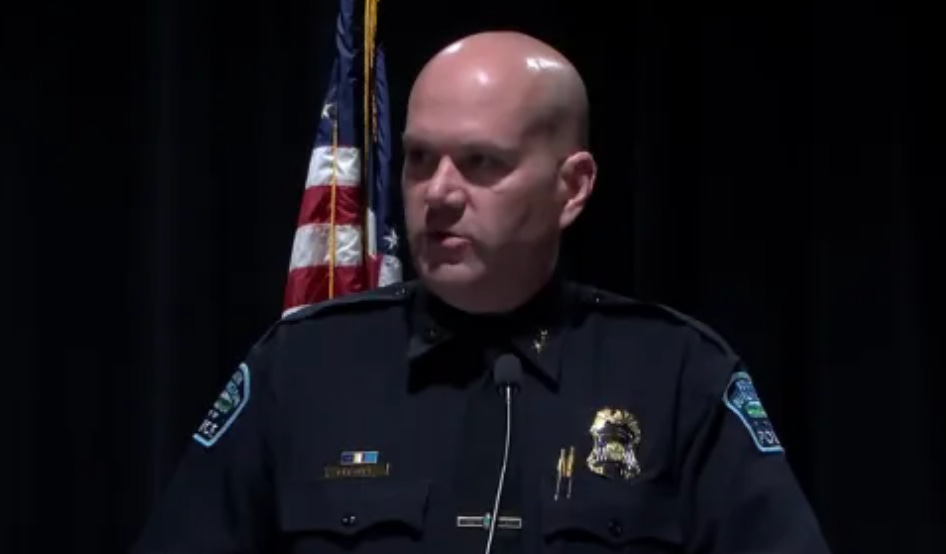
South Burlington Police Chief William Breault held a press conference Wednesday night at City Hall flanked by Burlington Police Chief Shawn Burke and Vermont State Police Tactical Services Unit Commander Capt. Michael Filipek. The three officers — none of whom had been told the operation was coming — delivered a unified message: they had no authority to stop what ICE had set in motion, but they wanted the public to know it did not reflect their standards.
“Would not have been how I would have done it,” Breault said. “From the beginning, this plan was not executed to the standard that local law enforcement here in South Burlington — and I’m sure the chief in Burlington and the state police would agree — not how we would do things.”
Breault criticized what he called the federal agents’ “poor decision making and planning,” specifically questioning whether it was wise to attempt an arrest in a busy residential corridor during morning rush hour near two schools, and whether the ensuing car chase through that corridor was “fully necessary.” He said he raised those concerns directly with federal officials during the day. They were ignored.
What happened
Around 7:30 a.m. Wednesday, ICE deportation officer Colton Riley — based out of the agency’s St. Albans field office — was conducting surveillance on a Dorset Street address when he observed two men get into a Toyota Camry. Suspecting the driver was his target, Riley followed. A second ICE vehicle attempted to box in the car in a nearby parking lot. The driver rammed the agent’s car head-on, according to a federal affidavit filed in U.S. District Court in Vermont, then drove through a wooded area adjacent to South Burlington High School and Tuttle Middle School, entered oncoming traffic, and crashed into a civilian’s vehicle before abandoning the car on foot and entering a home at 337 Dorset Street.
South Burlington Police learned about the operation only when 911 calls came in reporting the crash. The department says it was not notified of the planned enforcement action in advance.
The subject of the federal warrant was Deyvi Daniel Corona-Sanchez, a Mexican national who was arrested on or about October 27, 2021, after being found crossing the Rio Grande near Eagle Pass, Texas. He was deported in 2022. Federal filings allege he subsequently reentered the United States illegally — a federal felony under 8 U.S.C. §1326. In January 2026, he was arrested by the Middlebury Police Department on a DUI charge, with that case still pending. A criminal arrest warrant was signed Wednesday by federal Magistrate Judge Kevin Doyle.
A neighbor, Richard Landsman, told Vermont Public that an Ecuadoran family with two children had lived at 337 Dorset Street for roughly a year. It was not publicly established whether Corona-Sanchez was a resident of the home or had entered it to seek refuge from the pursuit. The identities and legal status of the two women also removed from the home by federal agents have not been disclosed.
The nine-hour wait — and why it mattered
ICE agents stood outside 337 Dorset Street for nearly nine hours before entering. That delay was not logistical. It was legal.
Federal agents initially had only an administrative warrant — a document signed by an ICE official, not a judge — which does not carry Fourth Amendment authority to enter a home without consent. In May 2025, acting ICE Director Todd Lyons signed a controversial internal memo asserting that administrative warrants are constitutionally sufficient to force entry. That position has been rejected by at least one federal court: in January 2026, U.S. District Judge Jeffrey M. Bryan ordered the immediate release of a Minnesota man, finding that ICE violated the Fourth Amendment when it forcibly entered his home armed only with an administrative warrant.
In the South Burlington case, agents waited until a federal judge signed a criminal arrest warrant before proceeding. Vermont State Police Lt. Cory Lozier, the Williston Barracks station commander, made the significance of that distinction clear in remarks to reporters on scene during the afternoon standoff.
“When there’s a warrant signed by a judge, it’s happening,” Lozier said. “If we have to intervene to make sure it’s done safely, then we might have to, absolutely. And safely probably means more to local assets that are in Vermont, because we’re here tomorrow, and the next day, and months to come. The feds are not — they’re going to do the thing and leave.”
That sentence, spoken in real time by a Vermont State Police commander, captures the core institutional tension the evening’s press conference made official.
A community response years in the making
By mid-morning, roughly 150 to 200 people had gathered outside the home. Migrant Justice, a Vermont-based farmworker and immigrant rights organization with an approximately 2,000-member rapid response network, activated its emergency line after a neighbor called in the operation. The crowd grew throughout the day — bringing guitars, hot food, and linked arms at the home’s doors — before the mood shifted sharply around 5 p.m. when tactical units and additional state and federal officers arrived with the criminal warrant in hand.
Vermont State Police and federal agents pushed through the crowd, entered the home with a battering ram, and removed three people. Protesters moved to block the convoy of vehicles waiting to transport the detainees, locking arms around trucks and preventing them from leaving the scene for more than an hour. Officers eventually cleared the road using flash-bang grenades, pepper balls, and pepper spray. Vermont State Police subsequently confirmed that no chemical agents or less-lethal munitions were deployed by state or local officers — all such force came from federal agents.
Four people were cited by local and state police for protest-related offenses; none remained in custody as of Wednesday night. Breault said he was not yet certain whether any would be formally charged.
South Burlington School Superintendent Joe Clark sent a message to families confirming that students and staff were not affected by the incident and that the district had received no advance notice from federal authorities.
Burlington Police Chief Burke, standing alongside Breault at the press conference, said the scenario had been anticipated. Local and state law enforcement agencies had met earlier in 2026 to coordinate how they would respond when federal immigration enforcement operations arrived in their communities.
“It was clear to us earlier here in 2026 that we would likely face one of these operations,” Burke said.
Where South Burlington stands
South Burlington is Vermont’s second-largest city and has taken a series of formal positions on immigration enforcement. Its police department maintains a ten-page Fair and Impartial Policing Policy, in place since 2024, that prohibits officers from assisting ICE unless federal agents present a criminal warrant signed by a judge. On February 2, 2026, the South Burlington City Council passed R-2026-05, formally condemning ICE and Border Patrol enforcement, surveillance, and practices.
Both policies held on Wednesday: South Burlington officers confirmed they did not assist with the immigration enforcement action itself and responded only to manage public safety and protect the right to protest. Vermont State Police similarly stated their involvement was limited to warrant execution and crowd safety, not immigration enforcement — a distinction that, under state law S.44 (2025), determines whether their participation violated Vermont’s prohibition on state cooperation with civil immigration enforcement.
Chief Breault was hired in 2024 after a competitive nationwide search, bringing 26 years of experience and the description from city leadership of representing “the best of modern 21st-century policing.” Wednesday night, standing at the podium at City Hall, he used his first major public test to say that what he had watched unfold on Dorset Street did not clear that bar.
“There are ways to conduct an arrest in a safer way without endangering community members,” he said.
ICE did not respond to requests for comment.
Sources: South Burlington Police Department press release; federal court filings, U.S. District Court of Vermont; Vermont Public; Seven Days; VTDigger; WCAX; MyChamplainValley; The Other Paper (South Burlington); The Boston Globe; South Burlington city website.