


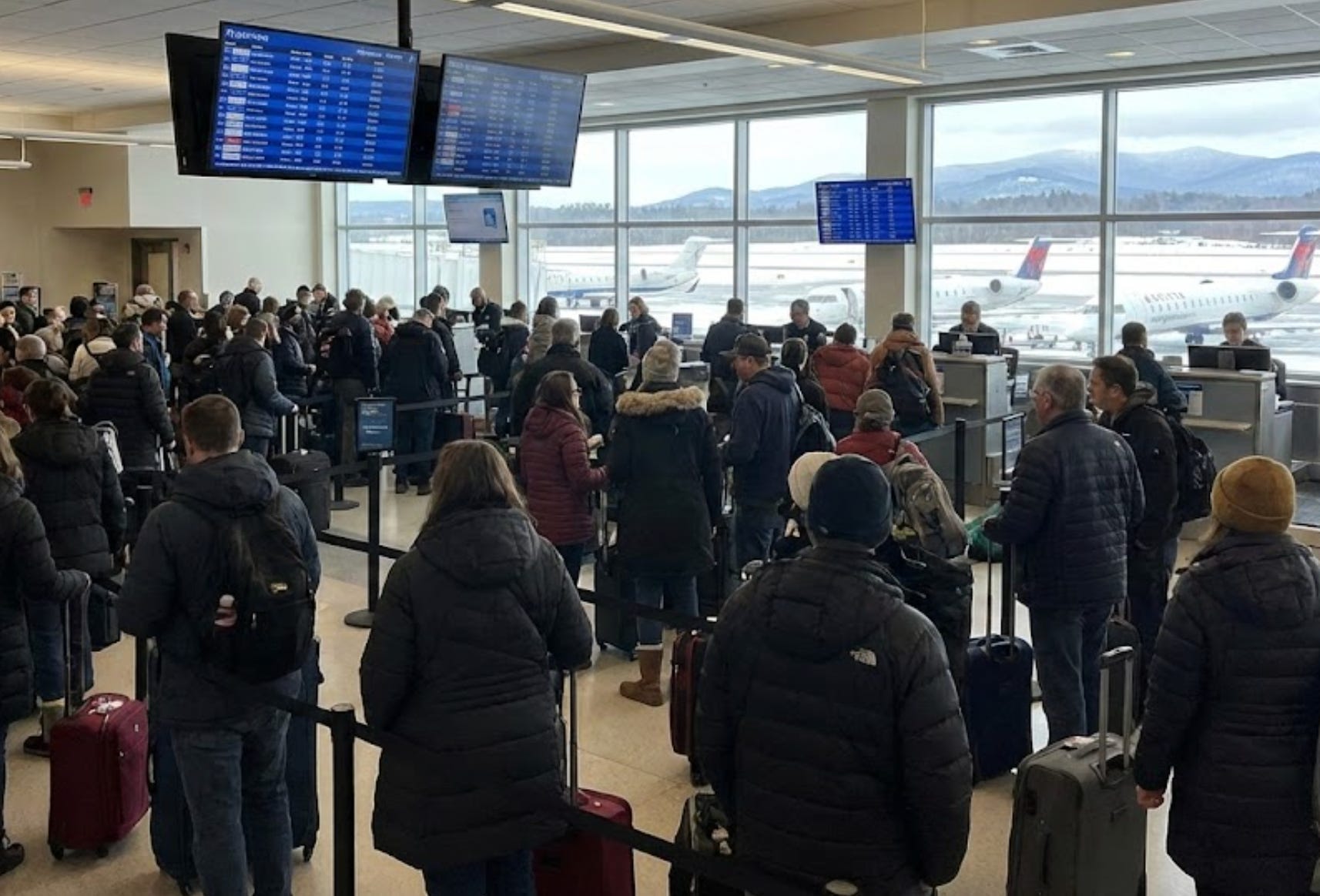
If you have flown recently, you know the sinking feeling of seeing “DELAYED” flash across the departure screen. For years, the conversation around what airlines owe you when things go wrong has been a source of frustration. Now, as of December 2025, a new bill in Congress is attempting to change the rules of the sky.
Introduced by Senators Mark Kelly (D-AZ), Richard Blumenthal (D-CT), and Edward J. Markey (D-MA), the Flight Delay and Cancellation Compensation Act proposes cash payouts for delayed passengers. However, to understand what this means for your next trip out of Burlington or beyond, we have to look past the headlines and into the complex machinery of Washington, D.C.
This explainer breaks down the bill, the political drama behind it, and the economic realities impartial observers are watching closely.
1. How We Got Here: A Regulatory Whiplash
To understand why this bill was introduced now, we have to look at the rapid policy shifts over the last year.
In late 2024, the Biden Administration’s Department of Transportation (DOT) began the process of creating rules that would require airlines to pay cash compensation for delays under their control. This was known as an Advance Notice of Proposed Rulemaking (ANPRM). It was a proposal to create a rule, not a finalized law.
However, following the inauguration of President Donald Trump in January 2025, the federal government pivoted toward deregulation. Under Executive Order 14192, titled “Unleashing Prosperity Through Deregulation,” agencies were directed to remove burdens on businesses to stimulate the economy.
Consequently, in November 2025, the Trump DOT formally withdrew the Biden-era proposal, arguing that mandatory compensation would inflate ticket prices and harm the industry. In response, Democratic Senators introduced this bill to bypass the DOT and make compensation a matter of federal law.
2. What the Bill Proposes
The legislation seeks to establish a standardized system where airlines must pay passengers for delays and cancellations that are deemed within the airline’s control (such as maintenance issues or crew scheduling).
The Compensation Tiers Unlike complex systems used in other countries, this bill proposes a simple time-based structure:
Delays of 3 to 6 hours: The airline must pay you $300.
Delays of 6 hours or more: The airline must pay you $600.
This applies regardless of the ticket price. A passenger on a discounted $99 flight would receive the same $300 payout as a business class traveler.
The “Duty of Care” Beyond cash, the bill would make current voluntary airline commitments mandatory by law. Airlines would be legally required to provide:
Free rebooking on the next available flight.
Meal vouchers during delays.
Hotel accommodations and transport for overnight disruptions.
The “Legislative Trigger” The bill contains a unique mechanism to force the government’s hand. It directs the DOT to form a committee and write these rules. However, if the DOT fails to act—a likely scenario given the current administration’s deregulatory stance—a stricter interim final rule automatically goes into effect 18 months after passage. This is designed to prevent the administration from simply ignoring the law.
3. Fact-Checking the Debate
When discussing legislation, it is important to separate political rhetoric from operational reality.
The “Cancelled Rule” Claim: Supporters of the bill have stated that the Trump Administration “cancelled” a consumer protection rule. Technically, the administration withdrew a proposal for a rule. Because the rule was never finalized, passengers did not lose an active legal right they already possessed, but rather the potential for a future right.
The “Preventable Delay” Narrative: The bill focuses on “preventable” delays caused by airlines. However, reports indicate that a significant portion of delays are caused by the Federal Aviation Administration (FAA) due to air traffic controller staffing shortages. The bill penalizes airlines for their errors but does not appear to address delays caused by government infrastructure failures.
4. International Comparison
Proponents argue this bill aligns the U.S. with the rest of the world. While true in spirit, the mechanics are different.
The European Union (EU): Compensation is based on flight distance. A short flight delayed by 3 hours gets a smaller payout (€250) than a long-haul flight (€600). The U.S. bill uses a flat rate, which is stricter for short domestic flights.
Canada: The Canadian system has tiers based on the size of the airline. Small regional carriers pay lower penalties than major airlines. The U.S. bill does not currently have a “small airline” exception, which could impact regional carriers that connect smaller communities.
5. The Economic Impact: Who Pays?
There is a distinct economic debate regarding who ultimately foots the bill for these payments.
The Consumer “Pass-Through”: Airline trade groups warn that these mandatory payments will act like a tax. To afford the liability of paying $300 per delayed passenger, airlines may increase base ticket prices for everyone. Essentially, every ticket would come with a mandatory “insurance premium” built into the price.
Risk to Regional Routes: There is concern that if airlines face high penalties for delays, they may stop flying to airports that are prone to weather issues or congestion to minimize their financial risk. This could potentially reduce flight options for smaller regional airports.
Operational “Padding”: To avoid the 3-hour delay penalty, airlines might lengthen their scheduled flight times (e.g., listing a 2-hour flight as 2 hours and 45 minutes). This ensures they arrive “on time” on paper, even if the flight takes longer.
6. Political Reality Check
Can this bill actually become law?
As of December 2025, the Republican party holds a majority in both the Senate (53 seats) and the House of Representatives. Given that the Republican platform currently prioritizes deregulation and reducing costs for corporations, a bill that imposes strict financial penalties on the airline industry faces a very steep uphill battle.
Most political analysts view this as a “messaging bill”—legislation designed to highlight the differences between the parties ahead of the 2026 midterm elections, rather than a bill expected to pass immediately.
What Happens Next?
The bill has been introduced and will be referred to the Senate Committee on Commerce, Science, and Transportation.
What you can watch for:
Committee Action: Will the Republican committee chair schedule a hearing for the bill? If not, the bill likely “dies in committee.”
Public Support: If public pressure regarding airline delays remains high, some provisions of the bill could be folded into other “must-pass” aviation safety legislation.
Airline Policy Changes: Sometimes, the mere threat of legislation forces airlines to voluntarily improve their policies to avoid regulation.
For now, the rules remain the same: if your flight is delayed, check your airline’s specific policy, but do not expect a government-mandated check in the mail just yet.
Excellent breakdown of the legislative trigger mechanism. The automatic interim rule is clever policy design since it forces the DOT to act or face stricter defaults, but I'm curious how the flat-rate compensation could backfire for passengers on ultra-budget routes. If a $50 ticket now carries a $300 risk, carriersmight just pull out of smaller markets entirely.