


For most Vermonters, the state’s digital infrastructure is invisible—until it isn’t. Whether it is a delay in processing an unemployment claim or a multi-day system outage at a state agency, the “digital backbone” of Vermont impacts daily life.
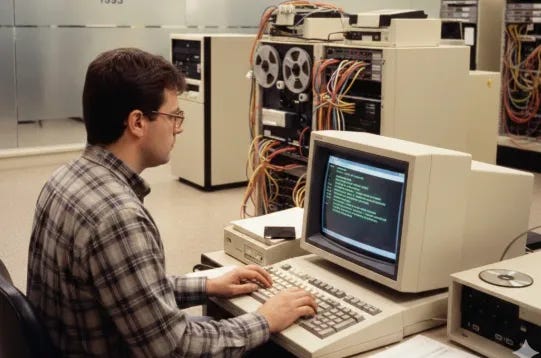
Currently, the state exists in a state of precarious dualism, where 50-year-old mainframe systems sit alongside a modern Agency of Digital Services (ADS) attempting to pull the state into the 21st century.
The Costly Mistake Made Years Ago: The Lost Federal Match
A primary driver of Vermont’s current IT struggle is rooted in a historical refusal of federal support. When child welfare data standards were first federalized in 1993, the federal government offered states a 90% match to modernize their data systems. According to the Vermont Office of the Child, Youth, and Family Advocate, Vermont declined this support.
The financial impact of that decision is staggering when viewed in today’s context. Had Vermont pursued a project of the same scale at that time, the state effectively walked away from:
Historical Dollars: Between $8.0 million and $20.1 million in 1993.
Modern Value: Approximately $18.0 million to $45.0 million in 2026 dollars.
Because Vermont did not upgrade then, the state is now “among the states furthest behind” in meeting federal data standards. This omission has created a cycle of financial loss where the state loses millions of dollars in annual federal reimbursements because legacy systems cannot track required data. Today, Vermont taxpayers must foot the entire bill for replacements that have become fragile enough to experience catastrophic failures.
The Architecture of Obsolescence
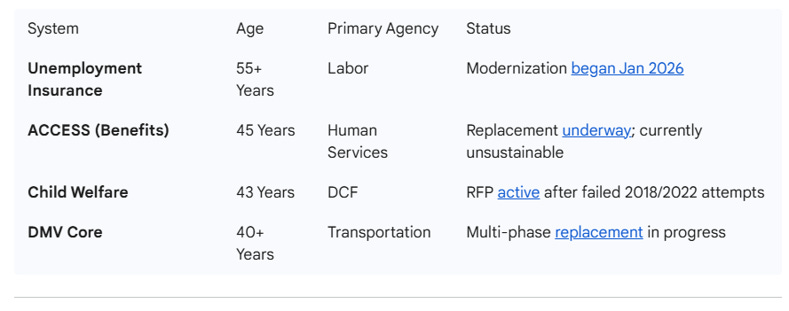
The scale of the “legacy burden” is significant. Many core functions of state government rely on software written in COBOL, a programming language from a previous era for which the expert talent pool is rapidly retiring. These platforms are not merely technical curiosities; they are functional impediments to effective governance, slowing emergency responses and exposing sensitive data.
The Priority Paradox: Legislative Focus vs. Critical Needs
Observers often ask why the Vermont Legislature allows the state’s digital backbone to crumble while focusing on other issues. Analysis of the FY 2026–2027 legislative priorities reveals a “Priority Paradox” where visible crises often crowd out invisible infrastructure.
The state’s focus on education transformation ($2.56 billion) and climate spending ($524 million) reflects immediate social and economic pressures. In contrast, the IT Modernization Fund is fully allocated with no new monies currently entering. For many lawmakers, it is easier to advocate for property tax relief than for a technical necessity with a history of procurement delays and cost overruns.
Modernization Impediments and Project Risks
The history of IT upgrades in Vermont is marked by a cycle of ambitious goals followed by schedule overruns. A 2023 review by the State Auditor found that of six major projects, only one was delivered on time and within budget.
A current focal point of risk is the $70 million Workday ERP project. Independent reviewers have cautioned that without a proper gap analysis, the state risks paying for software it cannot fully utilize or being forced to maintain the very legacy systems it sought to replace at a significant additional cost.
Beyond the “Spiraling Deficit” Narrative
Recent reports of a “spiraling IT deficit” within ADS require context regarding how IT is funded in Vermont. ADS operates as an internal service fund, billing other agencies for support.
When the legislature mandates a new digital service but does not increase that agency’s budget to pay ADS, a deficit occurs. This is often a governance issue—a gap between the technical requirements for statewide security and the state’s willingness to fund them. Despite these fiscal hurdles, ADS doubled its number of completed projects in 2025, reaching a high degree of operational efficiency.
What Happens Next
The next two years (2026–2027) serve as a critical test for Vermont’s digital transformation. The impending rollout of the Department of Labor’s new unemployment system in Spring/Summer 2026 and the final phases of the Workday ERP system will determine if the state can finally overcome its legacy burden. To succeed, Vermont must move away from “one-time” funding mindsets and treat technology as a core utility, requiring consistent investment to ensure the systems residents rely on are stable, secure, and modern.
There has never been a software project completed on time or on budget in the history of mankind. However, this one seems urgent for all the reasons cited. Another great piece of journalism--congrats and keep up the good work.