


In Part 1, we followed a single dollar of local option tax from your wallet to a $15 million surplus sitting in the state’s PILOT Special Fund. We showed how 50 Vermont towns contribute 25% of their local option tax revenue to a fund that collects far more than it pays out — roughly twice what the state needs to meet its annual PILOT obligations.
Now comes the harder question: what should happen to that surplus?
Earlier this month, lawmakers had an answer. It lasted less than 24 hours.
The waterfall: what it was and where it came from
The idea started in the Senate Transportation Committee in mid-February. Committee Chair Richard Westman was looking for ways to address a stark reality: the governor’s proposed FY27 budget cuts town highway programs by over $7 million — a 7.3% reduction from $96.7 million in FY26 to $89.6 million in FY27 — while the state faces a $33 million structural deficit in the Transportation Fund that puts $163 million in anticipated federal matching funds at risk.
Westman’s original concept was even more ambitious — a new “Local Option Municipal Services Tax” that would work like a second LOT, with the state’s share going to a dedicated transportation fund instead of PILOT. The Vermont League of Cities and Towns worked with both chambers’ transportation committees to refine the idea, and it eventually simplified into something called the “waterfall.”
Think of it like a bathtub with an overflow drain. The faucet is LOT revenue flowing in — 25% of what 50 towns collect. The drain is PILOT payments flowing out — about $12 million per year to municipalities hosting state property. The tub is overflowing; the surplus is more than $15 million and climbing.
The waterfall would have installed a second drain: once PILOT payments go out, 50% of whatever remains in the fund each year would automatically flow to every municipality in Vermont as block grants for town highway and structure repair. The other 50% would stay in the fund as a reserve. These grants would have come on top of existing town highway aid — new money, not a substitution.
The House Transportation Committee voted to include the waterfall in sections 14 and 15 of H.944, the annual transportation bill. VLCT supported it. The math worked: 50% of the estimated surplus would have more than closed the $7 million gap between FY26 and FY27 town highway funding, with room to grow as LOT revenue continued to increase.
There was one more detail worth noting. The waterfall would have sent block grants to all Vermont municipalities — not just the 50 towns that contribute LOT revenue. A town like Hardwick or Chelsea, with no local option tax and no tourism economy, would have received highway money generated by consumption taxes in Burlington and Stowe. This was redistribution by design, and it represented a different philosophy than VLCT’s other stated position of returning surplus funds specifically to “the municipalities that raised it.”
The 24-hour kill
Less than 24 hours after the Transportation Committee voted the waterfall into the bill, the House Ways and Means and Appropriations committees stripped it out. Transportation Committee Chair Matt Walker was given only brief comments before the provision was removed.
This wasn’t a policy debate resolved through deliberation. It was a jurisdictional exercise. In the Vermont Statehouse, the money committees — Ways and Means and Appropriations — have final authority over how funds are allocated. The Transportation Committee can propose spending within the annual transportation bill, but that bill gets a final review from the money committees before it goes to the floor. When spending proposals cross into tax policy or fund allocation, the money committees get the last word.
Why did they kill it? The waterfall competed directly with their own plan for the same money.
The competing plan: grand list expenses
For months, the House Ways and Means Committee had been drafting the Miscellaneous Tax Bill (H.933), which proposes a fundamentally different use for the PILOT surplus. Instead of sending money back to towns for roads, H.933 would shift the costs of maintaining Vermont’s property tax system onto the PILOT fund.
These costs include lister training, property valuation defense by the Division of Property Valuation and Review (PVR), and per-parcel payments to towns for reappraisal and the annual equalization study used to set the statewide education property tax rate. These expenses have traditionally been funded from the General Fund.
The governor got there first. In his January budget address, Governor Scott proposed using $3.5 million of the PILOT surplus for these purposes. The House liked the idea and expanded on it, using $3.41 million in one-time money from the fund for the same expenses in the FY26 budget adjustment, which the governor signed into law.
H.933 would go further, making these appropriations an ongoing, permanent use of the PILOT fund. PILOT fee payments would come out first, grand list expenses second, and only then would any surplus remain.
And it gets more expensive from here. The House Ways and Means Committee is also working on implementing Act 73, which would regionalize property assessments. The current per-parcel payment of $8.50 covers a fraction of the actual cost of reappraisal. Under the draft bill, that payment would jump to $66 per parcel — or two-thirds of the total reappraisal cost, whichever is less — plus $8.50 per parcel annually for grand list maintenance. This change would draw about $7 million out of the fund immediately, and roughly $3.5 million in ongoing future years.
If both the waterfall and the grand list expenses were funded simultaneously, the surplus would be gone. The money committees chose grand list. Roads lost.
What replaced the waterfall
Two things were offered in place of the waterfall.
A mileage-based user fee for electric vehicles. The money committees inserted language into the transportation bill establishing a per-mile charge on battery electric vehicles, set at about 1.4 cents per mile. This is sound long-term policy — EV drivers don’t pay gas tax and should contribute to road maintenance. But it doesn’t solve the immediate problem, for a mechanical reason we covered in January: the system piggybacks on annual vehicle inspections, and you need two odometer readings to calculate miles driven. The fee won’t generate any revenue until fiscal year 2028 — and even then, only an estimated $350,000 to $1 million in the first year, eventually reaching about $2.5 million. Meanwhile, the existing $89 annual EV registration fee gets repealed, so FY27 is actually a net loss to the Transportation Fund.
The MBUF addresses the relatively small number of battery electric vehicles registered in Vermont against a $33 million transportation deficit. It’s the right principle at the wrong scale, and on the wrong timeline to help anyone’s roads this construction season.
A one-time appropriation of $1.7 million from the Transportation Infrastructure Bond Fund for town highway aid. This is borrowed money — debt-financed maintenance rather than dedicated revenue — and it is one-time. Once it’s spent, it’s gone.
Neither replacement comes close to what the waterfall would have provided.
The questions your town should be asking
The materials we’ve reviewed — from VLCT’s advocacy alerts to legislative testimony to the Joint Fiscal Office’s projections — lay out the mechanics clearly. What they don’t do is resolve the underlying tensions. Here are the questions that informed Vermonters should be weighing.
When VLCT says “return the surplus to municipalities,” which municipalities do they mean?
VLCT’s formal policy calls for returning the surplus to “the municipalities that raised it” — meaning only the 50 LOT towns. But the waterfall VLCT also supported would have sent block grants to all 246+ municipalities, including the roughly 200 that don’t have a local option tax. Those are two different philosophies. The first says the money belongs to the towns whose shoppers, diners, and visitors generated it. The second says surplus state revenue should be spread where the need is greatest. Both have merit. But VLCT has endorsed both positions simultaneously without fully acknowledging the tension between them.
Did voters actually understand the deal?
VLCT argues that voters who approved local option taxes didn’t intend for their revenue to pay for property reappraisal. That’s probably true. But did those same voters understand that 25% of their LOT revenue would go to a state fund that might pay for highway repair in a town they’ve never visited? The “voter intent” argument is deployed selectively depending on which surplus proposal is under discussion. The 25% state share was the statutory condition from day one. Towns that adopted LOT agreed to send a quarter to the state. What the state does with its share has always been a legislative decision, not a Town Meeting decision.
Is it actually wrong to use the surplus for grand list work?
VLCT opposes using PILOT money for property reappraisal, arguing that setting the state’s grand list and education tax rate is a core state responsibility that shouldn’t be financed by locally raised consumption taxes. That’s a reasonable position. But reappraisal directly benefits municipalities — it’s how towns maintain accurate property values and fair taxation. The current $8.50 per parcel payment covers a small fraction of actual costs, and Act 73’s regionalization will cost more. If not from the PILOT surplus, then from the General Fund — which is under enormous pressure from education spending, health care, and the potential loss of federal revenue. Someone has to pay for it. The question isn’t whether it’s a legitimate expense. It’s who should bear the cost.
Does your town benefit from the PILOT fund even if you don’t have a local option tax?
Almost certainly yes, and most people don’t know it. More than 200 municipalities receive some form of PILOT payment because the Agency of Natural Resources owns land in their communities — state forests, parks, wildlife management areas. Those PILOT payments are funded by the same 25% LOT share that comes from the 50 contributing towns. So a town with no local option tax, no restaurants, and no hotel rooms may still receive PILOT payments funded in part by consumption taxes generated in Stowe and Burlington. That’s redistribution — and it might be entirely reasonable. But it’s invisible to most Vermonters, and it complicates the argument that the surplus belongs only to the towns that generated it.
What happens to your roads if none of this gets fixed?
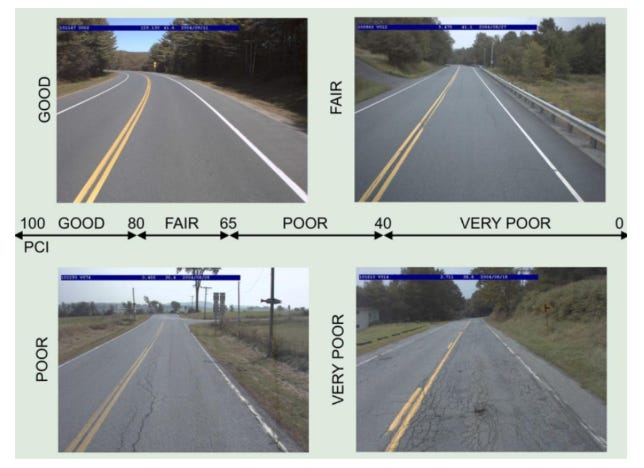
Town highway aid drops by over $7 million next year. Construction costs have risen over 60% since the pandemic. Some town highway capital budgets have a quarter of the purchasing power they had ten years ago. Transportation Secretary Joe Flynn has testified that if current funding levels are maintained, more than half of all Vermont road surfaces will be rated in poor or very poor condition by 2030 — up from roughly a quarter today.
The consequences are already visible. Brattleboro reported to lawmakers that its 60-mile paved road network needs $18.83 million in investment, with over 20 miles requiring major reconstruction at a cost exceeding $14 million. Morristown found more than half its roads in poor or very poor shape and is weighing whether to discontinue as many as 19 roads. Monkton is considering permanently closing a popular town road after successive flooding events.
When state aid declines and roads keep failing, towns have two choices: let the roads deteriorate, or raise property taxes to fill the gap. Either way, the cost lands on local taxpayers. The irony is hard to miss — local option taxes were supposed to diversify municipal revenue away from property taxes. Instead, the state’s handling of the surplus may end up increasing property tax pressure. That’s the opposite of what LOT was designed to do.
What comes next
It’s not over. Neither the annual appropriations bill nor the miscellaneous tax bill has gone to the House floor for a vote. VLCT’s Executive Director Ted Brady has sent a letter to lawmakers on all finance-related committees objecting to the proposed PILOT fund appropriations. VLCT and member communities testified yesterday — Tuesday, March 24 — before the House Ways and Means Committee.
The money committees could still put the waterfall back. They could take the grand list expenses out. They could do both, or neither.
What they cannot do is avoid the underlying math: a fund built on locally raised consumption taxes is collecting far more than it needs for its stated purpose, and every committee in the Statehouse wants a piece of it. The towns that generate the revenue want it back. The towns that don’t generate it want a share through highway aid. The state wants to use it to backfill expenses it used to pay from the General Fund. Everyone has a claim. Nobody is being fully honest about the tradeoffs.
If your municipality raises local option taxes or receives PILOT payments — and more than 200 do — this fight affects your budget directly. VLCT is asking residents to contact their legislators and the governor. Whether you agree with VLCT’s position or not, the underlying questions are worth your attention. They’re about how Vermont raises money, who decides where it goes, and whether the system works the way you thought it did when your town voted yes.
Compass Vermont publishes independent, data-driven reporting on Vermont policy. If this was useful to you, please consider sharing it or subscribing.
........."Nobody is being fully honest about the tradeoffs.".........When was the last time Montpelier was???