


At the bottom: how to find the Westmore case in the state’s filing system, the 30-day deadline to weigh in on a new tower, and who gets notified when antennas are added to an existing one.
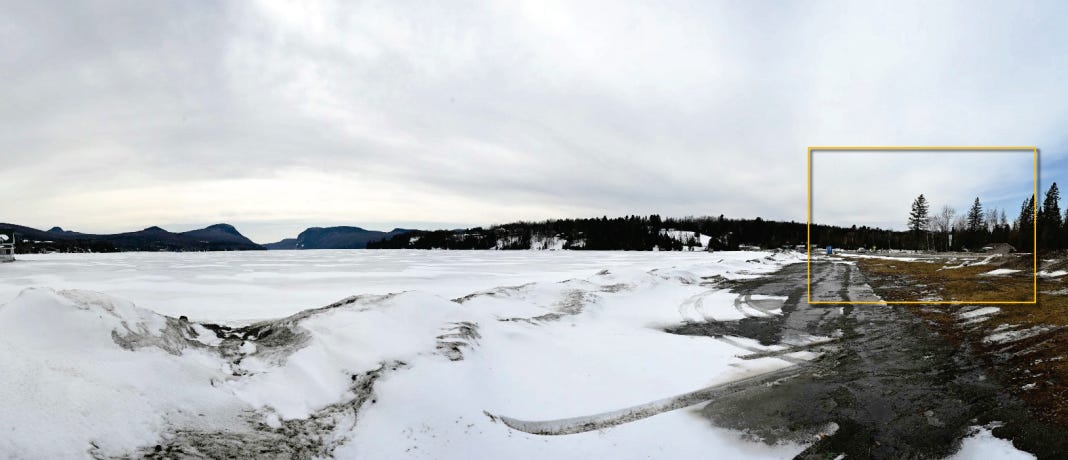
On Sept. 4, the Vermont Supreme Court upheld the state permit for a 140-foot telecommunications tower near Lake Willoughby. The Westmore residents who have fought the tower for more than two years asked the court last week to take another look, VTDigger reported. They want to protect the setting of a lake that has been a National Natural Landmark since 1967.
The case for the tower rests on communications in a place where they often fail. The ambulance squad that covers Westmore has committed to putting its radio antenna at the top. The tower is also built to hold cell phone equipment, though no cell carrier has signed on.
A Place Where Signals Fail
Cell service along the lake is poor, and neither side disputes it.
In July, a hiker dropped a phone off a cliff on Mount Pisgah, triggering an automatic crash alert and a response from more than a dozen emergency agencies. The hiker didn’t know the alert had gone out because there was no cell service, WCAX reported.
Business owners near the lake told WCAX that customers often complain about the lack of cell service and ask to use their Wi-Fi.
Ray Lanier, who has owned a home on the lake for 34 years and opposes the tower, told Seven Days he gets no cell service at his house.
In 2025, Vermonters made 233,237 calls to 911. Of those, 181,069 came from cell phones, about 77 percent, according to the state’s Enhanced 911 Board. In places without cellular coverage, those calls can’t be made over the cell network.
What the Tower Is Committed to Carry
The Glover ambulance squad committed in a February 2024 letter to putting its antenna at the top of the tower, and the owner agreed to charge no rent, according to the owner’s federal court filing. The squad told WCAX it encourages any new commercial tower to make room for public safety communications.
Gaps in responder radio are a statewide problem. In a January report, Vermont’s Public Safety Communications Task Force found that fire and EMS radio networks “do not provide sufficient coverage” and “place public safety responders and the communities they serve at great risk.” It said many fall “well short” of the standard of covering 95 percent of their service area. The task force’s plan for a statewide responder network would rely almost entirely on existing towers. In Westmore, the hearing officer found no existing facility could meet ITW’s coverage objectives.
The tower’s owner, Massachusetts-based Industrial Tower and Wireless, also sells two-way radio by subscription. It’s push-to-talk radio for businesses and agencies, licensed by the Federal Communications Commission, and it is not cell phone service. The Public Utility Commission’s final order approves the tower for “wireless mobile radio service to first responders in the area and to the Petitioner’s own wireless commercial mobile radio service customers.”
Where Cell Service Comes In
The tower has room for cell carriers, the companies that sell phone service, like AT&T and Verizon. Renting space on one tower to several companies is called collocation, and it’s state policy because it means fewer towers. The Public Utility Commission noted that “the new tower will include adequate space for future collocation opportunities.”
The owner, known as ITW, told a federal court in 2024 that the carriers it approached had “deferred their decision until ITW obtains” a state permit. No carrier has signed on in the public record. That leaves a loop at the center of the dispute: without a permit, carriers won’t commit, while opponents cite the lack of a carrier commitment as evidence that the tower’s cellular benefit is speculative. Hunter Thompson, the state’s telecommunications director, told Seven Days last year there’s “no guarantee” carriers will come. “I can completely understand the frustration of the residents of Westmore, but that is the value proposition,” he said.
If a carrier does sign on, how far its coverage reaches will depend on its equipment and the terrain. State and federal law give streamlined review to certain antennas added to an existing tower (details at the bottom).
What Residents Want Protected
For opponents, the loss is the view. “The views of the gap are going to be marred forever,” Donna Dzugas-Smith, who leads the opposition, told Seven Days, referring to the cliffs at the lake’s south end. “This is the Lake Lucerne of North America!” Lanier said.
The state agreed the tower will change the setting. The hearing officer found it “will not fit within the context of the wooded area.” He ruled that the effect on the scenery wasn’t severe enough to deny a permit, because trees and terrain hide most of the tower and most public views are more than a mile away. The Public Utility Commission adopted that finding, and the Supreme Court upheld it.
The residents also say the process is hard on ordinary people, and the state doesn’t entirely disagree. Michael Swain, special counsel to the Department of Public Service, told VTDigger earlier this year that the process has formalities that “may make participation as a party to a proceeding challenging for non-lawyers.” This year the Legislature, in Act 129, added a required public meeting in town before a developer files for a larger tower project.
Supporters see the trade differently. The landowner, Peter Hyslop, who leases the site to ITW, told Seven Days that better emergency response and the prospect of cell coverage outweigh the downsides. “I feel it’s going to be a very, very minimal impact,” he said.
“This isn’t over,” Dzugas-Smith told VTDigger. If the tower is built, the Glover ambulance antenna goes on top. Whether cell service follows along Route 5A depends on whether a carrier signs on.
How to Check on a Tower Near You
Look up a case. The Public Utility Commission posts every tower application in its online filing system, ePUC. Search by town. The Westmore tower is case 24-1755-PET.
Before a developer files. Act 129 requires a warned town meeting before the application is filed. The applicant must attend, and the Department of Public Service attends if the town requests it. The requirement doesn’t apply to minor changes to existing towers or to smaller projects, such as new towers no taller than 140 feet that meet the state’s size limits.
After a developer files. Comments, requests to join the case as a party and requests for a hearing are due within 30 days of when the application is served. The Public Utility Commission does not consider anything filed late, including from the town.
When antennas are added to an existing tower. For additions that qualify as minor changes (the law’s term is “de minimis”), notice goes to the landowner, the selectboard and the Department of Public Service. Only those three may object to that classification, within 30 days.
The full process. The Public Utility Commission’s citizen’s guide walks through it.