


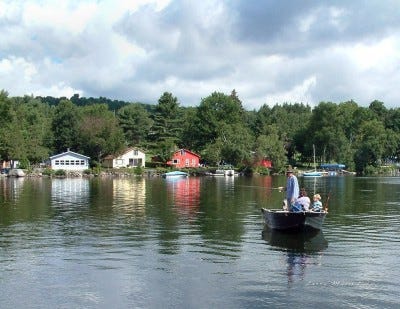
According to a post on the Department of Environmental Conservation’s official Facebook page, state water quality staff visiting Lake Carmi in Franklin last week recorded a spring water clarity reading of 6.3 meters using a standard Secchi disc, the tool scientists lower into a lake until it disappears from view.
Using a newer Secchi viewscope, the reading reached 7.2 meters. DEC has been conducting spring clarity measurements on Vermont lakes since 1970 and on Lake Carmi specifically since 1977 — across 29 sampling visits over nearly five decades, the lake’s spring average was 2.6 meters. Last week’s standard Secchi reading was nearly two and a half times that average. The previous all-time spring record, set in 2002, was 3.8 meters.
DEC Deputy Commissioner Neil Kamman accompanied field crews for the visit, which combined routine spring monitoring with a first look at results since the alum treatment concluded. DEC described the results as “just a very initial observation, but it sure is encouraging,” noting that lab analysis of collected samples and continued monitoring throughout the season will determine whether the improvement holds.
What the treatment involved
Beginning the week of September 22, 2025, and running through October 30, contractors applied a mixture of aluminum sulfate and sodium aluminate — the primary compound commonly known as alum — across the lake from a barge stationed at Lake Carmi State Park’s boat launch. The project was designed by Barr Engineering of Minneapolis following a 2024 feasibility study; the physical treatment was administered by SOLitude Lake Management, a Virginia-based lake restoration firm. The final cost was $3.7 million, according to DEC Deputy Commissioner Neil Kamman’s January 2026 briefing to the Vermont House Committee on Environment — up from an early estimate of $3.5 million reported by Vermont Public before the project began. The project was funded through Vermont’s Clean Water State Revolving Fund and Clean Water Revolving Loan Fund; Franklin Select Board Chair David Bennion said at the time the town would bear none of the cost.
Alum works by bonding to phosphorus already present in a lake’s water column and sediment, forming a dense material called “floc” that sinks and creates a barrier preventing phosphorus already stored in the lakebed — called legacy phosphorus — from cycling back into the water to fuel algae blooms. The treatment is not designed to address new phosphorus entering the lake from the surrounding watershed. According to DEC, treatments typically remain effective for 10 to 15 years, though continued phosphorus runoff can shorten that window.
A lake in crisis for decades
Lake Carmi, covering 1,375 acres in Franklin County and reaching a maximum depth of 33 feet, is the fourth largest natural lake located entirely within Vermont. DEC listed it as “impaired” for phosphorus in 2008, meaning it failed to meet Vermont Water Quality Standards. In 2018, Vermont’s Secretary of Natural Resources designated it the state’s only Lake in Crisis — a designation established under Act 168 and codified in 10 V.S.A. § 1310 — due to the long-term presence of toxic cyanobacteria blooms that periodically close the lake to swimming and recreation late each summer.
The state’s response over the past decade-plus has included agricultural best management practices throughout the watershed — manure injection, cover crops, reduced tillage — along with a zero-discharge wastewater system at Lake Carmi State Park, shoreline vegetation projects by private landowners, and road erosion controls. By 2021, DEC reported that phosphorus reductions from agricultural practices alone had exceeded the targets set in the lake’s Total Maximum Daily Load plan. But the blooms continued, sustained by legacy phosphorus already built up in the sediment over decades.
In 2019, the state installed an aeration system in the lake in an attempt to oxygenate bottom sediments and reduce phosphorus release. It did not work — DEC’s own documentation states the system “was not able to effectively reduce surface water phosphorus concentrations or cyanobacteria blooms and seems to have had the opposite effect.” The system was not operated in 2024, and its removal was planned for 2025. Barr Engineering was then contracted to conduct a comprehensive alum feasibility study, which led directly to last fall’s treatment.
The complication: clearer water, more weeds
State regulators have cautioned against treating the Lake Carmi intervention as a broad template for other impaired Vermont waters. A DEC official told Vermont Public in July that the state would be “hard-pressed” to recommend alum more widely and that regulators would rather focus resources on preventing phosphorus from entering lakes in the first place.
Part of the reason is an unintended consequence already observed elsewhere in Vermont: greater water clarity allows sunlight to penetrate deeper, which can accelerate the growth of invasive aquatic plants. Vermont Public reported that a similar dynamic followed the alum treatment at Lake Morey in Fairlee, requiring an early herbicide application to manage invasive Eurasian milfoil. Franklin Select Board Chair Bennion has identified invasive plant growth as a concern to watch at Lake Carmi this season.
What’s next
DEC stated that lab results from last week’s samples are pending and that monitoring will continue throughout the 2026 season. The department’s real-time monitoring data, collected through a platform buoy operated jointly by DEC and the University of Vermont, is available at the UVM EPSCoR Lake Carmi portal. Full documentation of the restoration effort, including meeting minutes, historical data, and reports, is at dec.vermont.gov/watershed/restoring/carmi.
I have wonderful childhood memories of a family cottage on the east side of the lake. The water was pristine most of the time, with lots of fish and very swimmable (I probably swallowed a lot of Lake Carmi in the process with no ill effects). The introduction of chemical fertilizers on the farms on the west side of the lake started to produce increased algae, but at the time that I "disengaged", Carmi was still a relatively clean lake. It was frustrating and heartbreaking to see the phosphorous-induced destruction of the lake, because the cause had always been obvious and reversible. I think that I'm going to make a little nostalgic trip to Carmi this summer--thanks for another great article.