


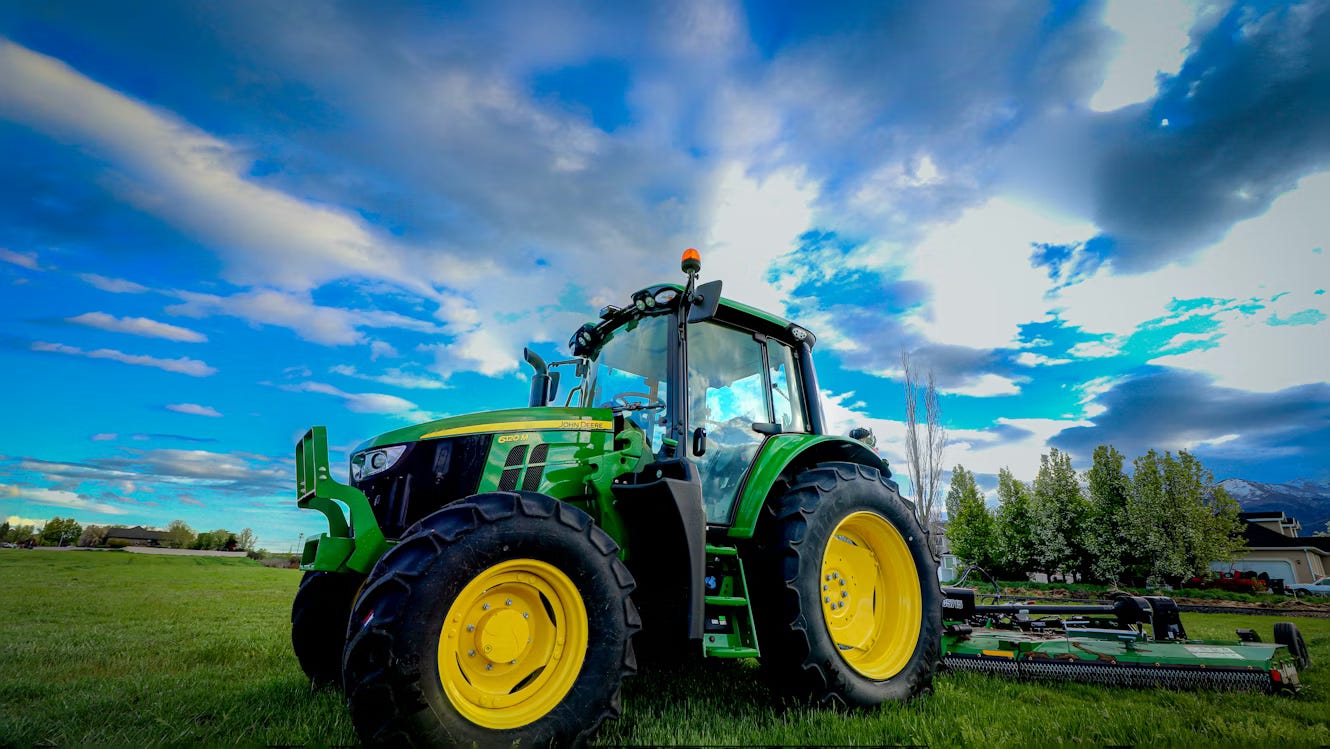
John Deere agreed this week to pay $99 million to settle a federal class action lawsuit alleging the company monopolized its repair services — and Vermont dairy farmers, loggers, and agricultural equipment operators are among those who may be eligible for a share.
The settlement, filed April 6 in the U.S. District Court for the Northern District of Illinois, covers anyone who paid a John Deere authorized dealer for repairs to large agricultural equipment — tractors, combines, harvesters — between January 10, 2018 and the date of the court’s preliminary approval. A judge must still approve the deal before it takes effect.
If you paid a Vermont John Deere dealer for large equipment repairs in the past seven years, here’s what you need to know.
How to file a claim
Claim forms will be available at www.DeereRepairSettlement.com. As of publication, that website is under construction. The filing deadline will be set once the court approves the settlement. Deere has provided plaintiff attorneys with its customer contact database to help identify eligible class members, so some Vermont operators may receive direct outreach.
One critical note: the $99 million doesn’t go entirely to farmers. Attorneys’ fees, lead plaintiff awards, and administrative costs come out first. The remainder is divided among eligible class members who file timely claims. According to plaintiffs’ court filings, the recovery is estimated at 26 to 53 percent of total overcharge damages. Actual individual recovery will depend on documented repair expenditures and the number of claims submitted.
What Deere was alleged to have done — and why it cost you money
The lawsuit, which consolidated more than a dozen cases filed across the country, alleged that Deere violated federal antitrust law by withholding the diagnostic software and repair tools that farmers and independent mechanics need to fix modern equipment — and by conspiring with its authorized dealer network to make those dealers the only practical option for repairs.
The result, plaintiffs argued, was “supracompetitive” pricing: farmers paying inflated dealer rates because they had no real alternative. A John Deere tractor or combine runs on proprietary software. Without the diagnostic codes, even a skilled mechanic can’t fix it. You either wait for the dealer — which in rural Vermont can mean days or weeks during planting or harvest — or you pay whatever they charge.
The estimated class size is well in excess of 200,000 farmers nationally. Vermont’s share of that is small in number, but the per-farmer recovery will be proportional to what individual operators actually paid in dealer repair costs since January 2018. Farms and logging operations with heavy dealer repair histories stand to recover the most.
Deere denied wrongdoing. “We’re pleased that this resolution allows us to move forward and remain focused on what matters most — serving our customers,” said Denver Caldwell, Deere’s vice president of aftermarket and customer support.
Beyond the money: what changes going forward
The settlement also includes injunctive relief that goes beyond the cash payment. Deere agreed to make available to farmers for 10 years “the digital tools required for the maintenance, diagnosis, and repair” of large agricultural equipment. The company must deliver that access by December 31, 2026.
A separate February 2026 EPA guidance clarification affirmed that farmers may bypass certain emissions-related software locks for repair purposes, providing an additional regulatory backstop independent of the settlement.
In July 2025, Deere launched its Operations Center PRO Service, a digital self-repair platform it describes as giving equipment owners direct access to maintenance, diagnostics, and repair tools across its agriculture, turf, construction, and forestry portfolio. The platform carries an annual subscription fee — $195 per machine for farmers, and $5,995 per year for independent repair shops — a cost structure that right-to-repair advocates argue turns a legal right into a recurring expense.
Not everyone is impressed with the settlement. Willie Cade, a board member of the Repair Association and a long-time right-to-repair advocate, told AgWeb the settlement is “too little, too late” and that it “will not fundamentally change the monopolistic repair environment that Deere enjoys.”
The FTC lawsuit — filed separately in January 2025 by the Biden administration and joined by Illinois, Minnesota, and three other states — is still alive and pending before the same federal judge. That case contains a sharper allegation: that even the diagnostic tools Deere provides to farmers and independent shops are intentionally limited, leaving them unable to perform the same repairs as authorized dealers. A federal judge refused to dismiss the FTC case in June 2025. It remains unresolved.
Vermont’s missed chance — and who killed it
Vermont farmers are in a particularly exposed position because the state has no right-to-repair law of its own.
Vermont came close. H.81, a bill that would have required manufacturers like John Deere, Caterpillar, and Tigercat to provide the manuals, diagnostic codes, and parts needed to repair farm and logging equipment at fair market value, passed the Vermont House in May 2023 on a 137-2 vote — one of the most lopsided votes of that session, drawing support from Democrats, Republicans, Progressives, and Libertarians alike.
Then it went to the Senate, where it sat for nearly a year while a flood of lobbying opposition arrived from national equipment manufacturers and their dealer networks. The Vermont opponents were easy to identify: the North American Equipment Dealers Association, United Ag and Turf Northeast, and Champlain Valley Equipment of Middlebury all testified against the bill. These are Deere’s Vermont authorized dealers — the same businesses that stood to lose repair revenue if farmers gained the legal right to fix their own equipment or take it to an independent shop.
When the Senate Agriculture Committee finally moved the bill in late April 2024, it had been significantly weakened. The most damaging change: an exemption for any equipment manufacturer that had already signed a voluntary memorandum of understanding on repair access. The problem was that John Deere had already signed exactly such an MOU — with the American Farm Bureau Federation in January 2023. Right-to-repair advocates consistently described the Deere-AFBF MOU as unenforceable and toothless. The Senate amendment would have handed Deere a ready-made escape from Vermont law before the law ever took effect.
The Senate also stripped the bill’s private right of action, removing the ability of individual Vermont farmers to sue Deere directly if the company violated the law. Enforcement would have been left entirely to the Vermont Attorney General’s office.
The House refused to accept either change. With no time left in the 2024 biennium, the bill died. Vermont entered 2025 with no state right-to-repair protection and no backstop if Deere fails to honor its federal settlement commitments.
What to do now
For Vermont farmers and loggers, the immediate action item is straightforward: bookmark www.DeereRepairSettlement.com, gather any records of John Deere dealer repair invoices dating back to January 2018, and file a claim when the site goes live. The court approval process typically takes several months, so the filing window is likely to open later in 2026.
Seven years of overcharges won’t fully be made right by a settlement website. But it’s a start — and it may be the only relief Vermont equipment operators get for a while.
Compass Vermont reached out to the Vermont Attorney General's office and VPIRG for comment. This story will be updated if responses are received.
Compass Vermont is an independent Vermont news outlet. If you found this story useful, consider becoming a paid subscriber to support this kind of reporting.
........"Nothing runs like a Deere"......