


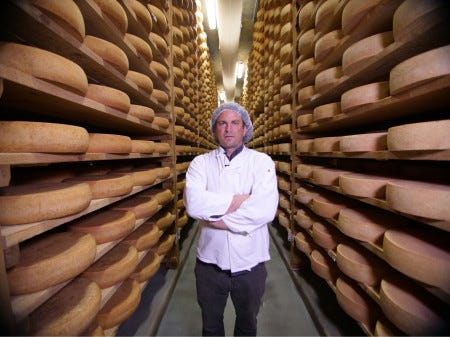
In the cellars at Jasper Hill Farm in Greensboro, a robot brushes and turns many of the aging cheese wheels. The turning matters. A wheel left sitting in one spot ripens unevenly, because gravity pulls the moisture down and away from the rest of the cheese.
The brushing keeps mold on the rind in check, so the rind forms slowly and evenly. People still make the judgment calls. A vault specialist checks every batch and decides whether it needs more or less brine, a salt-water wash that controls which microbes grow on the surface.
Now Jasper Hill co-founder Mateo Kehler will help figure out whether a machine can take on a different farm job, the one that waits until everyone else has gone to bed: the paperwork. FarmBot Tech, a Sausalito, California, startup, is building artificial intelligence that farmers talk to instead of typing into. The company announced Nov. 12 that Kehler is its first “Founding Farmer,” a working farmer brought in before new features are built to help decide what the company makes and in what order. A white paper the company wrote with Diverse AI Solutions also calls its Founding Farmers ambassadors for the company.
A Workday That Starts at 2:30 a.m.
Kehler’s farm day begins with milking at 2:30 in the morning and runs nearly around the clock. That’s the workday he will test FarmBot Tech’s tools against.
“We do the paperwork at night after the day’s work is done, and we don’t hear about a new rule until a regulator shows up,” Kehler said in the white paper.
The paperwork is real. Under the Required Agricultural Practices, the state rules every Vermont farm must follow, a farm that spreads manure or fertilizer has to log each application and keep the records for five years. The state’s record-keeping booklet lists what goes into every entry:
the date and time of day
the field
the type of manure or fertilizer and where it came from, such as a manure pit
the weather and temperature
how wet the soil was
the spreader used and how much was applied
Some of this already has an app. Farmers can log those entries in the field, even without an internet connection, using goCrop, which University of Vermont Extension developed. FarmBot Tech wants to go a step further: the farmer says the update out loud, and the software files it.
How the Talking Software Works
FarmBot Tech launched an early version Oct. 22. A farmer asks a question out loud, in plain English, and gets an answer about their own farm, with no dashboard to click through. The company says the platform turns everyday farm updates into organized records ready for regulators. It also matches farms with grants and government funding programs.
For livestock, the company plans to combine satellite data with the daily entries farmers make in their animal logbooks, to build a plan for each animal and for the whole herd. FarmBot Tech hasn’t published a price. It is a different company from FarmBot Inc., which sells garden robots.
The company is betting that farm technology has a design problem. Precision agriculture means using technology to manage a farm field by field or animal by animal: GPS steering on tractors, yield maps that show how much each part of a field produces, electronic ear tags, robotic milkers. The share of U.S. farms using it fell from 27% in 2023 to 22% in 2025, according to the USDA. FarmBot Tech points out that the drop came even as the tools improved and got cheaper.
Vermont was behind before that drop. In the 2022 Census of Agriculture, 209 of Vermont’s 6,537 farms reported using precision agriculture, about one farm in 30. Nationally, the figure was 226,092 of 1,900,487 farms, about one in eight. USDA research also found that small family farms use these tools at the lowest rates.
Tariffs on One Side, Multinationals on the Other
Jasper Hill has its own reasons to want better tools. Compass reported in October that Jasper Hill’s Canadian sales had dried up in the U.S.-Canada trade fight. Kehler told CTV News Ottawa that tariffs were also raising what the company pays for equipment.
The longer fight, Kehler said, is against much bigger competitors.
“Our competition is multinational corporations, highly capitalized enterprises that are standardizing and defining market spaces,” he said in the Nov. 12 announcement. “We need to be at the front lines of innovation, in quality and in technology, and we can’t get there without good tools.”
Small Herds, Premium Milk
Kehler and his brother, Andy, started making cheese in 2003. Before that, Mateo was working as a carpenter for local contractors, building second homes on land that struggling dairy farms had left behind. Today Jasper Hill buys milk from neighboring farms and pays a premium for it, including two Greensboro farms with about 50 cows each.
There’s nothing magic about 50 cows. It’s simply small. Vermont’s 528 dairies milked 105,514 cows in 2022, according to the census, an average of about 200 cows per farm. Kehler says Jasper Hill’s premium is what keeps herds of around 50 cows in business. Jasper Hill says selling to it lets those farms step away from the volatile and less profitable commodity milk market. Several of them have passed from one generation to the next, Kehler says, and rely on that market to keep going as family businesses.
That’s the kind of farm he wants technology to reach. Kehler said he took the role to help open up tools that have historically gone only to the wealthiest and best-resourced operations, “so the advantage doesn’t always go to the biggest operations.”
Satellites Join the Cows Under the Moonlight
The next step is the sky. FarmBot Tech has a three-year partnership with Pixxel Space, whose Firefly satellites capture more detail than ordinary satellite imagery. The company says the imagery can flag crop stress, nutrient problems, soil conditions and water use before a farmer can see them from the ground. The first tools are due by the end of this year, starting with grapes, coffee, cattle and dairy.
If the plan works, a farmer milking at 2:30 a.m. will have a satellite’s view of the fields to go with it. The test for a 50-cow farm is whether the farmer gets an evening back.
“Farmers are practical,” Kehler said. “Unless something materially changes their experience for the better, it’s a hard sell.”