


ANALYSIS
Amanda Janoo, the Democratic/Progressive candidate for governor, says private equity and large corporations buying homes are among the biggest reasons Vermont housing costs so much. She wants to tax them at the highest rates.
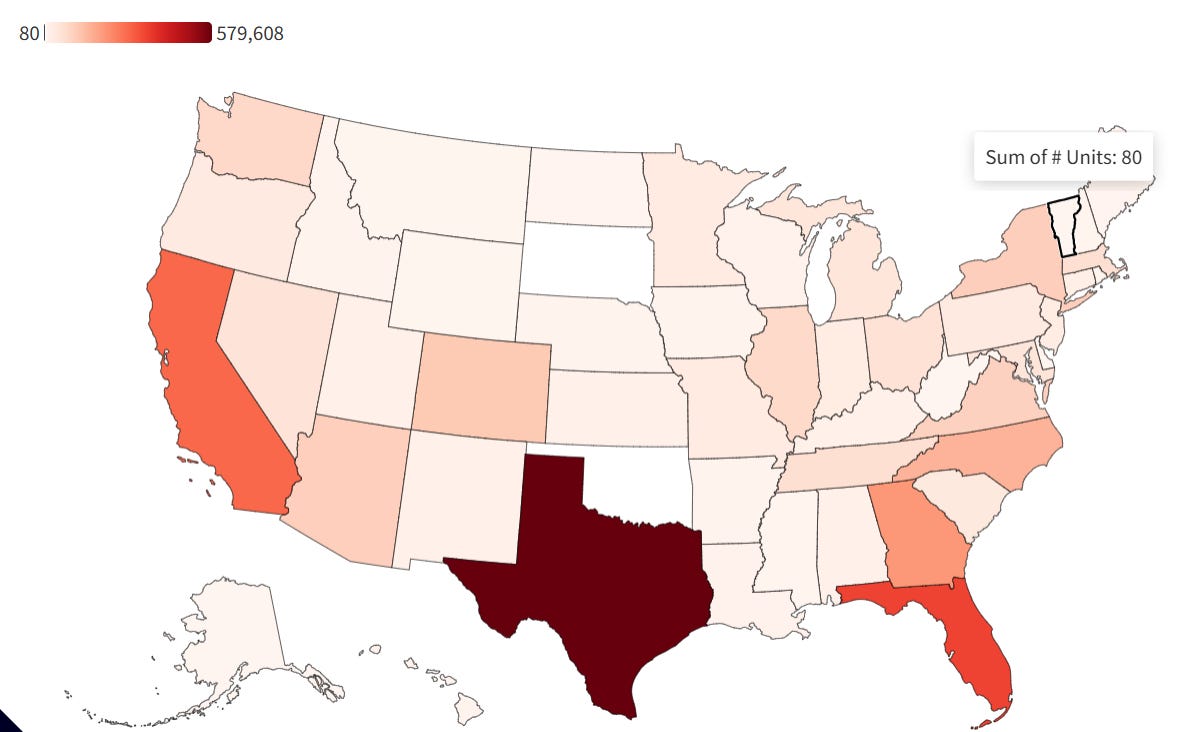
The records Compass reviewed show little of that buying in Vermont. A national tracker counts 80 private equity–owned apartments in the state, the lowest number on its map. The big investors went to fast-growing Sun Belt cities instead.
We provide the data. You make the decisions. At the bottom: how to see who owns homes in Vermont, and where to read each candidate’s housing plan before Nov. 3.
What Janoo Says
Private equity firms pool money from wealthy investors and institutions to buy assets, then sell them later for a profit. In housing, they buy apartment buildings and, in some markets, single-family homes in bulk to rent out.
Janoo wants “the highest tax rates to be for private equity and for large corporate ownership of the housing stock, because that’s one of the largest drivers right now of the increase of the price of housing,” she told WCAX on Oct. 1.
Her campaign platform puts large corporate and private-equity owners in a higher property tax class, alongside luxury second homes, commercial vacation rentals and vacant investment properties. It also promises to close loopholes that let large investors “hide behind multiple LLCs.”
Janoo has also framed it as prevention. She told the Essex Reporter she wants to stop a corporate takeover of Vermont housing.
Those are two different arguments. The first is a claim about what is happening now, which records can check. The second is a judgment about the future.
What Vermont’s Records Show
The state and private records Compass checked find corporate ownership small, and large-investor buying rare:
Who owns homes: Corporations, partnerships and other entities owned 2% to 3% of Vermont’s residential properties every year from 2015 through 2025, the Vermont Housing Finance Agency found in town property records. The count rose from about 5,000 to about 7,000. That group includes nonprofits and government, so private equity is only part of it.
Who the landlords are: The real estate data firm BatchData counts about 18% of Vermont’s single-family homes as investor-owned. Individuals hold about 82% of those, and about 91% belong to owners with just one property. Owners with 1,000 or more homes bought one Vermont house in the last three months of 2025, and sold more than they bought in early 2026.
Lawmakers weighed the issue this year. H.607, which would limit large investors’ purchases of one- and two-family homes, got House committee hearings from January to March and never came to a vote.
Where the Big Buyers Went
Nationally, 32 investors each owned more than 1,000 single-family rental homes in 2022, nearly 450,000 homes in all, the U.S. Government Accountability Office reported. That was about 3% of the country’s single-family rentals.
Those homes are concentrated in a few Sun Belt cities. Large investors held about 25% of single-family rentals in the Atlanta area, 21% around Jacksonville and 18% around Charlotte.
The GAO found the big investors look for:
Fast-growing places, with rising population, jobs and rental demand
Dense clusters of rentals, which keep repair and leasing costs down
Newer homes. In an Atlanta study, the homes they owned were more likely to have been built after 1999.
Vermont matches none of those. Its population grew 0.2% from 2020 to 2025, according to the Census Bureau. Its homes are spread across small towns, and its biggest metro area, around Burlington, is small by national standards.
Vermont’s 2021 Investor Surge, and How It Faded
Vermont did see a burst of investor buying when interest rates were near zero. Investors bought 17% of the 13,999 homes sold in Vermont in 2021, up from 2% before 2016, VTDigger reported from CoreLogic data. That was the largest jump of any state.
By mid-2022, as rates rose, the share fell back to 7%.
CoreLogic counted as an investor anyone who had owned three or more homes at once in the previous 10 years. That includes people with a vacation house or two, not just companies, and the data didn’t separate the two.
Congress Already Acted
Worry about large investors buying homes isn’t only a Democratic issue. President Trump issued an executive order on it in January. Congress then passed the 21st Century ROAD to Housing Act, which became law without the president’s signature on July 11.
The law bars for-profit companies that control 350 or more single-family homes from buying more, starting Jan. 7, 2027, according to legal analyses by Latham & Watkins and Greenberg Traurig. Violations can cost up to $1 million each, or three times the home’s price, whichever is greater. The U.S. Treasury still has to write the rules.
The law leaves gaps, and they are where Janoo’s forward-looking case still applies. It doesn’t cover:
Apartment buildings
Manufactured homes
New homes built to rent
Rundown homes bought and substantially rebuilt to rent
Apartments are the one gap someone has counted. The Private Equity Stakeholder Project, a nonprofit watchdog that scrutinizes private equity’s effects on housing and other industries, tracks apartment buildings with five or more units. Its tracker finds private equity firms own about 13% of U.S. apartments, almost 3 million units, as of April 1.
In Vermont, the Private Equity Stakeholder Project’s latest state map counts 80 private equity–owned apartments, the lowest number on the map. Texas, at the top, has 579,608. The tracker doesn’t say who owns them. The group calls its list incomplete, so the true number could be somewhat higher.
The biggest firms are concentrated elsewhere. The 11 largest private equity apartment owners on the group’s list, led by Blackstone, Greystar and Starwood Capital, together hold more than 1 million apartments. That’s more than a third of all the private equity–owned apartments the group counted nationally. Compass found no public record of any of them owning apartments in Vermont.
When Harbor Group International, one of those 11, agreed in 2025 to buy five New England apartment complexes for $740 million, they were in Massachusetts, New Hampshire and Rhode Island, Bisnow reported.
What It Means for Your Tax Bill
If you own the home you live in, you would not be in the private-equity tax class Janoo proposes. That class reaches large corporate owners, and the records show few of them own Vermont homes. A top rate on that group would likely land on a small number of properties.
The parts of her plan more likely to reach Vermonters are the higher rates on luxury second homes and commercial vacation rentals. Her platform sets no rate for any of the new tax classes and doesn’t define either one. Any new tax class would need a vote of the Legislature.
The records show Vermont isn’t where large investors have been buying. Janoo’s argument is that Vermont should act before that changes. Congress has now made a version of that bet for the whole country, starting Jan. 7.
Check It Yourself
The records are public, so you can weigh the claims for yourself.
Who owns Vermont homes: HousingData.org’s residential ownership page breaks down owners by type, from town property records.
The candidates’ own plans: Read Janoo’s platform and Scott’s campaign site.
Your ballot and polling place: Use the Secretary of State’s My Voter Page to find your sample ballot and polling place. Election Day is Nov. 3.