


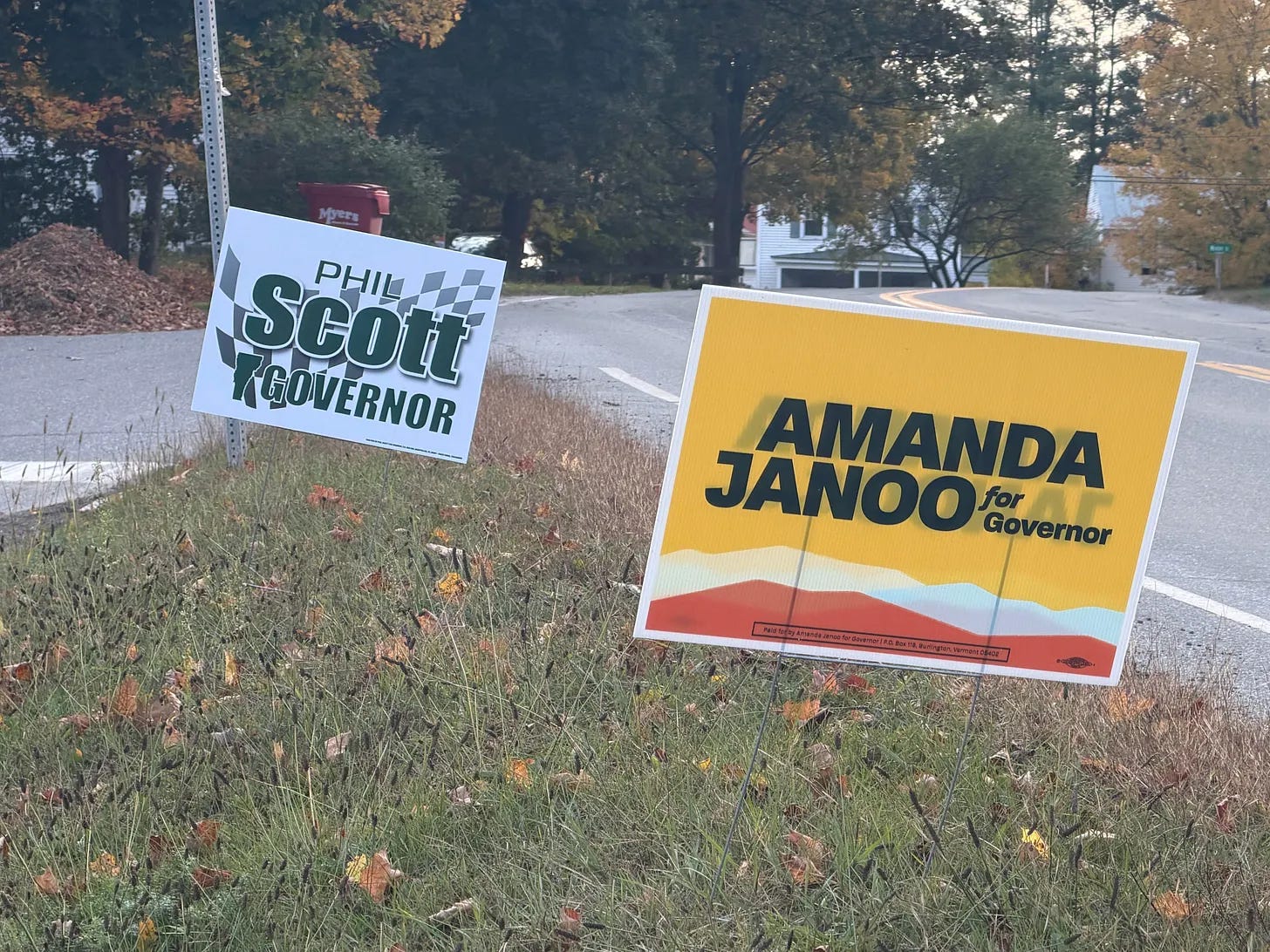
“Democratic newcomer Amanda Janoo holds a small lead over Republican incumbent Phil Scott in the race for Governor of Vermont. However, most likely voters in Vermont expect Scott to win.”
That’s how the University of New Hampshire opened its final poll of the governor’s race, released Sunday. The poll has Janoo, a Democrat/Progressive, leading Scott 51% to 43% among likely voters.
Janoo’s campaign emphasized that lead in a Monday release headlined “Janoo is Up Eight Points in Final Poll as Lead Over Five-Term Governor Grows.” But the same survey produced another striking finding. Sixty-two percent of likely voters expect Scott to win, while only 25% expect Janoo to. Even among Janoo’s supporters, 40% expect Scott to prevail. The poll tells two different stories: whom voters prefer, and whom they expect to win Tuesday.
What Voters Expect
Pollsters usually lead by asking people whom they’ll vote for. The UNH poll also asked: “Regardless of your vote, which candidate do you think is most likely to win the 2026 election for governor?”
A voter can support Janoo and still expect Scott to win. The first answer measures that voter’s own choice; the second measures that voter’s read of everyone else. And 62% expecting Scott to win is not a 62% chance that he will.
The expectation question has a strong record. Economists David Rothschild and Justin Wolfers found that asking voters who will win forecast presidential elections more accurately than asking how they’ll vote. In an analysis of the 2014 elections, expectation questions missed half as many governor’s races as vote questions did. The researchers’ explanation is that people answering about expectations draw on what they know of their friends’ and family’s plans.
That record gives voters’ expectations weight, but it doesn’t establish which question will prove more accurate in Vermont this year. In the UNH poll, the two questions point in opposite directions.
Did the Lead Grow?
In September, UNH had Janoo at 49% and Scott at 43%, with 6% undecided. This time, UNH added a follow-up question for undecided voters asking which way they lean. Those voters are called leaners. The 51%-to-43% figure includes them.
UNH also reports the result without leaners, which is the version that matches September: Janoo 50%, Scott 42%. Janoo’s reported lead widened from six points to eight. In those directly comparable results, her support rose one point and Scott’s fell one point. Changes that small don’t, by themselves, establish that the electorate shifted.
The undecided share fell from 6% to 2%. Over the same period, independent Brian Judd rose from 2% to 4%, and Freedom and Unity candidate Dean Roy picked up 1%.
UNH’s bar chart is titled “With Leaners” over both its September and October panels. The September numbers didn’t include leaners. A footnote under the chart says so.
How Certain Is an Eight-Point Lead?
UNH lists a margin of error of plus or minus 2.9 points for likely voters. That figure applies to each candidate’s share, not to the gap between them.
Pollsters adjust their raw results so the people who answered look like the state as a whole. That’s called weighting. A rough calculation that leaves out weighting puts the margin of error on the gap at about 5.5 points, and Janoo’s eight-point lead exceeds that estimate. But UNH says its published margins have not been adjusted for the uncertainty weighting adds. So the 5.5-point calculation doesn’t settle how precise the weighted result is.
The Headline
UNH’s headline on the Vermont poll reads “Blue Wave Lifts Janoo Over Scott in Vermont?” That suggests party is the reason for Janoo’s lead. The survey doesn’t establish that. Most of her supporters, 72%, say their vote is more for Janoo than against Scott, and 82% of those say it’s about her specifically. That doesn’t rule out a broader partisan pull, but it isn’t evidence of one either.
UNH released its New Hampshire poll the same day under a plain headline: “Dems Lead in Federal Races, Governors Race Deadlocked.”
The Other Polls and the Record
Of the three pollsters in this story, UNH is the only one whose fall surveys have put Janoo ahead.
State Navigate, Oct. 23–25, 1,752 likely voters: Scott 49%, Janoo 46%.
Vermont Public, September: Scott ahead by 10 points.
UNH’s final poll in 2024 had Scott 39 points ahead of Esther Charlestin. He won by nearly 52, about 13 points more than the poll showed.
As Compass reported in September, polls and prediction markets have each missed in Vermont before, and neither decides the race.
UNH’s Case
UNH’s poll draws from a panel of about 2,700 Vermont adults recruited at random by phone, text and mail. In September, Survey Center director Andrew Smith said that kind of panel is the same method used by Gallup, CNN and Pew.
UNH weighted the sample by age, sex, education and region, and to Vermont’s 2024 election results. The sample’s recalled 2024 presidential vote, Harris 62% and Trump 31%, closely matches the actual result of 64% to 32%.
The poll also finds conditions that favor a challenger this year:
Only 20% of Vermonters approve of President Trump, the lowest in New England.
Democrats are more engaged: 69% say they’re extremely interested in the election, compared with 59% of Republicans.
Janoo is better liked than Scott, with 54% favorable to his 42%.
38% of Janoo’s supporters say they voted for Scott in 2024. That’s reported crossover, the kind of shift a challenger needs.
What the Poll Shows
Read in full, the UNH poll measures a close race two ways, and the two point in different directions: whom voters support, and whom they expect to win. The release’s presentation leans further than its numbers do, with a “blue wave” headline the survey doesn’t establish and a September chart labeled with leaners it didn’t have.
The Campaigns
“A poll in the homestretch isn’t what tells us we’re succeeding,” Janoo said in Monday’s release. She pointed instead to turnout at her campaign’s canvasses and its endorsements, and said the campaign would spend every second until the polls close getting out the vote.
Scott’s campaign has argued that polls understate his support. After the September polls, spokesperson Emma Shouldice said that “public polling has always undervalued the Governor’s support.”
As of Friday, nearly 140,000 Vermonters had already voted, according to the Secretary of State’s office. That’s nearly half the 292,000 ballots cast in Vermont’s 2022 general election. Polls are open until 7 p.m. Tuesday.
News comes from the facts. Opinions should only come from you. Please consider a paid subscription to Compass Vermont.