


You’re at the counter with a coffee and a sandwich. The total is $8.62. You hand over a ten. The clerk gives you back $1.40 instead of $1.38, or maybe $1.38 exactly, or maybe there’s a handwritten sign taped to the register saying the store is out of pennies and you’re not sure what that means for you.
Any of those could be what’s happening at your register. All of them trace back to the same law.
Since June 8, a Vermont business has been allowed to round your cash total to the nearest five cents. The rule arrived inside Act 128, the Legislature’s economic development bill, and it runs about three paragraphs. It now sits in the chapter of Vermont law that defines the dollar, the cent and the mill as the state’s units of account.
Here’s the part that matters at the counter: it’s optional. Every store decides for itself. There is no statewide practice to learn. There is only whatever the register in front of you happens to do, and there’s a decent chance nobody has told you which one it is.
What your store might be doing
Five possibilities, and you can’t tell them apart by looking.
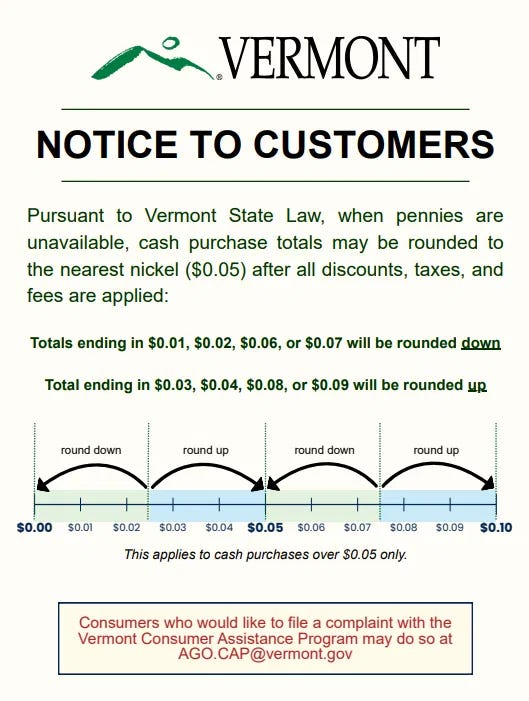
Rounding by the state’s table, with the notice posted. This is the version the law is built for. Totals ending in 1, 2, 6 or 7 cents come down. Totals ending in 3, 4, 8 or 9 go up. The store posts the state’s model notice at the register or the door, and you can read the whole rule while you wait.
Rounding by the table, no notice. The rounding is lawful. The missing notice is its own problem — the law requires businesses that round to post it — but that’s between the store and the state, and it doesn’t make your $8.60 wrong.
Rounding down every time. Some shops just eat the difference rather than think about it. You come out ahead or even, every single time. Technically this isn’t the statute’s method. Practically, nobody is going to complain.
Rounding up every time. This is the one to notice. It isn’t the statute’s method either, and that matters more here, because the whole point of Act 128 was to give businesses legal cover. The law says rounding by its table isn’t an unlawful price increase, a surcharge, an unfair or deceptive practice, or discrimination. A store that only ever rounds up doesn’t have that cover. It gave up the protection the law was written to provide.
Not rounding at all. Asking for exact change, steering you to a card, digging out the penny jar.
If you want to know which one you’re dealing with, the receipt tells you. Compare the subtotal, the tax, and what you actually handed over. It reconciles or it doesn’t.
The sign says something the law doesn’t
The state produced a model notice for stores to post — the one with the Vermont logo and the number line with the little arrows. If you’ve seen it, you’ve seen this line at the top:
Pursuant to Vermont State Law, when pennies are unavailable, cash purchase totals may be rounded to the nearest nickel…
When pennies are unavailable. Reasonable enough. It sounds like a contingency — like rounding kicks in on a bad supply day.
The law doesn’t say that. Its operative sentence reads that a person in a cash transaction “may round the final amount due to the nearest $0.05,” and then gives the table. No shortage required. No standard for what “unavailable” would even mean. A store can round every cash sale, all day, with a drawer full of pennies, and be squarely within the law.
The “when pennies are unavailable” language does appear in the act — in its purpose section, which explains why lawmakers wrote it. Purpose sections tell you the intent. They aren’t the permission. The permission is unconditional.
The notice adds one more limit that isn’t in the statute either: that rounding applies only to purchases over five cents. Nothing in the law says so.
That the notice is narrower than the law isn’t a technicality, and Arizona shows why. When Arizona wrote its own rounding law in March, it put the penny-availability condition in the operative text, not the preamble: rounding applies where one-cent coins “are not available or are not used by a seller.” Arizona also made rounding mandatory rather than optional, and — the part with real teeth — expressly forbade sellers from using any rounding method other than the standard one. In Arizona, a store that rounds up every time is breaking the law. In Vermont, it has merely forfeited a legal shield it may never need.
Three things nobody put on the poster
If you return it, you get back what you paid. The law says that if a transaction was rounded, a cash refund goes to you “in the exact amount initially paid.” Rounded up two cents on the way in, you get those two cents on the way out. A real protection, and it isn’t mentioned anywhere on the notice.
Paying part cash still counts. The law defines a cash transaction as one where payment is made “entirely or partially in cash.” Twenty in bills and the rest on a card is a cash transaction, and it can be rounded. The notice and the Department of Taxes guidance both describe this as a cash-purchase rule, which is true but leaves that out.
The state gets the same either way. Tax is calculated on the real total before any rounding, so nothing here changes what Montpelier collects. The pennies come out of the space between you and the store, not out of the treasury.
And if something seems off?
This is where it gets strange.
The notice was written by the Department of Liquor and Lottery. Complaints go to the Attorney General’s Consumer Assistance Program, the address printed at the bottom of the poster. But the power to actually penalize a business for not posting belongs to the Secretary of Agriculture, Food and Markets — the agency that inspects gas pumps and grocery scales — under a penalty section borrowed from an entirely different title of Vermont law, capped at $500. That agency also runs its own consumer complaint form, which the poster doesn’t mention.
Three agencies, two complaint windows, one poster, five hundred dollars. Vermont is not alone in the last part: Arizona also handed enforcement to its agriculture department’s weights and measures division. Rounding, it seems, is being treated everywhere as a cousin of the gas pump.
What that enforcement looks like in practice is a matter of public record, and it’s worth knowing before you assume anyone is being fined. The Agency’s weights and measures program starts with an official notice on a first violation and a written corrective action report from the store; penalties escalate only if inspectors find the same problem again, with referral to the Attorney General as the far end. The Agency publishes its violation records back to 2011, sorted into four categories — price scanners, short weight, missing meter seals, and short measure. A missing rounding notice is not among them. Whether Act 128 checks have been folded into that inspection routine at all doesn’t appear anywhere in the public record.
There’s also a gap at the start. The law took effect June 8. The state wasn’t required to have the model notice ready until July 1. For about three weeks, a business could round under the law’s protection while the notice it was supposed to display didn’t yet exist.
So is it costing you money?
Almost certainly not much. But how it works is more interesting than the amount.
Start with the rule itself, which is even. Four endings go down, four go up, and the amounts match exactly — over a full run of possible totals you gain six cents and give back six. If the last digit of your total were random, this law would cost nobody anything, ever.
First: most cash purchases aren’t affected at all. The best data on this is a Federal Reserve Bank of Richmond study by economists Zhu Wang and Russell Wong, which is where the widely quoted “$6 million” figure comes from. Rather than simulate, they used the Fed’s Diary of Consumer Payment Choice — 24,728 real transactions logged by 4,671 adults over three days in 2023. Of those, 3,559 were cash. And 2,436 of the cash transactions — more than two-thirds — ended in whole dollars, so rounding wouldn’t touch them. Of the rest, about 35 percent ended in a zero or a five, also untouched.
Work that through and roughly one cash transaction in five is actually subject to rounding at all. Across every payment method, it’s about three in a hundred.
Second: the totals that are affected lean the wrong way, slightly. Wang and Wong found real cash totals cluster on 3, 4, 8 and 9 cents — the round-up digits — rather than spreading evenly. Applying the standard rule to each transaction and scaling to the adult U.S. population, they put the national cost at $6.06 million a year. That works out to about 2.35 cents per adult per year. Scaled to Vermont’s roughly 532,000 adults, on the order of $12,500 statewide — our arithmetic, not theirs, and rough. Per affected transaction, the average drift is about an eighth of a cent.
Third — and this is the Vermont part — our tax rates decide whether the drift is random or locked in.
We checked every price from $1.00 to $99.99 against each Vermont rate. At 6 percent sales tax, 7 percent in local-option towns, 9 percent meals, and 11 percent alcohol in local-option towns, multiplying by the tax scatters the final digit across all ten values and the net effect lands within a hundredth of a cent of zero. Those rates are, in effect, randomizers.
Two rates aren’t. And they are the two that matter most in Vermont.
Zero percent. Vermont doesn’t tax groceries, clothing, footwear or medicine. On those, the shelf price is the total. So a single item priced at $4.99, or $2.49, or $6.19 — any price ending in 9 — produces a total ending in 9. Nine rounds up. Not usually. Every time. That is arithmetic, not a forecast, and it holds for every 9-ending price we tested.
Ten percent. Vermont’s alcoholic beverage tax is 10 percent statewide on drinks served for immediate consumption — bars, restaurants, taverns, clubs. It’s also the meals rate in the 44 municipalities that have adopted the 1 percent local option meals tax. And 10 percent is too clean a multiplier to scramble anything: whatever your price ends in, the total’s last digit is fixed. A $7.99 drink lands on 9 and rounds up, every time. A $7.89 drink lands on 8 and rounds up two cents, every time. A $7.79 drink lands on 7 and rounds down two cents, every time.
That last one is worth sitting with, because it cuts against the easy version of this story. At 10 percent the outcome isn’t stacked against customers — it’s stacked, full stop. Which way depends on how the menu is priced. A bar that ends its prices in .99 will round up on every cash drink it sells for as long as those prices hold. A bar down the street that ends its prices in .79 will round down on every one. Neither is doing anything wrong. Neither is choosing. The menu decided it.
The one place the tilt does run consistently against customers is the untaxed aisle, and even there it vanishes as soon as you buy more than one thing:
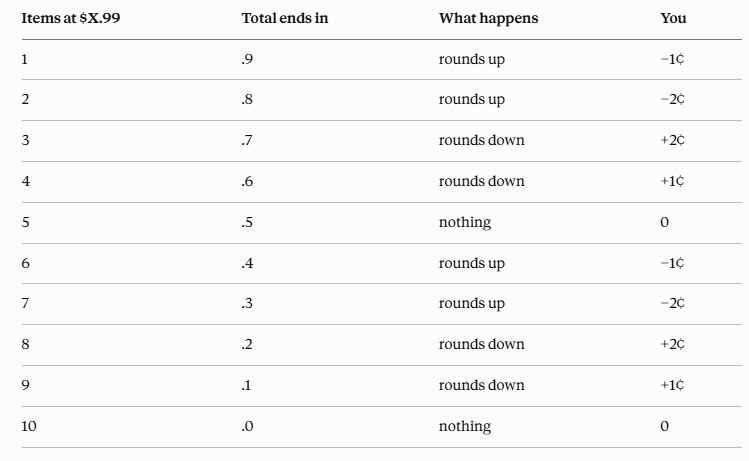
A full grocery run comes out level. The exposure is the small stuff — one or two untaxed items, paid in cash, at a store that rounds. The gas station run.
Which means it lands on people who pay cash. In the Fed’s diary data, Vermonters’ age group is the tell: adults 55 and older used cash for about 22 percent of their payments, roughly double the 12 percent rate among people under 55. Vermont is one of the oldest states in the country, with about 22.8 percent of residents over 65 against 18 percent nationally. If anything, the $12,500 estimate is a floor.
Questions the record doesn’t answer
Some of this is simply not knowable from the documents, and it’s worth being plain about which parts.
Whether a store that rounds without posting keeps its legal protection. The law grants the protection in one subsection and requires the notice in another, and the text does not connect them. Arizona’s statute leaves less room for the question by forbidding alternative methods outright. Vermont’s doesn’t address it.
Why the notice describes a narrower rule than the statute. Nothing in the act, the Department of Taxes guidance, or the notice itself explains the gap. The purpose section is the likeliest origin, but that’s an inference, not a finding.
Whether anyone is enforcing the notice requirement. No rounding-notice category appears in the Agency of Agriculture’s published violation records, which is consistent with either no enforcement or no violations found — the record can’t distinguish between them.
How many Vermont businesses are rounding. The law is optional, there is no registry, and no one has counted. Any figure you see is a guess.
What share of Vermont transactions are cash. The national diary data is the best available proxy. No state-level measurement appears to exist.
What to watch
Whether lawmakers come back and do what Arizona did — make rounding mandatory and bar every other method — which would end the store-by-store guessing Vermont has chosen instead. Whether the notice gets rewritten to match the law. And whether anyone in Montpelier notices that the 10 percent alcohol rate turns every cash bar tab in the state into a coin flip that was decided months ago, by the menu.
In the meantime: check your receipt. It’s two cents. It’s also the only way to know.
How we got the numbers: rounding outcomes come straight off the statutory table in Act 128. The claims about which tax rates scatter the final digit and which lock it were computed deterministically over every price from $1.00 to $99.99 at 0, 6, 7, 9, 10 and 11 percent, with tax rounded to the cent before the statutory rounding is applied; the basket table is arithmetic. National transaction figures are from Wang and Wong, “Rounding Up: The Impact of Phasing Out the Penny,” Federal Reserve Bank of Richmond Economic Brief No. 25-27 (July 2025), which uses the 2023 Diary of Consumer Payment Choice. The finding that roughly one cash transaction in five is subject to rounding is our arithmetic from the transaction counts they report, not a figure they publish. The Vermont dollar figure scales their national estimate by adult population and is ours, not theirs. Local option tax counts are from the Department of Taxes list as published, counting only municipalities whose tax is in effect as of publication.