


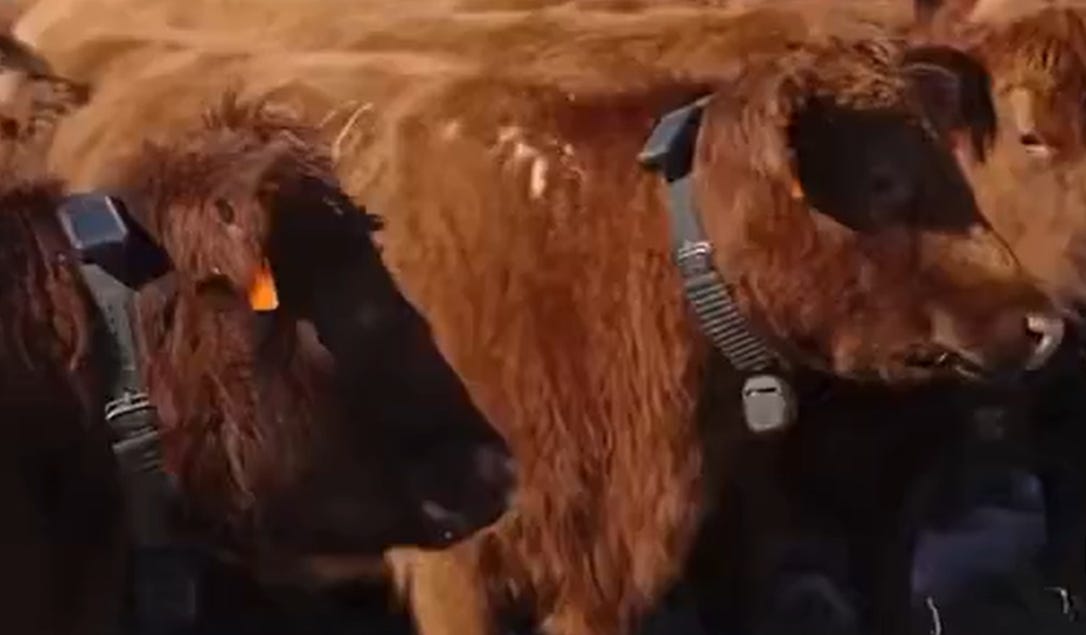
A viral social media post over the weekend announced that billionaire investor Peter Thiel had bet $2 billion on a smart collar that lets farmers herd cows from a phone. Millions of people shared it. Tech investors called it the future of agriculture. The company behind it, New Zealand-based Halter, is now valued at $2 billion and has collars on 600,000 cattle across three countries.
Vermont — where the dairy industry is losing farms, losing workers, and facing an acute labor shortage — doesn’t appear to have access to it yet.
The Technology Is Real
Halter makes solar-powered GPS collars for cattle. Farmers use a smartphone app to draw virtual fence boundaries on a satellite map of their land. When a cow approaches the boundary, the collar plays a directional audio tone. If the cow doesn’t turn back, it delivers a vibration. As a last resort, a low-energy electric pulse — about one-tenth the strength of a conventional electric fence, according to the company.
Most cows learn to respond to sound alone within seven to 10 days. Peer-reviewed research published in the Journal of Dairy Science found that after a 10-day training period, 50 percent of cows received zero corrective pulses per week in paddock containment, and 35 percent received zero during virtual herding to the milking parlor.
Beyond fencing, the collars track movement, grazing behavior, rumination, fertility cycles, and health patterns around the clock — generating what the company says is upward of 1,000 data points per minute per cow. Machine learning trained on hundreds of thousands of animals flags early signs of illness or distress, and the system can herd dairy cows to the milking parlor without a farmer, a dog, or a motorcycle.
In dairy farming, where cows must be milked at least twice daily, 365 days a year, regardless of weather, staffing, or flooding — automated herding is the feature that attracted the most attention from investors and the most interest from farmers in New Zealand and Australia.
The Investment Is Real, Too — But Smaller Than the Hype
Bloomberg reported March 20 that Founders Fund, the venture capital firm co-founded by Peter Thiel, is leading a new funding round that would value Halter at approximately $2 billion — double the $1 billion valuation the company reached last June when the firm BOND led a $100 million Series D.
A viral post from the account Milk Road AI framed this as Thiel personally betting $2 billion. That’s wrong. The $2 billion figure is the company’s pre-money valuation, not the check size. The actual round size hasn’t been disclosed. Still, the deal is reportedly oversubscribed — more investors want in than there is room for — which is notable in a sector where agtech startups have been declaring bankruptcy in recent years as farmers proved slow to adopt new technology.
The viral post also described Halter’s founder Craig Piggott as “a rocket engineer who built spacecraft at Rocket Lab.” Piggott grew up on a dairy farm in New Zealand, studied mechanical engineering at the University of Auckland, and worked at Rocket Lab for about nine months during his final year of university. An intense stint — he worked directly under CEO Peter Beck — but not a career building spacecraft. Beck became one of Halter’s first investors and remains on its board.
The post called the company’s proprietary system a trademarked “Cowgorithm.” That one checks out. Halter’s U.S. website lists COWGORITHM® as a registered trademark of Halter USA Inc., alongside HALTER®, PASTURE PRO®, and — notably — BUILT FOR BEEF™. The company has used the term in interviews since at least 2021. It refers to the on-device machine learning that tailors cues to each individual animal based on thousands of motion data points per minute.
Where It Works — And Where It Doesn’t Yet
Halter currently has collars on 600,000 cattle across New Zealand, Australia, and the United States, serving more than 1,000 operations. Since launching U.S. operations in 2024, the company says American ranchers have created more than 11,000 miles of virtual fencing — roughly the full perimeter of the continental United States — representing approximately $220 million in avoided physical fencing costs. Those figures are from Halter’s own press materials and have not been independently verified.
The company charges farmers $5 to $8 per animal per month on a subscription model, with collars included.
But there is a critical distinction in what’s available where. Halter’s U.S. expansion has been focused on beef ranching operations across 22 states, from California to the Great Plains. Virtual fencing and GPS tracking work for beef. The full dairy package — automated herding to the milking parlor, heat detection, 24/7 health monitoring calibrated for lactating animals — is the system that has transformed pasture-based dairy operations in New Zealand and Australia.
As of this writing, Halter’s U.S. website tells the story clearly. The company maintains dedicated dairy pages for its New Zealand and Australian markets. The U.S. site has no dairy page — the URL returns a 404 error. Every customer testimonial on the U.S. site is from a beef rancher. The “How It Works” section links exclusively to /en-us/beef. One of the company’s registered U.S. trademarks is BUILT FOR BEEF™. As of mid-2025, the Northeast Organic Dairy Producers Alliance reported that Halter’s dairy-specific features were not yet available in the U.S., with the company anticipating expansion into the American dairy sector by the end of 2025 into 2026. Halter’s U.S. operations are headquartered in Boulder, Colorado.
That timeline means the system generating $2 billion worth of investor enthusiasm — the one that herds cows to the milking parlor from a phone and monitors the health of every animal in real time — does not appear to be available to American dairy farmers today. Compass Vermont has reached out to Halter for confirmation on its U.S. dairy timeline and will update this story with any response.
What Vermont’s Dairy Industry Looks Like Right Now
Vermont’s dairy industry is the economic engine of the state’s agricultural sector, contributing over $5 billion and supporting approximately 17,318 jobs. Vermont farms produce roughly two-thirds of New England’s milk supply.
The trajectory is heading in one direction. Vermont had 868 dairy farms a decade ago. Today there are 439. Most of the closures were small- and medium-sized operations. Only 9 percent of the state’s remaining dairies milk more than 700 cows.
And the labor situation is acute. An estimated 94 percent of Vermont dairy farms that hire outside workers use migrant labor — a workforce of roughly 750 to 850 mostly Mexican workers, according to industry estimates. Federal immigration enforcement actions at Pleasant Valley Farms in Berkshire last spring sent shockwaves through the industry. Farmworkers reported being afraid to leave their homes. Farm owners warned of operational disruptions.
The Vermont Agency of Agriculture has acknowledged the stakes directly: without a sufficient labor base, Vermont will have farms with cows that don’t get milked or fed.
Halter’s technology is designed to automate herding, eliminate the need for physical fencing across difficult terrain, monitor animal health around the clock, and reduce the daily labor load by hours. Whether that would make a meaningful difference on Vermont’s remaining dairy operations — and whether the economics would work at Vermont scale — are open questions. For now, the technology isn’t being marketed to them.
What Vermont Farmers Are Testing Instead
Vermont isn’t starting from zero. The Agritech Institute for Small Farms, created by the Strolling of the Heifers nonprofit in 2022, ran a pilot program in 2024 testing virtual fencing from Nofence — a Norwegian competitor — on five cattle farms and four vegetation management sites across the state. The institute secured more than $300,000 in grant funding from the Dairy Business Innovation Center, the Vermont Housing and Conservation Board, and other organizations, allowing farmers to test the equipment at no cost.
Ben Nottermann, co-owner of Snug Valley Farm in East Hardwick, participated in the pilot and reported saving at least 45 minutes per day by moving fence lines through the app instead of physically relocating posts. Over a 200-day grazing season, he said the labor savings alone covered the cost. During the catastrophic flooding in July 2024, Nottermann said the app was a lifesaver — he was separated from his herd for five days but could track each cow and move virtual boundaries away from flooded areas remotely.
Melanie Harrison of Harrison’s Home Grown Farm in Addison offered a pragmatic view: she sees the technology becoming more cost-effective over time as fence materials and labor costs keep rising. “It’s good to try and be kind of on the forefront of that technology and be able to adapt early on,” she told the Hardwick Gazette.
Other Vermont farmers in the pilot raised concerns about the steep learning curve, weak mobile networks in rural areas, the risk of predator attacks without physical fences, and cost.
The Cost Question
At Halter’s $5 to $8 per cow per month, here’s what the subscription would look like for a Vermont dairy:
100-cow operation: $6,000 to $9,600 per year
200-cow operation: $12,000 to $19,200 per year
700-cow operation: $42,000 to $67,200 per year
That’s a recurring cost on top of the tower infrastructure the system requires. For Vermont dairies already measuring profitability in pennies per hundredweight of milk, the math is not automatic — even if the technology offsets labor and fencing expenses.
One potential advantage for Vermont: Halter’s system uses solar-powered LoRaWAN towers that don’t rely on cellular networks, which could sidestep the connectivity problems that plagued the Nofence pilot in more remote parts of the state.
For comparison, Vermont’s Pasture and Surface Water Fencing Program currently provides up to $15,000 per farm to install physical fencing infrastructure for pasture management and water quality improvement. Whether state or federal agricultural programs will eventually extend to virtual fencing technology is a policy question that has not yet surfaced in Vermont.
Where This Is Heading
The global precision agriculture market is estimated at $9.5 billion in 2025, with projections to surpass $17 billion by 2031. Halter isn’t the only player. Merck’s animal health division monitors 2 million dairy cows globally through its Allflex and SenseHub systems. Nofence is operating in Vermont. John Deere is investing in autonomous equipment and AI-driven analytics.
What attracted $2 billion in valuation to Halter is the combination of virtual fencing, active herding, and health monitoring in one platform — powered by a subscription model where revenue grows as herds grow. It’s the kind of recurring-revenue structure that venture capitalists have made fortunes on in software, applied to cows.
Whether that model — designed for massive New Zealand pasture dairies and sprawling Western ranches — could work in a state where most remaining farms run fewer than 200 cows, margins are thin, the terrain is hilly, and winters are long is an unanswered question. So is the more basic one: when, or whether, Halter plans to offer its dairy product to American farmers at all.
The technology to manage a dairy farm from a smartphone exists. The investment community thinks it’s worth $2 billion and climbing. Whether it could work for a 150-cow pasture dairy in Addison County the same way it works on a 10,000-acre beef ranch in Wyoming is a question that hasn’t been tested. As of today, Halter’s own U.S. website doesn’t have a dairy page to ask it.
Halter’s U.S. website is halterhq.com/en-us; as of March 23, 2026, it contains no dairy-specific page or content. The Bloomberg report is here. The Northeast Organic Dairy Producers Alliance published an overview of virtual fencing vendors available in the U.S. Vermont’s Agritech Institute for Small Farms can be reached through the Strolling of the Heifers organization. The Hardwick Gazette’s coverage of the 2024 Nofence pilot includes interviews with participating Vermont farmers.