


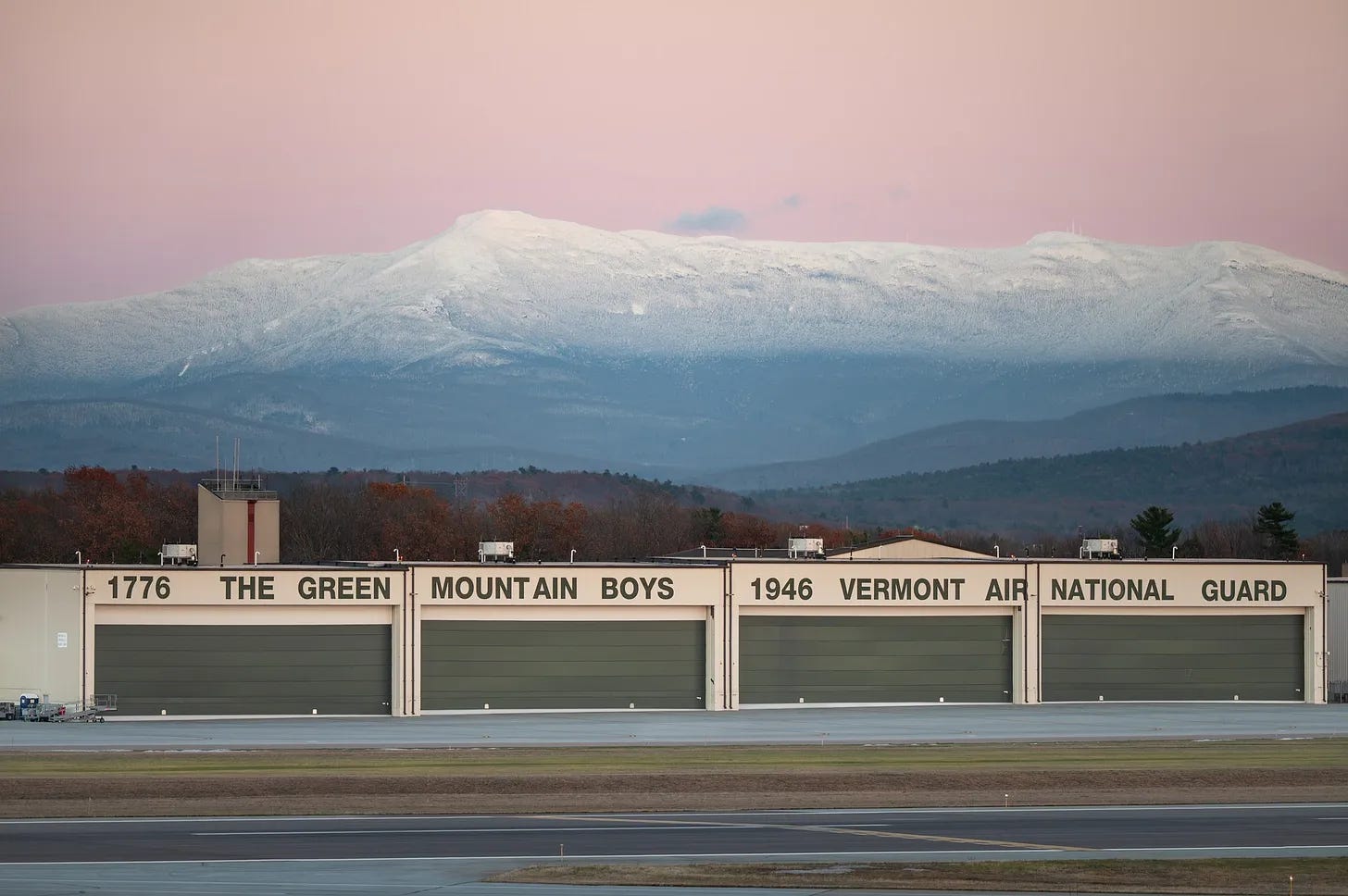
The families of approximately 1,000 Vermont Air National Guard members have spent the past two months navigating an information vacuum that one legislator called “not normal.” Unlike previous deployments marked by public ceremonies and detailed timelines, the 158th Fighter Wing’s mobilization in December 2025 came with minimal notice and even less transparency about where their loved ones were going or when they might return.
Some families learned about the move not from official Guard channels, but from independent flight trackers on social media who spotted F-35As with Vermont tail markings crossing the Atlantic.
The secrecy surrounding these deployments represents a stark departure from how Vermont’s “Green Mountain Boys” have historically operated. When the unit deployed to support NATO operations in 2022 or rotated to Japan in 2024, Governor Phil Scott and congressional delegations attended public ceremonies. This time, there were no such events.
From Vermont to the Caribbean: Operation Southern Spear
The 158th Fighter Wing’s journey began in mid-December 2025 when members received short-notice orders for federal mobilization. The destination: Roosevelt Roads Naval Station in Puerto Rico as part of Operation Southern Spear, initially described as a maritime counternarcotics campaign in the Caribbean.
Vermont’s Air Guard spokesperson, Lt. Col. Meghan Smith, told concerned families in early December that the Guard was “not authorized to share” information about the location, duration, or purpose of the mission. Even Major General Gregory Knight, Vermont’s Adjutant General, told state legislators in January that details remained “scant” and he could not provide a timeline for how long the deployment would last.
Governor Scott found himself in the unusual position of having no additional information to share with Vermonters. Under Title 10 federal orders, the unit had been placed under direct presidential control, bypassing the governor’s normal command authority. When pressed by reporters and concerned citizens, Scott referred questions to the Pentagon—which declined to comment.
The Venezuela Raid: A Mission’s True Scope Revealed
The counternarcotics framing proved incomplete. On January 3, 2026, the 158th Fighter Wing’s F-35A stealth fighters participated in Operation Absolute Resolve, the raid that captured Venezuelan President Nicolás Maduro. The mission involved more than 150 U.S. military aircraft targeting government facilities in Caracas.
Vermont’s F-35As brought specific capabilities to the operation. The aircraft’s stealth characteristics and advanced sensors made them ideal for Suppression of Enemy Air Defenses (SEAD), neutralizing Venezuelan air defense systems to protect extraction teams moving in to capture Maduro and his wife, Cilia Flores.
The Department of Defense described the operation as “spectacularly executed” with “sheer guts and grit,” noting no U.S. fatalities and seven wounded. Venezuela reported significant casualties among the Presidential Guard, while Cuba confirmed 32 military and intelligence advisors killed.
Crossing the Atlantic: The Middle East Pivot
Within weeks of the Venezuela raid, families began hearing their loved ones would be leaving Puerto Rico. But many were “not told for where,” according to one family member who spoke to Seven Days.
The answer came not from official channels but from independent defense watchers. On January 29, six F-35As with Vermont tail markings were tracked landing at Lajes Air Base in the Azores, Portugal—the standard Atlantic crossing point for combat aircraft heading to the Middle East. They were accompanied by KC-46 Pegasus aerial refueling tankers that had originated in the Caribbean.
Flight tracking data identified at least 12 C-17 Globemaster III cargo flights moving between Puerto Rico and Jordan between February 2-6. The likely destination: Muwaffaq Salti Air Base in Jordan, a key hub for U.S. Central Command operations that currently hosts F-15E Strike Eagles and A-10C Warthogs.
One family member told reporters they had to rely on “Armchair Admiral,” an independent social media flight tracker, to determine their spouse was likely in Jordan. The fact that families turned to public social media to locate their loved ones during a potential war zone deployment illustrates the communication breakdown.
The Vermont F-35: Why This Unit Matters
The 158th Fighter Wing became the first Air National Guard unit to transition to the F-35A Lightning II in 2019, making it one of the most capable Guard units in the country. The fifth-generation stealth fighter can reach speeds of Mach 1.6 and features advanced sensor fusion that allows pilots to detect and destroy enemy radar and missile systems before being detected themselves.
This technical sophistication explains why National Guard units like Vermont’s are increasingly called upon for high-risk missions. As one expert told local media, Guard pilots are often the “most seasoned” in the military, with decades of flight experience that makes them the “first go-to” for presidents engaging in complex operations.
The 158th’s high operational tempo in recent years—rotating through Kadena Air Base in Japan, Germany for NATO missions, Puerto Rico, and now Jordan—demonstrates both the platform’s reliability and the proficiency of Vermont’s citizen-airmen.
The Iranian Pressure Campaign
Vermont’s F-35As are now positioned as part of what President Trump has described as a “massive armada” heading toward Iran. The deployment includes the USS Abraham Lincoln carrier strike group and represents what the administration calls “Maximum Pressure” 2.0—a strategy using overwhelming military presence to coerce Tehran into nuclear negotiations.
The White House issued a fact sheet in February stating the buildup responds to Iran’s refusal to reach a “fair, equitable deal” regarding its nuclear program. The administration imposed 25% tariffs on countries trading with Iran to intensify economic pressure.
Vermont’s SEAD-specialized F-35As would be critical in any potential strike on Iranian nuclear facilities, given their ability to penetrate modern air defenses. An Iranian drone was reportedly shot down while approaching the USS Abraham Lincoln in early February, indicating active tensions in the theater.
Trump has warned that “probably bad things will happen” if negotiations fail, while Iran’s Supreme Leader has threatened retaliation for previous strikes on Iranian nuclear facilities.
Vermont’s Congressional Delegation: Opposition and Paradox
Vermont’s federal representatives have been vocal in opposing the deployment while simultaneously securing federal funding for Guard infrastructure—a tension that came into sharp focus at a February 6 press conference in Montpelier.
Senators Bernie Sanders and Peter Welch celebrated $58 million in federal earmarks for Vermont, including $4 million for Vermont National Guard infrastructure such as a new readiness center in the northeastern part of the state. Yet at the same event, they condemned what they called the President’s “unconstitutional escalation.”
Sanders stated that the Venezuela attack gives a “green light” for other nations to violate international law and seize resources. He emphasized that only Congress has the power to declare war. Welch strongly opposed their mobilization in what he called a “relentless march to war” that he argues is illegal under the Constitution.
The Vermont Democratic Party officially termed the deployment “unconstitutional, dangerous, and an abuse of power.” Governor Scott has remained largely silent, referring specific questions about the mobilization to the Pentagon.
The Constitutional and Legal Questions
Legal experts have raised significant concerns about the deployments. The New York City Bar Association called on Congress to “halt the President’s violations of U.S. and international law in Venezuela,” while the UN General Assembly voted 75 to 20 to declare the Venezuelan invasion a “flagrant violation of international law.”
The administration has relied on Article II constitutional authority as Commander-in-Chief and invoked a “law enforcement” justification to bypass the War Powers Resolution. Legal scholars note similarities to a 1989 Office of Legal Counsel opinion by William Barr that was used to justify the Panama invasion—arguing the military can execute arrest warrants on foreign soil.
However, Secretary of State Marco Rubio and Defense Secretary Pete Hegseth reportedly provided classified briefings to Congress in late 2025 assuring members that no land-based attack on Venezuela was planned. The subsequent January 3 raid has been viewed by many as a deliberate circumvention of congressional oversight.
The Family Impact: Beyond the Headlines
For the approximately 1,000 members of the 158th Fighter Wing and their families, the policy debates unfold against personal challenges. Unlike active-duty military families who live near large bases with robust support infrastructure, many Guard families are scattered across Vermont’s rural communities.
The Vermont National Guard operates programs designed to support families: the Yellow Ribbon Program for deployment preparation, six Military & Family Readiness Centers statewide, and a charitable foundation that provides emergency financial grants. But these programs typically require advance notice to be effective.
The short-turnaround nature of the December orders disrupted the holiday season and left many members with little time to arrange their civilian employment, childcare, or financial obligations.
Infrastructure Investment Amid Deployment
The $4 million secured by Vermont’s senators for Guard infrastructure comes as the state prepares to elect a new Adjutant General. Both candidates in that race—Brigadier General Henry Harder and Colonel Brent Zeigler—have been asked by legislators whether they would resign rather than carry out “unlawful” or “illegal” orders, even though under military law, resigning is not an option.
The funding will support a new readiness center in northeastern Vermont, improving facilities for the approximately 2,800 Vermont Guard members statewide. The investment reflects the delegation’s complex position: supporting the institution and its members while opposing how they are being deployed.
Defense Secretary Pete Hegseth has touted the “deterrent effect” of operations like the Venezuela raid, suggesting the administration views the deployments as successful. Meanwhile, Vermont’s Guard leadership continues to navigate the dual pressures of federal orders and state concerns.
What Happens Next
The immediate future for Vermont’s families depends largely on diplomatic developments in the Middle East. The administration’s “Maximum Pressure” campaign could lead to several scenarios: a negotiated settlement that allows the 158th Fighter Wing to return home by spring, continued deterrence posture requiring extended deployment, or escalation into kinetic strikes on Iranian targets that would intensify the mission and potentially extend timelines.
Vermont’s congressional delegation has pledged continued oversight. Sanders and Welch have indicated they will press for greater transparency and challenge the constitutional basis for extended Guard deployments without congressional authorization. However, with the unit already under Title 10 federal control, the delegation’s ability to directly influence operations remains limited.
For now, Vermont’s Air Guard families continue adapting to a new reality where deployments arrive with minimal notice, missions involve kinetic operations in contested regions, and official information remains scarce. The transformation of National Guard units from weekend warriors to frontline strike forces has restructured military-civilian relations in ways that Vermont—a state of roughly 643,000 people—is experiencing acutely.
The 158th Fighter Wing’s technical capabilities ensured it would be called upon for the most demanding missions. What remains unresolved is how the institution will adapt its communication and support structures to match the operational tempo it now maintains, and whether families will continue learning about deployments from flight trackers rather than official channels.
So many people don't understand what the "National Guard" is. ........"Vermont’s Air Guard families continue adapting to a new reality where deployments arrive with minimal notice, missions involve kinetic operations in contested regions, and official information remains scarce. "........If you sign up to be in the Guard, you know [or should know] you can be called to "Active" duty at anytime! It say's so right in the papers your signing. This is nothing new. But they did change the length of total time served when you sign up. Use to be 6 yrs., now it's 8, even if you only sign up for 3. When I got out,[long time ago] I had been active duty for 2 yrs. I had 4 more yrs. till they had no more control over me. They asked me if I wanted the "Reserves". I just stared at the Guy. All he said was next and stamped my paper work no... On a side note, I don't feel bad for any of them. They should know what they got into. The "Military" is a totally different world, especially Active duty. And in a worse case scenario, Chittenden County Vermont has become a "Target" with the F-35's based there....