


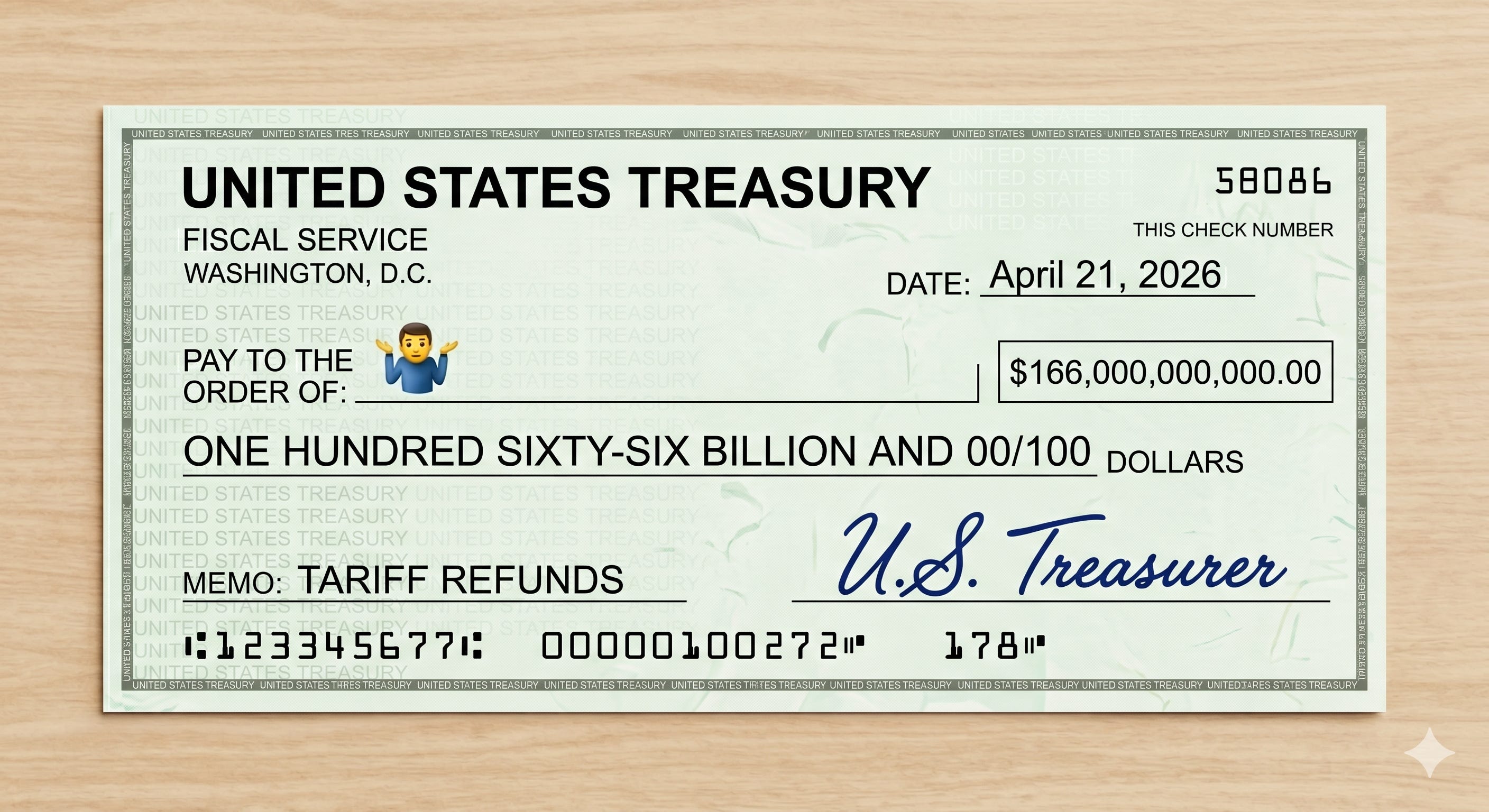
The federal refund portal opened Monday with approximately $166 billion to be refunded to U.S. companies that paid tariffs later ruled illegal by the Supreme Court. Vermont businesses are filing. Senator Peter Welch is cheering them on.
What Welch’s press release — and the businesses filing claims — leave unaddressed: the Vermont consumers who spent ten months paying higher prices because of the same illegal tariffs, and who are not eligible for a single dollar of what’s coming back.
Compass reported this gap in February, the week the Supreme Court struck down the Trump administration’s tariff regime. The Court ruled 6-3 that the International Emergency Economic Powers Act does not give the president the power to impose revenue-raising tariffs. Vermont businesses — including Burlington’s Terry Precision Cycling, a lead plaintiff in the case — had reason to celebrate. Their customers did not.
Federal law allows only the importer of record to claim a refund from U.S. Customs. Consumers paid higher prices at the register, not duties at the border. They have no paper trail, no direct claim through U.S. Customs, and no portal.
That hasn’t changed. What has changed is that the refund checks are now real, the amounts are significant — the government estimates it owes more than $166 billion nationally — and the question of what businesses plan to do with money that, in many cases, their customers already paid for them is no longer theoretical.
Vermont Attorney General Charity Clark has been consistent on this point since March. In a March 5 press release, Clark cited a Federal Reserve Bank of New York analysis finding that nearly 90 percent of the costs of the 2025 tariffs were ultimately borne by American consumers and businesses — not by the importers who paid duties at the border. Two weeks later, on March 18, Clark and a coalition of state attorneys general drew a clear line: businesses that raised prices because of the tariffs, she argued, should pass their refunds to those who ultimately bore the financial burden of an illegal policy.
That position has no enforcement mechanism behind it. What businesses do with their refunds remains, for now, entirely voluntary.
At the national level, voluntary isn’t holding. At least 17 consumer class-action lawsuits have already been filed against major companies — Costco, FedEx, and UPS among them — by shoppers who argue those companies would be wrong to pocket refunds on costs they passed to customers. Global law firm Reed Smith has predicted the cases will multiply now that the portal is live. Costco and FedEx have both pledged to return money to customers. A CNBC survey of chief financial officers found that most companies do not intend to follow suit.
Vermont’s importers are smaller. The class-action math doesn’t work at that scale. But Clark’s underlying argument applies equally: an illegal tax was collected, passed along the chain, and is now being refunded only at one end of it.
Senator Welch, who has fought the tariffs aggressively and deserves credit for that fight, is asking Vermont businesses to get in line. That’s the right call. What’s missing from his press release — and from the coverage that followed it — is any answer to what comes next for the Vermonters who kept those businesses running while the legal battle played out.
The refund portal is open. The harder question just opened with it.