



There is a fight happening in the Vermont Statehouse right now over a pot of money that most Vermonters don’t know exists.
It involves a $15 million surplus sitting in a state fund, a proposal to use that money to fix crumbling roads that was killed in less than 24 hours, and a fundamental question about whether taxes raised locally should be spent locally — or whether the state gets to decide.
To understand the fight, you first have to understand the money. And to understand the money, you have to follow a single dollar from the moment it leaves your wallet.
What is a “local option tax,” and are you paying one?
Vermont charges a statewide sales tax of 6% on most retail purchases. It also charges a 9% tax on restaurant meals, a 9% tax on hotel and short-term rental rooms, and a 10% tax on alcoholic beverages served at bars and restaurants. Every Vermonter and every visitor pays these taxes. They go to the state.
On top of those state taxes, individual towns can vote to add their own 1% surcharge. This is called a “local option tax,” or LOT. As of Town Meeting Day this month, 50 Vermont municipalities have adopted at least one.
There are three categories a town can choose from, and they can adopt any combination:
Meals and alcohol — 1% added to the state’s 9% meals tax (total: 10%) and 1% added to the state’s 10% alcohol tax (total: 11%). Under Vermont law, these are linked — a town cannot adopt one without the other. This applies to restaurant food, takeout, food trucks, prepared food at delis and bakeries, catering, and drinks served for immediate consumption at bars and restaurants. It does not apply to groceries. If you buy a sandwich at a deli counter, it’s taxed. If you buy bread and turkey and make the sandwich at home, it’s not. It also does not apply to a sealed bottle of wine purchased at a liquor store or retailer — that falls under the regular 6% sales tax.
Rooms — 1% added to the state’s 9%, for a total of 10%. This applies to hotels, bed-and-breakfasts, inns, and short-term rentals including Airbnb and VRBO.
Sales — 1% added to the state’s 6%, for a total of 7%. This is the broadest category. It covers most retail purchases — furniture, electronics, hardware, sporting goods, gifts, cannabis. But Vermont exempts clothing and shoes from sales tax entirely, so a pair of boots or a winter coat carries no state or local sales tax in any town. Groceries are also exempt.
Some towns adopt all three. Some adopt only meals and alcohol. Some started with meals, alcohol, and rooms, then added sales later. Each category is voted on separately at Town Meeting, and each town decides how to spend its share.
Not sure if your town has a local option tax? The Vermont Department of Taxes maintains an interactive finder where you can search by address or town name.
Does it matter where you shop or eat?
Yes. Vermont’s local option tax is what’s called “destination-based.” The tax is determined by where the buyer takes possession of the item — not where the store is located. If you live in a town without LOT but drive to Woodstock for dinner, you pay Woodstock’s 1% meals tax. If you order something online and it ships to your home in a LOT town, you pay the extra 1%.
This means the same $50 dinner costs $4.50 in state meals tax everywhere in Vermont. But in Woodstock, Stowe, Burlington, or any of the other LOT municipalities, it costs $5.00 — an extra 50 cents. Over the course of a year, for a household that eats out regularly, shops locally, and hosts visitors, the difference adds up.
Tourism-heavy towns adopted LOT specifically because visitors absorb much of the cost. Stowe’s town manager described it as a way to make visitors who “use our infrastructure and our services” help pay for them. But residents pay it too. When Woodstock adopted the sales tax in 2024, town officials estimated it would generate roughly $200,000 a year, noting that “the majority of shoppers are tourists.” The majority — but not all.
Here is what the difference looks like in practice:
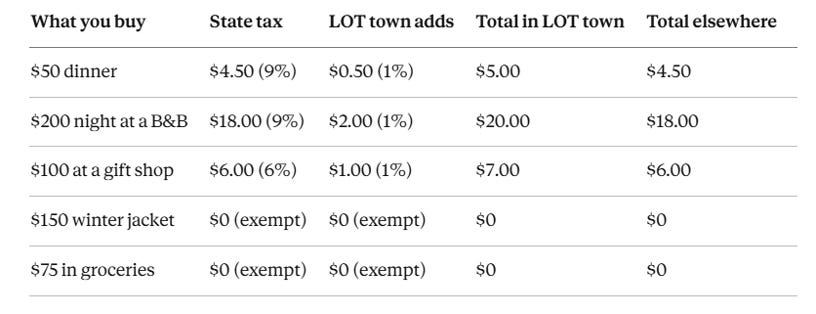
Clothing, shoes, and groceries remain tax-free regardless of where you buy them.
Follow the dollar: what happens after you pay
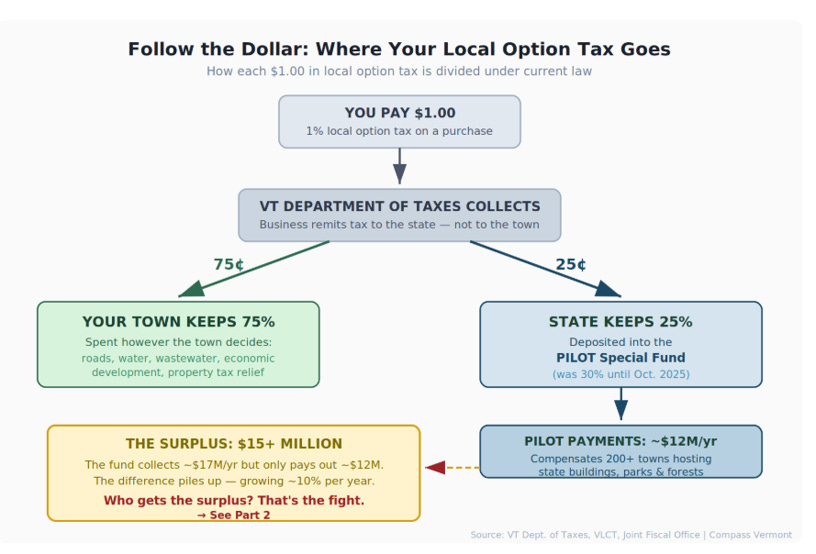
Here is what happens to that extra penny on every dollar, step by step.
Step 1: You pay. You buy a $100 item at a store in Woodstock. The register adds $7 in tax — $6 to the state for Vermont’s sales tax, and $1 for Woodstock’s local option tax. You pay $107.
Step 2: The business remits the tax to the state. Not to the town — to the Vermont Department of Taxes. The state collects and administers all local option taxes on behalf of municipalities. The business files electronically through the state’s myVTax portal, the same way it files state taxes.
Step 3: The state takes its cut. Of that $1 in local option tax, the state keeps 25 cents and sends 75 cents back to Woodstock. Until last year, the split was 70/30 — the state kept 30 cents. The Vermont League of Cities and Towns pushed for an 80/20 split; the legislature compromised at 75/25, effective October 2025.
Step 4: The town’s 75% arrives. Woodstock receives its 75 cents. What happens next is up to the town. Woodstock has earmarked its LOT revenue for infrastructure — water system upgrades, wastewater plant renovation, and its economic development director position. In fiscal year 2025 — the last full year on record — Woodstock collected roughly $777,000 total from all its local option taxes. That year, the old 70/30 formula still applied, so Woodstock kept about $544,000 and the state kept about $233,000. Under the current 75/25 split, the same revenue would leave Woodstock with roughly $583,000.
Other towns have made different choices. Bristol is directing 20% of its LOT revenue toward climate resilience and emergency preparedness. Morristown is using its new LOT revenue to help fund local roads and infrastructure. Waitsfield plans to put an estimated $600,000 per year toward a wastewater plant that would enable more housing. Each town decides locally.
Step 5: The state’s 25% goes into the PILOT Special Fund. This is where it gets complicated — and where most Vermonters lose the thread.
The state’s 25 cents doesn’t go into the General Fund. It goes into a dedicated account called the PILOT Special Fund. PILOT stands for “Payment in Lieu of Taxes.” The purpose of this fund is to compensate municipalities that host tax-exempt state-owned properties — courthouses, state office buildings, Agency of Natural Resources land, state parks, and correctional facilities. Since the state doesn’t pay property tax on buildings and land it owns, the PILOT program is supposed to make towns partially whole.
In fiscal year 2026, the state distributed $12.2 million in PILOT payments to municipalities across Vermont. These payments don’t just go to a handful of towns with big state office buildings. More than 200 municipalities receive some form of PILOT payment because the Agency of Natural Resources owns land — state forests, parks, wildlife management areas — in their communities.
Step 6: The surplus grows. Here is the problem. The PILOT Special Fund now takes in substantially more than it pays out. LOT revenue statewide exceeded $50 million last year across what were then roughly 37 towns. With 50 towns now contributing — but at the lower 25% rate — the fund’s annual intake continues to far exceed the roughly $12 million needed for PILOT obligations. The difference accumulates. By the end of fiscal year 2025, the surplus exceeded $15 million — and it grows by roughly 10% per year as more towns adopt LOT and consumption tax revenue rises.
The state, in VLCT’s words, “already raises about twice what is needed per year to fund its PILOT fee obligation.”
So where does the surplus go?
Right now, it sits there. And that is exactly what the fight is about.
The governor proposed using $3.5 million of the surplus to pay for property reappraisal and grand list expenses — work that has traditionally been funded from the General Fund but directly benefits municipalities. The House Ways and Means Committee went further, proposing to make these costs an ongoing use of the PILOT fund — potentially drawing $7 million per year once Act 73’s assessment regionalization takes effect.
The House Transportation Committee proposed a different use: a “waterfall” mechanism that would have automatically sent 50% of each year’s surplus to every municipality in Vermont as block grants for town highway repair — on top of existing state highway aid. This would have addressed a $7 million year-over-year cut in town highway funding while the state’s roads deteriorate toward a forecasted crisis.
That proposal was killed in less than 24 hours.
Both proposals, what replaced the waterfall, and what it all means for your roads and your property taxes, are the subject of Part 2.
Is your town on the list?
As of March 2026, 50 Vermont municipalities have adopted at least one form of local option tax. Among them: Bennington, Berlin, Bolton, Brandon, Brattleboro, Bristol, Burlington, Colchester, Dover, Fair Haven, Hartford, Jamaica, Killington, Londonderry, Ludlow, Manchester, Mendon, Middlebury, Montpelier, Morristown, Pittsfield, Pomfret, Rutland City, Rutland Town, Shelburne, South Burlington, Springfield, St. Albans City, St. Albans Town, Stowe, Stratton, Swanton, Vergennes, Waitsfield, Waterbury, Westmore, Williston, Wilmington, Winhall, Winooski, and Woodstock — among others.
Not all towns have adopted all three tax categories, and several of the newest adoptions will take effect on July 1, 2026. The Vermont Department of Taxes maintains an interactive finder tool where you can look up whether a local option tax applies to any specific address.
Thirteen towns voted to adopt new local option taxes at Town Meeting this month. Five others — Castleton, Chester, Londonderry (sales tax expansion), Milton, and Roxbury — voted theirs down. Stowe voted to double its rate to 2%, a move that will require legislative approval of a charter amendment before taking effect.
Part 2: The Waterfall, the Power Play, and the Questions Your Town Should Be Asking — publishes tomorrow.
Compass Vermont publishes independent, data-driven reporting on Vermont policy. If this was useful to you, please consider sharing it or subscribing.
Thank you, this was important information I otherwise might not have been made aware of.