


This report is based on testimony submitted to the Vermont House Environment Committee, the text of S.325 Draft No. 3.2 dated April 28, 2026, and written correspondence with the organizations named. Both were contacted for comment prior to publication.
Imagine if a real estate development company had done the same thing. The objections would likely be immediate.
The scenario playing out in the Vermont House Environment Committee is the mirror image of that hypothetical — and it has drawn almost no attention.
What the Bill Requires
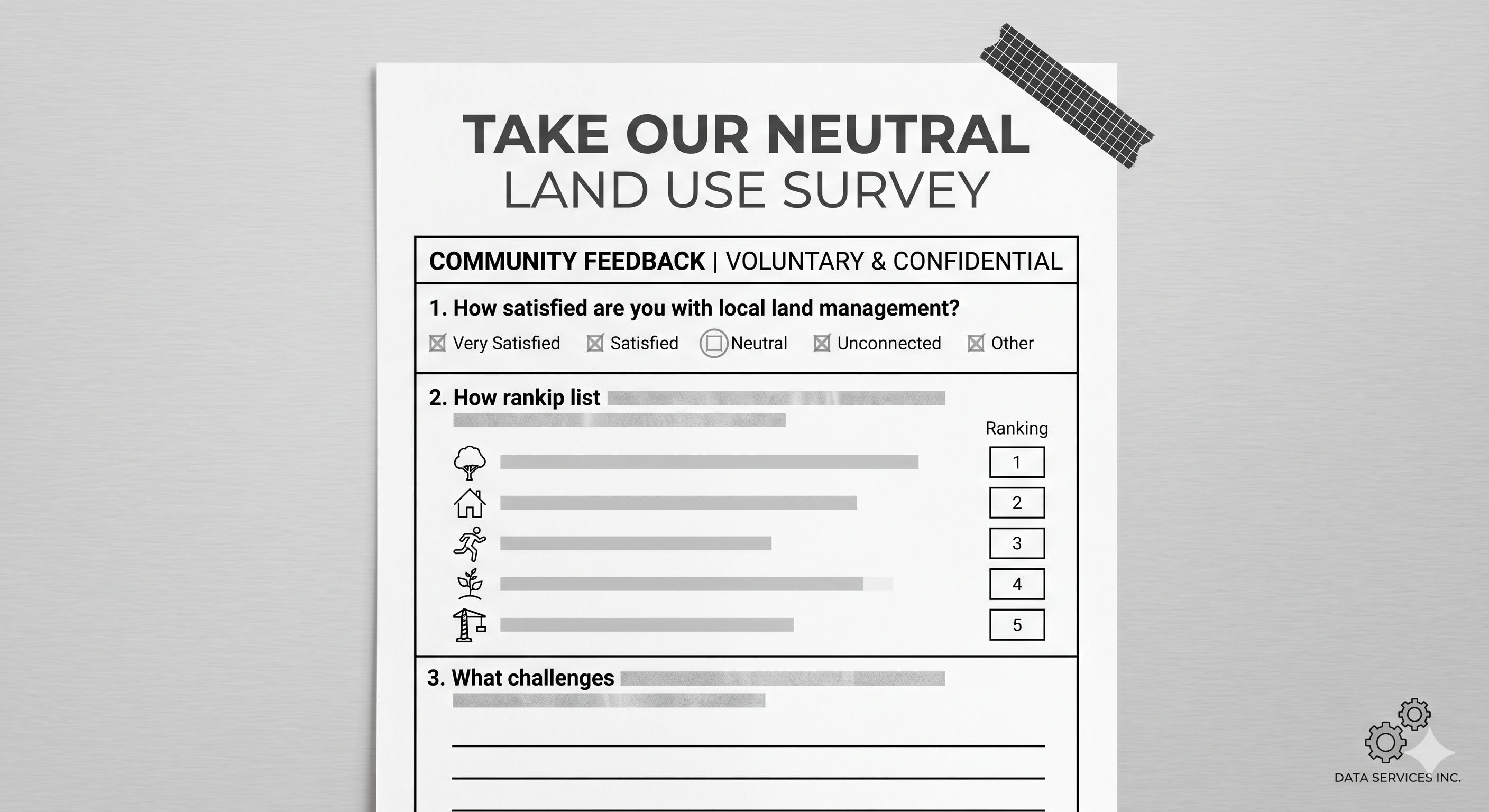
Section 8 of S.325 Draft No. 3.2 directs the Land Use Review Board to contract with a nongovernmental organization by January 15, 2027, to develop a public engagement plan. The organization would gather statewide input on risks to working lands and critical natural resources — agricultural soils, forest blocks, habitat connectors — and propose tools to protect them. The report would be due to the legislature by March 15, 2027.
The bill is explicit about what kind of organization qualifies. The contractor must have expertise in “maintaining neutrality on policy and political issues,” statewide democratic engagement, facilitation on public policy topics, and “a proven history of effective outreach in rural communities.” The contractor must also comply with Vermont’s Environmental Justice Act, 3 V.S.A. chapter 72, including its requirements for meaningful involvement by covered populations.
Draft No. 3.2 does not describe a competitive selection process or identify a contractor.
Who Is Already Pitching
In a letter submitted directly to the House Environment Committee, Michelle Monroe, Executive Director of the Vermont Association of Conservation Districts, and Denise Smith, Executive Director of the Vermont Council on Rural Development, proposed that their organizations be named in the bill to develop and implement the public engagement process.
“VACD and VCRD hold the expertise and the legal authority to develop and implement neutral and thoughtful public engagement processes,” the letter states, “that uphold and honor the conservation priorities of Vermonters in balance with the needs of our rural communities and working lands.”
The letter argues there is “no need to reinvent the wheel.” It identifies a specific state budget line — Sec. B.225.2 in the Agency of Agriculture, Food and Markets — through which funding could flow, with VCRD as a named partner.
The letter was signed by both executive directors.
The Vermont Association of Conservation Districts is a nonprofit organization representing 14 member districts that are public bodies organized under Vermont statute — specifically 10 V.S.A. chapter 31. Those districts operate under 10 V.S.A. § 723, which authorizes them to develop comprehensive plans addressing soil conservation, erosion control, and related natural-resource protection. Conservation is part of the districts’ statutory authority.
The joint testimony does not describe a neutral process. It describes a process that would “uphold and honor the conservation priorities of Vermonters.” That is a statement of intended policy direction, not a description of an open inquiry.
The Double Standard
The reason a real estate development company running this process would draw immediate objection is obvious: a development company has a financial and policy interest in outcomes that favor development. Handing it control of the public engagement process on land use would compromise the legitimacy of whatever that process produced.
The same logic applies in the other direction. An organization whose member districts are authorized by statute to protect natural resources, proposing to run a study on how to protect natural resources, is not a neutral convener. It is an interested party seeking to shape a process whose outcome it has already described.
Vermont’s housing crisis has made land use one of the most contested policy questions in the state. The public engagement plan created by S.325 is designed to build the kind of legitimacy that contested policy questions require — broad, verifiable, neutral input from Vermonters across the political and geographic spectrum. That legitimacy depends entirely on who runs the process.
What the Organizations Said
Compass Vermont contacted both executive directors by email on April 29, 2026, and asked how the joint testimony’s language aligned with the bill’s neutrality requirement for the contractor.
Smith responded the same day, offering a phone call and noting that VCRD “does not have a conservation mission” and has “facilitated neutral, non-partisan processes throughout Vermont for over 30 years.” Compass Vermont requested a written response to the specific question about the joint testimony language. Neither organization provided one by publication time. Monroe did not respond to the initial outreach.
Smith’s point about VCRD’s mission is fair on its own terms. The Vermont Council on Rural Development is a rural development and community engagement organization, not a conservation body. The neutrality concern applies more directly to VACD, whose member districts have statutory authority related to conservation and natural-resource protection.
But both organizations signed the joint letter. Both executive directors put their names on language describing a process that would “uphold and honor the conservation priorities of Vermonters.” That document — not either organization’s general mission — is what was submitted to the committee. Neither organization explained that language in writing.
The Blank Appropriation
The appropriation for the contractor in House Draft 3.2 reads “$X0,000.00” — a placeholder. The dollar amount has not been set. The committee is moving forward with an unspecified appropriation for a process whose contractor has not been selected and whose neutrality standard is already being tested before the bill has passed.
The VACD/VCRD letter has already identified where the money should go: through the NRCC budget line in the Agency of Agriculture. The organizations are not simply proposing to run the process. They are proposing the accounting mechanism to fund it.
The Senate version of S.325 included a specific $100,000 appropriation to the LURB for public engagement — a narrower task with a defined budget and no named contractor. Draft No. 3.2 instead contains a broader framework and a placeholder appropriation amount. Among the testimony reviewed by Compass Vermont, the VACD/VCRD letter is the only submission that both proposes specific organizations for the contractor role and identifies a budget mechanism to fund it.
What the Bill Does Not Resolve
Draft 3.2 does not establish a competitive selection process for the contractor. It does not define who evaluates whether an applicant meets the neutrality standard. It does not specify what happens if the LURB’s chosen contractor is challenged as insufficiently neutral by stakeholders on either side of the land use debate.
The committee vote line at the end of Draft 3.2 is blank. The bill has not yet been reported out of the House Environment Committee.
Compass Vermont contacted Michelle Monroe, Executive Director of the Vermont Association of Conservation Districts, and Denise Smith, Executive Director of the Vermont Council on Rural Development, for comment prior to publication. Smith responded and offered a call; Compass Vermont requested a written response to a specific question about the joint testimony language. Neither organization provided a written response to that question by publication time.
Great Article. Not surprising at all... It will be interesting to see who does the survey.